Evaluating if Your Current Ductwork Can Handle a Central Heat Pump Retrofit

The Hidden Challenge of Upgrading Older HVAC Systems
Your older gas furnace is running constantly, but your home still feels drafty and uncomfortable. You know it is time to upgrade, and moving to a modern, energy-efficient system sounds like the perfect fix. However, there is a hidden roadblock hiding right behind your vents. In our experience helping homeowners throughout Mission BC, evaluating if your current ductwork can handle a central heat pump retrofit is the single most important step before you sign off on a new installation. Many homeowners simply assume that the metal vents hidden in their walls and ceilings are universally compatible with any new climate control equipment. Unfortunately, our team at Rep-Air Heating and Cooling rarely finds that to be the case, especially if your house was built several decades ago.
When you start looking into modern home heating solutions, you will quickly discover that older duct systems were sized for a completely different type of technology. Discovering that your existing 1980s ductwork is undersized for new equipment creates a critical decision point for your project. You have to decide whether to retain your current vents, modify specific sections, or completely replace the duct system to ensure your new equipment runs efficiently. Proper evaluation is the only way to protect your investment in a central heat pump installation. Without taking a hard look at the pathways carrying air through your home, you risk attaching state-of-the-art machinery to an outdated delivery system.
Airflow Physics: High-Heat Gas Furnaces vs. Modern Heat Pumps
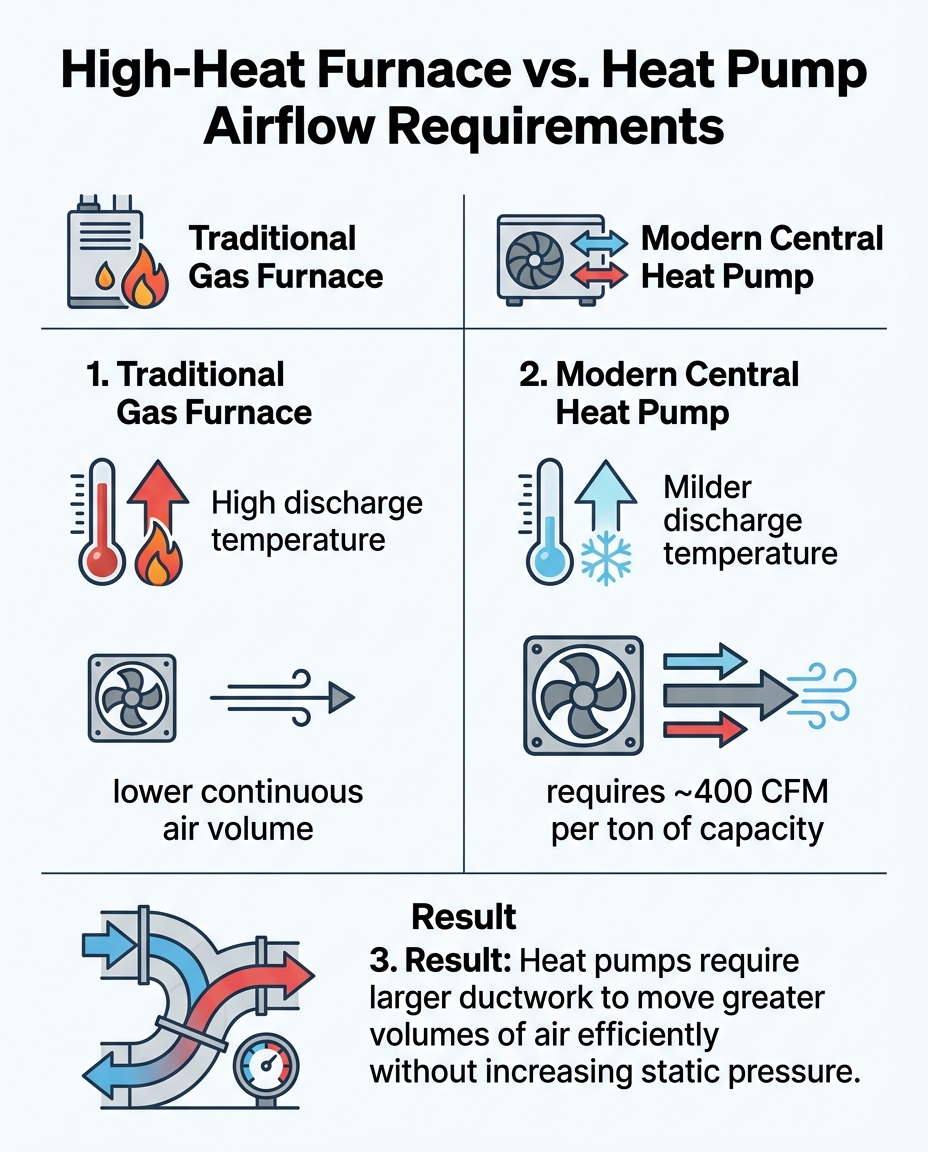
To understand why your existing vents might struggle with a new system, you have to look at the basic physics of how different heating systems move air. Traditional gas furnaces generate extremely high heat. Because the air coming off a gas heat exchanger is so hot, the furnace only needs to push a relatively small volume of air through the house to warm up your rooms. The system blasts a small amount of very hot air, hits the target temperature quickly, and shuts off.
Modern heat pumps operate on a completely different principle. Instead of burning fuel to create heat, they transfer ambient heat from the outside air into your home. This process produces a milder, more consistent discharge temperature. Because the air is warm rather than scorching hot, the system requires a significantly higher continuous air volume to heat your home effectively.
Evaluating if Your Current Ductwork Can Handle a Central Heat Pump Retrofit: The Core Physics
In the HVAC industry, air volume is measured in CFM, or Cubic Feet per Minute. While an older gas furnace might operate perfectly fine pushing a lower CFM, a modern heat pump typically needs around 400 CFM per ton of heating or cooling capacity to function properly. Moving these larger volumes of air requires physically larger pathways to maintain proper flow dynamics. If you try to force a massive volume of air through a narrow pipe, you create intense friction and resistance.
• Traditional Gas Furnace — Heat Generation Method: Combustion (burning fuel) — Discharge Temperature: Very High (often 120°F+) — Airflow Volume Required: Lower continuous volume
• Modern Central Heat Pump — Heat Generation Method: Heat Transfer (refrigerant cycle) — Discharge Temperature: Mild & Consistent (95°F - 105°F) — Airflow Volume Required: High continuous volume (~400 CFM/ton)

Why 1980s Ductwork Often Falls Short
The problem: When our crews inspect homes built in the 1980s across the Fraser Valley, we consistently see ductwork designed strictly for high-heat gas furnaces. Builders during this era often used narrow duct trunks and smaller branch lines because the heating equipment of the day simply did not need massive airflow to get the job done. The sheet metal was sized for the exact specifications of older combustion technology.
The cause: Beyond just the supply vents that push air into your rooms, the return air vents in these older homes are frequently undersized. The return air system is responsible for pulling air from your house back into the equipment to be conditioned. In many 1980s builds, you might find only one or two small return grilles in a central hallway. This setup starves modern systems of the air they need to circulate. Pushing high-volume air through narrow 1980s ducts creates a severe bottleneck effect. The equipment tries to pull in air it cannot access, while simultaneously trying to push out air through passages that are simply too tight.
The solution: Building standards and airflow calculations have evolved significantly over the last forty years. Today, identifying these bottlenecks early allows our professionals to expand trunk lines or add return drops before the new equipment is ever turned on. Recognizing the historical context of your home's construction is the first step toward achieving the comfort you expect from a modern upgrade.
The Hidden Danger of High Static Pressure
When you force too much air through too small a space, you create high static pressure. In accessible terms, static pressure is the resistance to airflow within the duct system. You can think of it like blood pressure for your home's HVAC system. If the pressure is too high, the heart of the system has to work dangerously hard just to keep circulation going.
Excessive static pressure forces the blower motor inside your new heat pump to overwork constantly. Modern systems often use variable-speed motors designed to ramp up when they sense resistance. If your 1980s ductwork is too restrictive, that motor will run at maximum capacity all day long. This drastically reduces the system's energy efficiency, wiping out the utility savings you expected to see. Worse, this constant strain leads to premature component failure. A blower motor that should last for over a decade can burn out in just a few years under high static pressure.
The consequences of poor airflow go beyond broken parts; they cause severe comfort imbalances in the home. Because we service systems through both hot summers and freezing winters, our technicians see firsthand how the diverse weather of the Fraser Valley requires year-round system reliance. High static pressure will cause seasonal headaches. In the winter, restricted air movement leads to heating inefficiencies and cold spots in distant bedrooms. In the summer, poor airflow can cause the indoor cooling coil to drop below freezing, turning the condensation into a solid block of ice and completely shutting down your air conditioning when you need it most.
Professional Diagnostics: The Importance of Pre-Quote Testing
A simple visual inspection is never enough to determine if your existing vents can handle a new heat pump. A contractor cannot just look at a metal box in your basement and confidently promise that it will support a high-efficiency system. This is where diagnostic static pressure testing becomes absolutely mandatory.
During a proper evaluation, professionals use specialized diagnostic tools to measure the exact airflow capabilities of your existing system. This reading tells the technician exactly how much resistance your current ductwork creates. Providing a quote without evaluating static pressure guarantees poor performance and post-installation issues. It is the equivalent of a mechanic quoting an engine replacement without ever opening the hood to see if the new engine will physically fit.
At Rep-Air Heating and Cooling, we take a Red Seal certified diagnostic approach to every project. This means we emphasize that proper static pressure testing is completed before quoting to prevent post-installation failures. Thorough diagnostics provide a clear path to resolution, ensuring you understand exactly what modifications are needed before any money changes hands. For example, during a recent spring service visit, one of our technicians, Colin, sat down with a homeowner to explain their entire system in detail. He answered their questions about airflow dynamics and gave specific maintenance advice based on actual system readings, ensuring they understood exactly how their home was operating before making any major changes.
Identifying Signs Your Ducts Require Modification
If your ductwork is not quite ready for a modern retrofit, there are usually physical signs and measurable data points that dictate whether the system needs upgrading, sealing, or expanding. Recognizing these signs early helps you plan for a comprehensive installation.
• Inadequate return air drops: If your system sounds like a vacuum cleaner gasping for air, or if doors slam shut when the system kicks on, your return vents are likely undersized and starving the equipment.
• Leaky supply joints: Duct leakage exacerbates static pressure issues. When conditioned air escapes into your attic or crawlspace through disconnected joints, the system loses volume before the air ever reaches your living space.
• Whistling or roaring vents: High-velocity air squeezing through narrow grilles creates noticeable noise. A properly sized modern system should operate quietly.
• Severe temperature imbalances: If your living room is perfectly comfortable but the master bedroom is always freezing, the ductwork is failing to distribute air volume evenly.
Addressing these ductwork issues simultaneously improves your overall indoor air quality and ventilation. When ducts are sealed and sized correctly, they stop pulling dusty, unconditioned air from crawlspaces into your breathing zones. Additionally, properly sealed and sized ducts are often required to qualify for regional energy rebates. Government and utility incentive programs may apply to qualifying heat pump installations, but they want to ensure their investments yield actual energy savings, which is impossible if the ductwork is leaking or highly restrictive.
Alternatives and Solutions for Problematic Ductwork
If a professional evaluation reveals that your 1980s ductwork fails the compatibility test, you are not out of luck. There are actionable next steps and solutions to ensure your home can still benefit from modern energy efficiency. The most common approach is modifying the existing ductwork.
This process often involves enlarging the return air plenum—the large metal box sitting right next to the equipment—to allow more air to flow into the unit smoothly. Technicians might also add additional supply vents in large rooms or install a secondary return grille in a hallway to relieve pressure. When modifying existing vents is not enough, partial duct replacement is an option in accessible areas like unfinished basements or crawlspaces. By replacing the main trunk line with a larger, properly sized channel, you can dramatically reduce static pressure for the entire house.
Our installation team knows that ensuring proper airflow is the foundation of successful HVAC retrofits in Langley and the surrounding regions. Without addressing the delivery system, the best equipment in the world will still underperform.
When to Consider Ductless Alternatives
Sometimes, modifying existing 1980s ductwork is structurally impossible or cost-prohibitive. If your home features finished basements with drywall ceilings hiding the ductwork, tearing everything open might not make sense. This is where architectural limitations directly impact duct expansion.
In these cases, ductless systems offer a highly efficient alternative. By bypassing problematic central ducts entirely, you deliver conditioned air directly into the specific zones of your home. This eliminates static pressure issues and duct leakage altogether. If you are weighing these options, choosing between ducted and ductless heat pumps for your home's architecture is a great next step to explore.
Taking the Next Step Toward Efficient Year-Round Comfort
Modern heat pumps are incredible pieces of technology, but they require proper airflow to deliver their promised efficiency and comfort. Guessing on duct size or assuming your 1980s home is perfectly compatible almost always leads to premature system failure and frustrating temperature imbalances. You deserve a system that works exactly as advertised, keeping your family comfortable through every season.
Always prioritize professional diagnostics over quick, sight-unseen estimates. A thorough static pressure test is the only way to know the truth about your home's infrastructure. Evaluating if your current ductwork can handle a central heat pump retrofit gives you peace of mind and protects your investment. If you are ready to explore your options, we invite you to schedule a comprehensive evaluation of your home's airflow today.
hear what our satisfied clients have to say
Neighbourhoods in the Fraser Valley