What an Indoor Air Quality Test Actually Measures in Damp Mission Basements

Uncovering the Source of Musty Odors in Below-Grade Spaces: What an Indoor Air Quality Test Actually Measures in Damp Mission Basements
When you walk downstairs and notice a persistent, heavy scent, you might wonder exactly what an indoor air quality test actually measures in damp Mission basements to determine if it is a harmless seasonal quirk or a serious health hazard. For homeowners living in older Mission BC homes, that familiar musty smell is a common and frustrating dilemma. Guessing whether the environment is safe is highly ineffective, especially when the health of your household is on the line. Objective measurement is required to understand the true state of your basement's environment. By utilizing comprehensive diagnostics, you can demystify these hidden air issues and take control of your home's lower levels.
Ready to address your home's specific needs? Explore our HVAC and air quality services to learn more about comprehensive testing.
The Danger of Guessing with Indoor Air
Many homeowners assume that a damp smell is just a normal part of owning an older property with a below-grade foundation. However, relying on your nose to gauge the safety of your indoor air leaves you vulnerable to invisible pollutants. Without precise data, you might invest in the wrong solutions—like buying small, ineffective dehumidifiers or masking odors with air fresheners—while the root cause continues to worsen behind your drywall.
Professional diagnostics replace guesswork with hard science. By deploying specialized sensors and sampling equipment, technicians can pinpoint exactly what is circulating in your air. This detailed assessment provides a clear, factual baseline, allowing you to make informed decisions about your property's ventilation, insulation, and overall climate control strategy.
Tracking Relative Humidity and Moisture Intrusion
The problem: Mission BC's heavy winter precipitation from November to January increases hydrostatic pressure against foundations, forcing moisture through concrete walls and floors. This continuous water intrusion creates the perfect breeding ground for airborne contaminants, making the lower levels of your home feel constantly clammy and uncomfortable.
The cause: As this moisture seeps indoors, it rapidly elevates the relative humidity—the amount of water vapor present in the air compared to the maximum amount the air could hold at that temperature. Health Canada recommends maintaining indoor relative humidity levels between 30% and 50%. When levels push past the threshold danger zone of 60%, biological growth can trigger within 24 to 48 hours, spreading rapidly across wood framing, paper-backed drywall, and stored belongings.
The solution: Comprehensive indoor air quality testing utilizes advanced data loggers to continuously monitor the environment over a set period. Tracking VOCs, particulate matter, and relative humidity percentages over several days is critical because moisture levels are rarely static. Testing equipment continuously logs these percentages to identify hidden moisture spikes that occur overnight when temperatures drop or immediately after a heavy rainfall.
Understanding Humidity Thresholds
• Below 30% — Impact on Basement Environment: Air is excessively dry; potential for cracked wood and respiratory irritation. — Recommended Action: Monitor levels; consider humidification if upper floors are affected.
• 30% to 50% — Impact on Basement Environment: Ideal zone recommended by Health Canada. Inhibits biological growth. — Recommended Action: Maintain current ventilation and temperature settings.
• 50% to 60% — Impact on Basement Environment: Warning zone. Air feels heavy and damp; early signs of condensation appear. — Recommended Action: Investigate moisture sources; improve air circulation.
• Above 60% — Impact on Basement Environment: Danger zone. High risk of rapid biological growth within 24-48 hours. — Recommended Action: Implement active dehumidification and professional diagnostics.
Detecting Hidden Biological Contaminants and Mold Spores
Demystifying the musty odor: That distinct, earthy smell in a damp basement is not just "stale air." It is actually a measurable byproduct of biological contaminants actively off-gassing. These emissions are known as Microbial Volatile Organic Compounds (MVOCs). When you smell a musty odor, you are inhaling the chemical byproducts of active biological growth occurring somewhere in the space, even if you cannot see it on the walls.
Capturing the evidence: To identify the exact nature of the problem, testing involves active air sampling. Technicians use specialized pumps that draw a precise volume of air over a collection medium. This process captures and quantifies airborne mold spores per cubic meter of air, providing a highly accurate count of what is floating in your breathing zone. This data is then analyzed in a laboratory to identify the specific genera of the spores present.
Active vs. dormant threats: A crucial part of this diagnostic process is discussing the difference between dormant spores and active amplification sites. Dormant spores are naturally present in almost all indoor and outdoor air, waiting for the right moisture conditions to activate. Active amplification sites, however, are areas in damp environments where spores have found water and a food source, multiplying rapidly and degrading indoor air quality. Testing helps pinpoint whether your basement just has normal background levels or an active, hidden colony.
The Role of Surface Sampling
In addition to air sampling, thorough diagnostics often include surface testing. If a technician spots a suspicious discoloration on a floor joist or behind a baseboard, they may take a direct swab or tape lift. This confirms whether the visible anomaly is a harmless stain or an active biological contaminant contributing to the airborne spore count.
Measuring Volatile Organic Compounds (VOCs) in Confined Spaces
Defining chemical pollutants: Volatile Organic Compounds (VOCs) are carbon-based chemicals that easily evaporate into the air at room temperature. Common examples include formaldehyde, benzene, and toluene. In a confined basement, these chemicals often originate from everyday stored items and building materials. Common basement sources include stored paints, varnishes, cleaning supplies, old synthetic carpets, and off-gassing construction adhesives.
The dampness correlation: There is a direct, scientific correlation between high moisture and chemical off-gassing. Warm, damp environments accelerate the off-gassing rate of these chemicals. When basement humidity is consistently high, the materials in the room break down faster, releasing a higher concentration of VOCs into the stagnant air. This is a primary reason why understanding how your HVAC affects indoor air quality is so critical—without proper ventilation, these chemicals remain trapped below grade.
Advanced sensor technology: To measure this invisible threat, specialized sensors are deployed to measure total VOC (TVOC) concentrations. These highly sensitive instruments detect the aggregate level of chemical pollutants in the air, providing a clear picture of whether the space's ventilation is adequate to dilute and remove these harmful compounds.
Common Sources of Basement VOCs
• Stored chemicals: Leftover paint cans, solvents, and pesticides often leak microscopic vapors even when tightly sealed.
• Building materials: Pressed wood furniture, fiberglass insulation, and fresh drywall compound release formaldehyde over time.
• Flooring: Synthetic carpets, vinyl tiles, and the adhesives used to install them are notorious for long-term off-gassing.
• Combustion appliances: Older, poorly vented water heaters or furnaces can introduce chemical byproducts into the surrounding air.
Quantifying Particulate Matter and Airborne Allergens
Measuring physical irritants in the air requires precise instrumentation that categorizes particles by size. Because basements are typically the lowest point in the home, they naturally collect debris, making particulate measurement a vital part of any assessment.
1. Identifying particle sizes: Testing equipment differentiates between PM10 and PM2.5. PM10 refers to inhalable particles with diameters that are 10 micrometers and smaller, such as heavy dust, pollen, and large pet dander. PM2.5 refers to fine inhalable particles that are 2.5 micrometers and smaller, such as smoke, fine smog, and microscopic allergens. Both matter because while PM10 irritates the eyes and throat, PM2.5 can penetrate deeply into the lungs.
2. Assessing the settling zone: Basements often act as settling zones for the entire house. Gravity pulls heavier dust, skin cells, and pet dander down to the lowest level, where it accumulates on concrete floors and exposed ductwork. High concentrations of particulate matter in a basement test usually indicate a lack of adequate air filtration and poor housekeeping in the lower levels.
3. Evaluating distribution risks: Once particles settle in the basement, they rarely stay there. Forced-air heating systems can inadvertently disturb and distribute these particles throughout the entire house if the system is not properly filtered or if the return ducts in the basement are pulling in contaminated air.
The Impact of Duct Leakage
When return ducts run through a dusty, contaminated basement, any unsealed joints act like vacuums. They pull particulate matter directly from the damp basement air and push it through the supply vents into your living room and bedrooms. Diagnosing high particulate levels often leads directly to identifying and sealing these hidden duct leaks.
The Stack Effect: Why Basement Air Quality Impacts the Whole Home
The problem: Many homeowners believe that closing the basement door isolates the musty smells and damp air. Unfortunately, building physics dictates otherwise. The air in your basement eventually becomes the air in your bedroom.
The cause: This upward movement is driven by the "stack effect." As warm air in the upper levels of your house rises and escapes through the roof and upper-floor leaks, it creates negative pressure in the lower levels. This negative pressure pulls cooler, damp air up from the basement and crawlspace to replace the escaped air. Because of this continuous upward draft, up to 50% of the air breathed on the first floor originates in the basement or crawlspace.
The solution: Mitigating this upward draft requires a comprehensive approach to home climate control. Modern solutions can manage airflow, dehumidification, and whole-home circulation to neutralize the stack effect. By balancing the home's pressure and introducing controlled, conditioned air—often through a modern heat pump installation—you can stop the damp basement air from migrating into your primary living spaces.
Breaking the Upward Draft
To effectively combat the stack effect, you must address both the air escaping at the top of the house and the air entering at the bottom. Sealing attic bypasses reduces the upward pull, while conditioning the basement air ensures that any air that does migrate upward is clean, dry, and filtered.
Translating Diagnostic Data into Actionable Solutions
Decoding the raw numbers: Testing is highly technical, but the final output should never be confusing. After the assessment, raw data—including humidity percentages, VOC counts, and PM levels—is compiled into a clear, readable report. This report translates scientific measurements into plain-English insights, showing exactly where your basement falls on the spectrum of healthy indoor air.
Building a remediation roadmap: Testing is only the first step; the data serves as a roadmap for targeted remediation. Instead of guessing at solutions, you can use the report to implement specific, proven upgrades. Depending on the metrics, this might include installing whole-home ventilation upgrades, sealing specific foundation leaks, or integrating dedicated dehumidifiers designed for low-temperature operation.
The value of local expertise: Interpreting these results requires more than just reading a chart; it requires an understanding of the regional environment. As local HVAC experts serving the Fraser Valley, Rep-Air Heating and Cooling understands the specific moisture challenges of Mission homes and uses precise testing to uncover hidden IAQ issues. This localized expertise ensures that the recommended solutions are specifically tailored to withstand the heavy rainfall and damp soils typical of the Pacific Northwest.


Frequently Asked Questions
What does an indoor air quality test check for?
An indoor air quality test checks for a specific range of airborne pollutants and environmental factors. It measures relative humidity, temperature, volatile organic compounds (VOCs), particulate matter (PM2.5 and PM10), and biological contaminants like mold spores. By evaluating these metrics, professionals can determine exactly what is degrading the air in your home.
Can an air quality test detect mold in walls?
Yes, an air quality test can detect the presence of hidden biological growth by measuring airborne spores and off-gassing chemicals. While the air sample won't tell you exactly which wall the growth is behind, a high concentration of specific spores or MVOCs strongly indicates an active amplification site nearby. Technicians use this data alongside visual inspections and moisture meters to locate the hidden source.
How do you test for mold in a damp basement?
Testing for biological contaminants in a damp basement involves using specialized pumps to draw air over a collection medium. This captures airborne spores, which are then analyzed in a laboratory to determine the spore count per cubic meter and identify the specific types present. Surface swabs or tape lifts may also be used on visible stains to confirm active growth.
What is a normal humidity level for a basement?
A normal and healthy humidity level for a basement is between 30% and 50%, as recommended by Health Canada. Keeping the relative humidity within this range prevents the air from feeling clammy and significantly inhibits the growth of biological contaminants. If levels consistently rise above 60%, active dehumidification is required to prevent rapid property damage.
How long does a comprehensive indoor air quality test take?
The physical setup and initial air sampling usually take one to two hours to complete on-site. However, comprehensive testing often involves leaving data loggers in the home for several days to track humidity and VOC fluctuations over time. Once the samples are sent to a laboratory, it typically takes a few days to receive the final, detailed report.
Taking the Next Step for Your Home's Health
Understanding exactly what an indoor air quality test actually measures in damp Mission basements is the first step toward reclaiming your home's comfort. By relying on precise metrics rather than guesswork, you can implement targeted solutions that eliminate musty odors and protect your family's air. Reach out to a professional to schedule your comprehensive diagnostic assessment today.
hear what our satisfied clients have to say
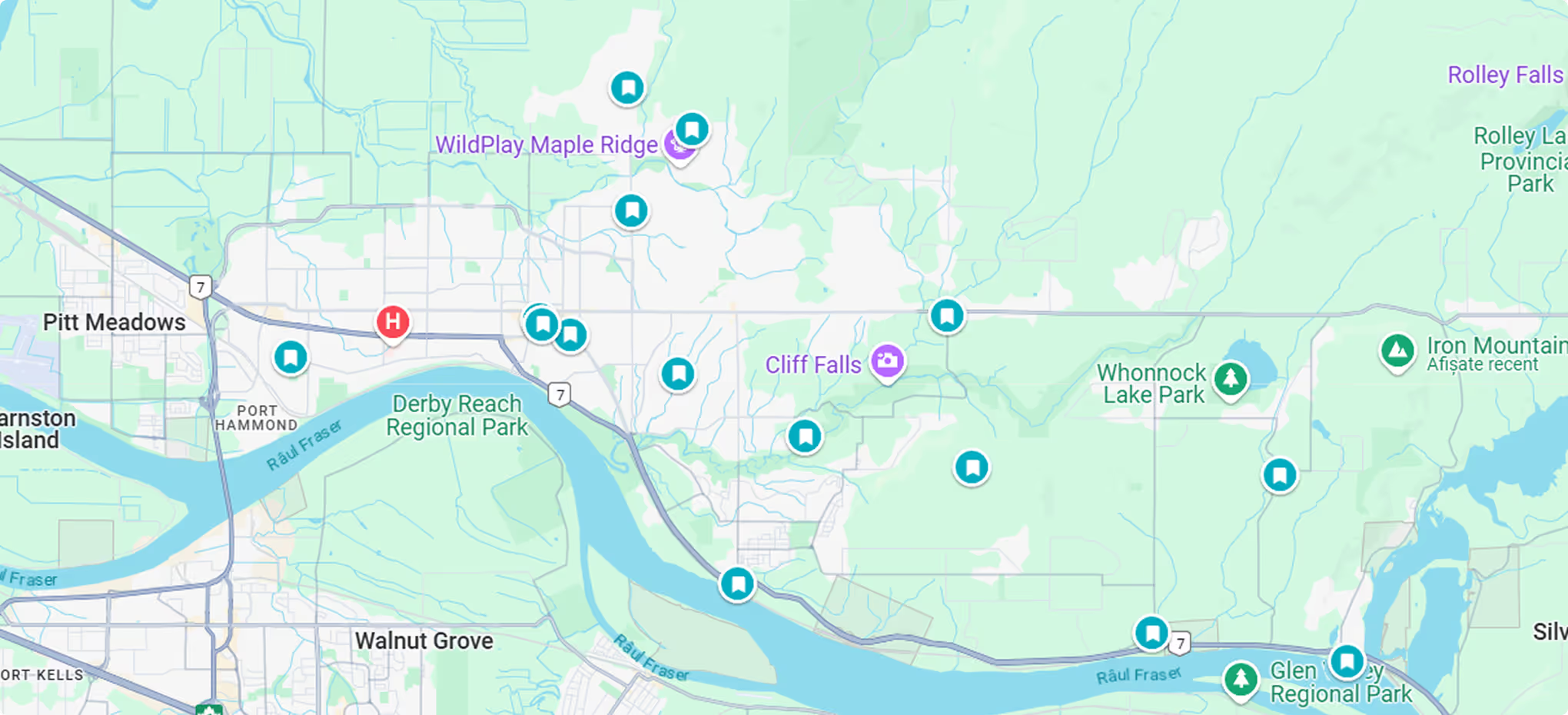
Neighbourhoods in the Fraser Valley