What to Expect from Mission's Electrical Permitting Process When Upgrading Your Home's Panel
Navigating Municipal Red Tape for Your Electrical Upgrade
Your old furnace is finally giving out, and you are ready to transition to a modern, high-efficiency climate control system. You pick out the perfect equipment, clear your schedule, and anticipate a more comfortable home. But then, the project hits a sudden administrative roadblock. Understanding exactly what to expect from Mission's electrical permitting process when upgrading your home's panel is the single most important step before scheduling your installation. Upgrading your electrical service is not just a matter of swapping out a metal box; it requires strict adherence to local regulations and safety codes.
Many homeowners feel frustrated when an exciting home energy upgrade is paused by municipal requirements. You want your new heat pump or air conditioner running immediately, but the local authorities require a precise sequence of permits and inspections first. Navigating the Mission BC municipal jurisdiction is a necessary, non-negotiable first step for safety, compliance, and the long-term protection of your property.
This guide provides a clear, realistic overview of the administrative sequence you will face. It is not a DIY manual for electrical work—handling high-voltage main lines is strictly for licensed professionals. Instead, this is your roadmap for understanding the timeline, the paperwork, and the inspections required to get your home ready for the future. By knowing what happens behind the scenes, you can coordinate your professional home services with confidence and avoid unexpected delays.
The Hidden Bottleneck in Home Energy Upgrades
Most homeowners do not realize their electrical panel is undersized until a contractor evaluates the home for a new HVAC system. Homes built decades ago were designed for a different era of energy consumption. When you try to add a high-draw appliance to an outdated panel, you risk overloaded circuits, tripped breakers, and severe fire hazards.
Common signs your upgrade will require administrative approval:
• Your current panel is only 100 amps: Modern homes generally require at least 200 amps to run comprehensive climate control systems alongside daily appliances.
• There are no empty breaker slots left: If your panel is completely full, adding a dedicated circuit for a heat pump requires a larger physical panel.
• Your home still uses fuses: Outdated fuse boxes rarely meet current safety standards and almost always trigger a mandatory upgrade during major renovations.
Because expanding this capacity involves drawing more power from the municipal grid, the city and the province must verify that your home's infrastructure can handle the load safely.
Why Fraser Valley Climate Demands Trigger Panel Upgrades
The varied Fraser Valley weather drives the adoption of robust heating and cooling systems, which in turn necessitates these electrical upgrades. Mission experiences distinct seasons, with hot summer stretches and freezing winter nights. To maintain consistent indoor comfort year-round, homeowners are increasingly turning to advanced heat pumps and central air conditioning systems.
Transitioning to these high-efficiency systems requires a significant amount of electricity. While modern HVAC units use energy far more efficiently than older baseboard heaters or window units, they still require a large initial surge of power to start their compressors. This sudden draw of electricity is exactly what pushes older residential panels beyond their safe operational limits.
If you are deciding between a 200 and 400 amp panel, evaluating your current and future climate control needs is the primary deciding factor. Upgrading to a higher capacity is an inevitable requirement for many local homeowners who want reliable, uninterrupted comfort during extreme weather swings.
The Shift to High-Draw Systems
Older homes in the Fraser Valley were built to support basic electrical loads: incandescent lighting, a standard refrigerator, a television, and perhaps an electric range. They were not built to support the electrical load of comprehensive, whole-home climate control systems running simultaneously with modern home offices, electric vehicle chargers, and advanced kitchen appliances.
Evaluating your current capacity is the absolute first step before planning an installation. To understand why modern HVAC equipment requires dedicated circuits and significant amperage, consider the typical power requirements of common household systems:
• Standard Lighting Circuit — Typical Amperage Required: 15 Amps — Dedicated Circuit Needed?: No (Shared)
• Electric Water Heater — Typical Amperage Required: 30 Amps — Dedicated Circuit Needed?: Yes
• Electric Range / Oven — Typical Amperage Required: 40 to 50 Amps — Dedicated Circuit Needed?: Yes
• Modern Heat Pump / Central AC — Typical Amperage Required: 30 to 60 Amps — Dedicated Circuit Needed?: Yes
• Electric Vehicle (EV) Charger — Typical Amperage Required: 40 to 60 Amps — Dedicated Circuit Needed?: Yes
When you add a 40-amp heat pump to a home that only has a 100-amp main service, you are consuming nearly half of the home's total available power with a single appliance. This mathematical reality is exactly why municipal authorities heavily regulate panel upgrades—they must ensure the home's wiring and the neighborhood's grid can safely support the increased demand.
Who is Responsible for Pulling the Permit?
A common point of confusion for homeowners is figuring out who actually handles the paperwork. In British Columbia, the responsibility for securing the proper electrical permits falls squarely on the licensed professional performing the work. Complex electrical upgrades are strictly regulated and require professional oversight to ensure total code compliance.
It is important to understand the distinct roles of the municipality versus provincial safety authorities. While the City of Mission governs broader building permits and zoning regulations, Technical Safety BC oversees the specific provincial electrical safety standards. Navigating both of these entities requires deep familiarity with local building codes and provincial procedures.
This is where a qualified contractor steps in. Managing the administrative burden from the initial quote to the final inspection is part of a professional contractor's scope of work. When unexpected complexities arise during home upgrades—much like one local spring installation where a gas line and stove hookup proved more complicated than initially quoted—a reputable professional team absorbs the administrative and technical burden without changing the original plan. They handle the red tape so you do not have to.
The Role of Technical Safety BC
Technical Safety BC is the independent, self-funded organization mandated by the province to oversee the safe installation and operation of technical systems, including electrical equipment. They are the ultimate authority on whether your new panel meets the BC Electrical Code.
Key responsibilities of Technical Safety BC in your project:
• Issuing the permit: Permits must be secured before any physical work begins on your property.
• Setting the standards: They dictate the exact specifications for grounding, bonding, and wire sizing.
• Protecting your investment: Compliance protects your homeowner's insurance policy and ensures your property value remains intact when it is time to sell.
Why Professional Oversight is Mandatory
Panel upgrades involve disconnecting and reconnecting to the main utility line, which carries a massive, un-fused amount of electricity directly from the street transformer. This carries significant risk. Local regulations mandate a strict licensed electrical contractor requirement for this specific type of work.
Professionals handle the paperwork, ensuring applications are accurate and approved without delay. If a homeowner attempts to pull a permit for a main service upgrade themselves, the application will almost certainly be rejected, as the utility provider will not coordinate a main disconnect with an unlicensed individual. Relying on experts for your residential electrical services ensures the job is done legally, safely, and efficiently.
The Sequence of Securing an Electrical Permit in BC
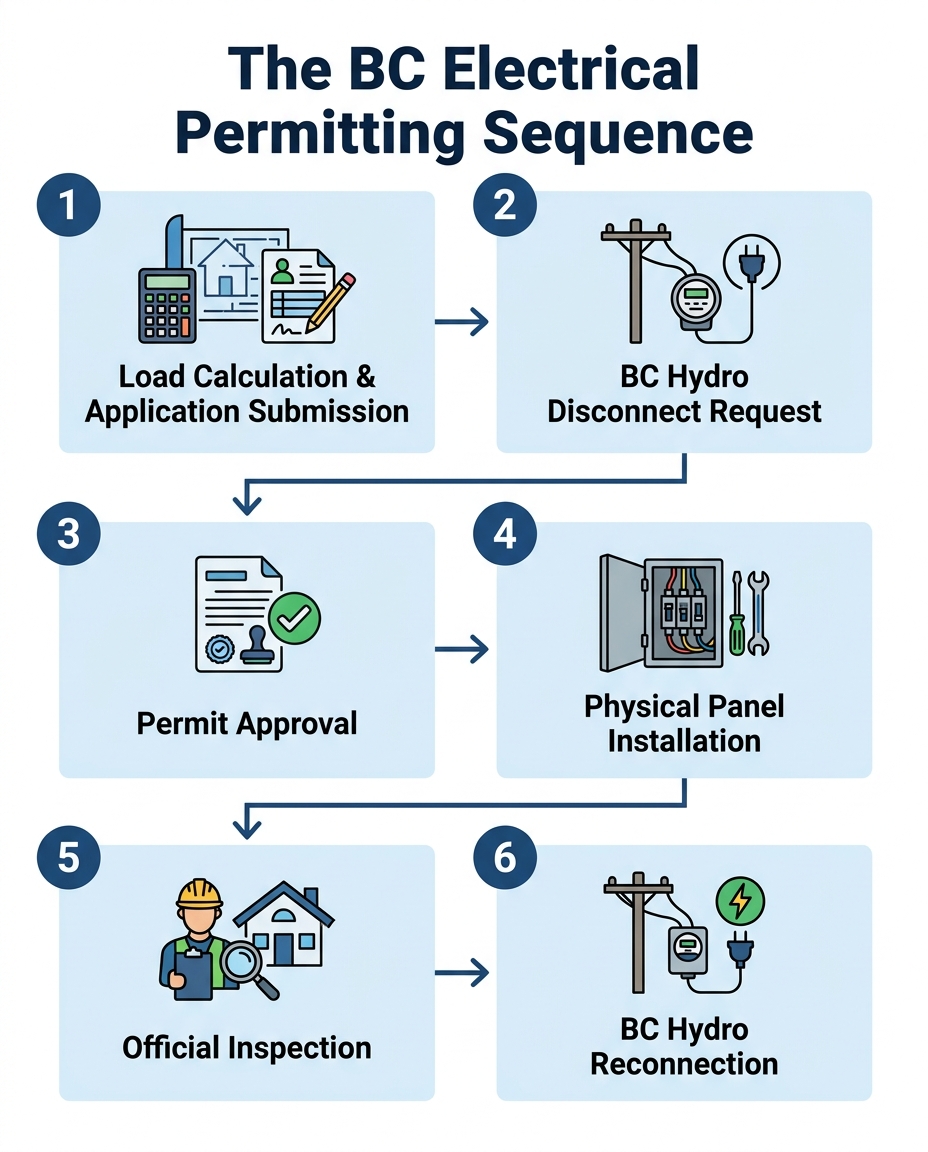
Knowing the exact sequence of events helps alleviate the stress of waiting. The administrative process follows a strict, ordered path. Any deviation from this path can result in immediate stop-work orders or heavy fines from the Mission BC municipal jurisdiction.
1. Initial Load Calculation and Application Submission: The contractor evaluates your home's current energy usage, calculates the new required load, and submits a detailed permit application to Technical Safety BC or the local delegated authority.
2. Coordination with BC Hydro for a Disconnect: The contractor submits a formal request to BC Hydro to schedule a temporary service disconnect. This is required to safely remove power from the main lines entering your home.
3. Approval of the Permit: Once the paperwork is reviewed and the fees are paid, the official permit is issued, allowing the physical panel replacement to commence on the scheduled disconnect day.
4. Physical Installation and Rough-In: The old panel is removed, the new larger panel is mounted, and all existing circuits are carefully transferred and balanced across the new breakers.
5. Scheduling and Passing Inspections: An official inspector visits the property to verify that the installation strictly adheres to the BC Electrical Code.
6. Final BC Hydro Service Reconnection: Once the inspector passes the work, BC Hydro is notified to permanently restore full power to the newly upgraded system, followed by a final project sign-off.
Coordinating with BC Hydro
Panel upgrades require the main power to be safely disconnected by the utility provider. The lines coming from the street into your meter base are always live and carry enough voltage to be instantly fatal. Only BC Hydro technicians are authorized to cut this power at the source.
This step requires precise scheduling between the contractor, the utility, and the homeowner. Administrative delays here can pause the entire project, making experienced coordination vital. A seasoned contractor knows how to align the BC Hydro disconnect window perfectly with the installation team's arrival, minimizing the amount of time your home is without power.

Inspection Phases and Realistic Timeline Expectations
Setting realistic expectations for how long the administrative and inspection processes take is crucial for maintaining your peace of mind. Upgrading your electrical system is not a one-day affair from start to finish. While the physical swap of the panel often happens in a single day, the surrounding administrative timeline stretches much further.
Municipal red tape and inspector availability heavily impact the overall timeline of a home energy upgrade. Depending on the season and the current backlog at Technical Safety BC, securing the initial permit can take anywhere from a few days to a couple of weeks. Coordination with BC Hydro often requires booking weeks in advance.
Administrative and third-party scheduling can sometimes cause hold-ups. During one spring installation in the region, an unforeseen delay with an external electrician pushed the schedule back. However, a dedicated contractor mitigates this frustration by communicating clearly, waiting patiently, and ensuring that once the power is on, the final system is explained thoroughly with a guided tour and written instructions. Proactive scheduling and ensuring the work is done right the first time are the best strategies for mitigating delays.
What Happens During the Final Inspection?
Depending on the scope of the work, there may be a rough-in inspection (if extensive new wiring is run through open walls) followed by a final inspection. For a straightforward panel swap, the final inspection is the critical hurdle.
The inspector verifies several critical safety points:
• Code Compliance: They ensure all connections, wire gauges, and breaker sizes meet the current BC Electrical Code.
• Grounding and Bonding: They check that the system is properly grounded to the earth and bonded to the home's metal piping, which prevents electrocution during a fault.
• Safe Clearances: They measure the physical space around the new panel to ensure there is adequate working clearance (typically a minimum of 1 meter in front of the panel) for future maintenance.
A passed inspection is required before the utility will permanently restore full service. If the inspector finds a flaw, they will issue a defect notice, requiring the contractor to fix the issue and schedule a re-inspection, which adds further delays.
• Load Calculation & Permit Application — Typical Duration: 1 to 3 Days — Primary Party Responsible: Licensed Electrical Contractor
• Permit Processing & Approval — Typical Duration: 1 to 2 Weeks — Primary Party Responsible: Technical Safety BC / Municipality
• BC Hydro Disconnect Scheduling — Typical Duration: 2 to 4 Weeks Notice — Primary Party Responsible: Contractor & BC Hydro
• Physical Panel Replacement — Typical Duration: 4 to 8 Hours — Primary Party Responsible: Licensed Electrical Contractor
• Final Inspection & Sign-Off — Typical Duration: Within 48 Hours of Install — Primary Party Responsible: Provincial/Municipal Inspector
Planning for Your Compliant Panel Upgrade
While the permitting process involves multiple steps, extensive paperwork, and strict regulatory oversight, it is entirely manageable with the right professional team in your corner. By understanding the licensed electrical contractor requirement and the roles of Technical Safety BC and BC Hydro, you can approach your home energy upgrade with realistic expectations.
We strongly advise homeowners to plan their electrical upgrades well in advance of their HVAC installation dates. Do not wait until your old furnace completely dies in the middle of winter to start thinking about your electrical panel. Proactive planning allows your contractor to navigate the municipal red tape without the pressure of an emergency situation.
Preparing Your Physical Space for the Upgrade
While your contractor handles the paperwork, there are steps you can take to ensure the physical installation goes smoothly on the day of the BC Hydro disconnect.
• Clear the area: Ensure there is at least one meter of clear, unobstructed space in front of your current electrical panel. Remove shelving, storage boxes, and furniture.
• Plan for a power outage: Your home will be without electricity for several hours during the swap. Plan to keep your refrigerator closed and have backup battery power for essential medical devices or home office equipment.
• Review concurrent projects: If you are planning other renovations, let your contractor know. It is often more efficient to run new circuits for a future hot tub or electric vehicle charger while the panel is already opened up.
Exploring options to fund the project can happen concurrently with the administrative planning. Because these upgrades are often tied to energy-efficient heat pumps, there are occasionally general energy rebates or tax incentives available for modernizing your home's infrastructure (always verify current programs with your utility provider). You can also explore financing options for electrical upgrades to spread the investment out over time, allowing you to secure the required capacity now without delaying your comfort.
Frequently Asked Questions
Do I need a permit to upgrade my electrical panel in BC?
Yes, an official electrical permit is legally required for any panel upgrade in British Columbia. This process is governed by Technical Safety BC or your local delegated municipality. Attempting this work without a permit violates provincial law, voids your homeowner's insurance, and creates severe safety hazards.
Can a homeowner pull an electrical permit in BC?
While homeowners can pull permits for minor electrical work in some specific jurisdictions, upgrading a main electrical panel requires a licensed professional. Because a panel upgrade involves disconnecting the main service lines from the utility grid, BC Hydro and Technical Safety BC mandate that a Licensed Electrical Contractor oversees the project.
How long does an electrical permit take to be approved in BC?
The approval timeline for an electrical permit typically ranges from a few days to a couple of weeks, depending on the current backlog. However, the actual bottleneck is often scheduling the service disconnect with BC Hydro, which can require several weeks of advance notice. Proactive scheduling by your contractor is essential to keep the project on track.
What happens during a BC electrical inspection?
During an electrical inspection, a certified safety officer reviews the installation to ensure it strictly complies with the BC Electrical Code. They check the main connections, verify proper grounding and bonding, ensure the wire gauges match the breaker sizes, and confirm there is adequate working clearance around the panel.
Who is responsible for pulling the electrical permit?
The licensed electrical contractor performing the upgrade is responsible for pulling the necessary permits. A reputable professional will handle all the administrative paperwork, load calculations, and fee submissions on your behalf, ensuring the project is entirely compliant before any physical work begins.
Does BC Hydro need to be involved in my panel upgrade?
Yes, BC Hydro must be involved in any electrical panel upgrade. Their technicians are required to safely disconnect the main power lines at the street or meter before your contractor can safely remove the old panel, and they must return to reconnect the service once the final inspection is passed.
Your Next Step Toward a Modernized Home
Navigating the administrative requirements of a major electrical upgrade doesn't have to be overwhelming when you have experienced guidance. By understanding the permitting sequence, the inspection phases, and the necessary utility coordination, you can confidently prepare your home for the next generation of high-efficiency climate control. A clear, realistic overview of the City of Mission's electrical permitting process ensures your home energy upgrade moves forward safely, legally, and without unnecessary delays.
hear what our satisfied clients have to say
Neighbourhoods in the Fraser Valley