How Mission's Unique Elevation Changes Affect HVAC Sizing and Wind Exposure
The Hidden Impact of Mission's Topography on Your Home's Comfort
Your furnace is running nonstop, but the rooms facing the hillside still feel drafty and cold. Understanding exactly how Mission's unique elevation changes affect HVAC sizing and wind exposure is the first step toward solving this frustrating problem. Many homeowners assume that if a heating system matches the square footage of their house, it should keep every room warm. However, living on the slopes of Mission vs. Mission Valley introduces complex environmental variables that standard sizing formulas simply ignore. When a home sits on an elevated, exposed slope, it loses heat much faster than an identical home sheltered down in the valley.
This creates a critical decision point for homeowners facing an equipment replacement: accepting a standard replacement quote based purely on square footage, or demanding a custom load calculation that factors in altitude and wind chill. Relying on generic measurements often leads to inadequate heating on cold days and premature system wear from constant cycling. To ensure long-term comfort and efficiency, securing professional HVAC services from a dedicated team like ours, who specialize in precise heating system sizing and installation, is essential.
Understanding Mission's Microclimates: Valley Floor vs. Elevated Slopes
A microclimate is a localized zone where the climate differs significantly from the surrounding area. Mission's specific topography, rising steeply from the Fraser River up into the coastal mountains, creates highly distinct microclimates. In our years of serving Mission, we've noticed that baseline climate data used by many contractors generally reflects the weather in the sheltered Fraser Valley. While accurate for lower elevations, this data severely underestimates the heating requirements for homes located higher up the slopes.
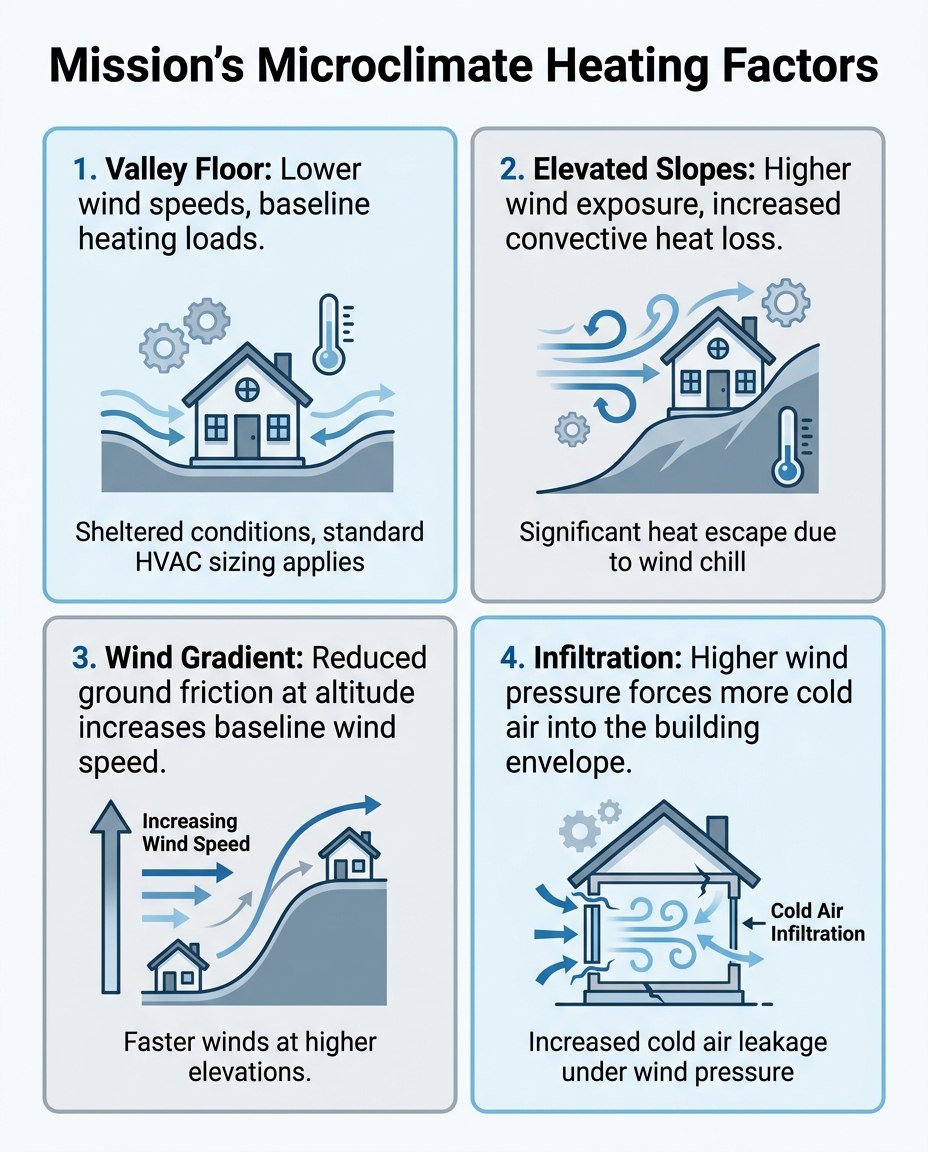
During the high-wind winter months, the stark difference in heating loads between the sheltered valley floor and the exposed slopes becomes obvious. As elevation increases, the ambient temperature naturally drops—a phenomenon known as the environmental lapse rate. Furthermore, elevated areas experience reduced ground friction. Down in the valley, trees, buildings, and natural geographical shielding slow the wind down. Up on the residential slopes, there is far less friction to break the wind, resulting in significantly higher baseline wind speeds that actively pull heat away from your home.
The Sheltered Fraser Valley
Homes located on the valley floor benefit from natural geographical shielding. The surrounding terrain acts as a buffer against prevailing weather systems, leading to lower average wind speeds. Because these homes are not constantly battered by high winds, their heating loads are more predictable and align closely with regional Fraser Valley averages. A standard heating system in this zone experiences less strain and operates under relatively stable environmental conditions.
The Exposed Residential Slopes
Conversely, our team frequently works on homes built on the elevated slopes of Mission that face direct exposure to prevailing winds coming off the mountains and the river valley. The lack of natural windbreaks means these houses endure higher velocity gusts. Combined with the noticeable drops in ambient temperature compared to the valley floor, homes in these upper neighborhoods experience a drastically different thermal reality. The physical structure of the house must fight much harder to maintain a comfortable indoor temperature.
• Average Wind Speed — Sheltered Valley Floor: Lower (buffered by terrain and structures) — Elevated Residential Slopes: Higher (reduced ground friction)
• Ambient Temperature — Sheltered Valley Floor: Aligns with regional baseline data — Elevated Residential Slopes: Consistently lower due to altitude
• Heating Load Predictability — Sheltered Valley Floor: Standard, predictable baseline — Elevated Residential Slopes: Highly variable, requires custom calculation
• System Strain — Sheltered Valley Floor: Moderate, standard cycling — Elevated Residential Slopes: High, constant operation during wind events

Convective Heat Loss and High-Wind Winter Months
To understand why homes on hills feel colder, it helps to look at the physics of convective heat loss. Every house has a thin, invisible layer of relatively still air surrounding its exterior walls, which acts as a minor insulating buffer. Convective heat loss occurs when moving air strips this warm boundary layer away from the building's exterior. The faster the wind blows, the faster this heat is stripped away, forcing the heating system to replace the lost warmth.
Most people understand wind chill as it applies to the human body—how a 30°F day can feel like 15°F when the wind is howling. The exact same principle applies to your home's building envelope. During high-wind winter months, the effective temperature acting on the outside of your house is much lower than what the thermometer reads. High-wind events drastically increase the rate at which heat transfers through your walls, windows, and roof.
At higher elevations, the compounding effect of lower ambient temperatures and higher wind speeds creates a severe penalty for heating systems. We often see situations where a furnace that easily keeps a valley home at 70°F might run continuously on a slope-side home and still only achieve 64°F. This is because the rate of convective heat loss exceeds the system's capacity to deliver BTUs (British Thermal Units) into the living space.
• Stripped Boundary Layers: High winds constantly remove the insulating pocket of air around the exterior siding.
• Accelerated Thermal Bridging: Wood framing and metal fasteners conduct heat out of the house faster when exposed to freezing winds.
• Increased Surface Cooling: Large surface areas, particularly roofs and windward walls, act like giant radiators leaking heat into the neighborhood.
Why Square-Footage Rules of Thumb Fail in Exposed Neighborhoods
The traditional "rule of thumb" sizing method—calculating heating capacity by multiplying the home's square footage by a generic regional factor—originated decades ago when specialized calculations were too time-consuming. While this shortcut might occasionally work in perfectly average, sheltered subdivisions, our team can confirm it fails spectacularly in distinct microclimates.
Generic regional climate data does not know that your house sits on a bluff facing a prevailing northern wind. When contractors rely solely on square footage, they ignore the unique thermal dynamics of your specific property. Recently, a local homeowner reached out to our team during the spring for a routine assessment of their heating and cooling system after struggling with uneven temperatures. Our technician, Colin, spent time explaining how their specific system was sized, answering questions about its performance limits, and providing maintenance advice to keep it running efficiently despite the heavy workload imposed by their home's placement.
When an HVAC system is improperly sized for an exposed neighborhood, the consequences affect both comfort and equipment longevity:
The Reality of Undersized Systems: An undersized system on a windy slope will run constantly without ever reaching the thermostat set point. This continuous operation drives up utility bills, creates uncomfortable cold spots in wind-facing rooms, and drastically shortens the lifespan of blower motors and heat exchangers due to relentless wear and tear.
The Reality of Oversized Systems: Conversely, a pattern we see often is contractors trying to "play it safe" by installing a massive unit. An oversized system blasts the house with heat and shuts off quickly—a process called short cycling. Short cycling prevents the system from properly filtering the air or controlling indoor humidity, leading to a clammy indoor environment and frequent mechanical breakdowns from constantly turning on and off.
Building Envelope and Infiltration Rates at Higher Altitudes
Beyond convective heat loss, wind gradients heavily impact a building's infiltration rate. The building envelope is the physical separator between the conditioned interior and the unconditioned exterior—comprising the roof, foundation, walls, doors, and windows. Infiltration refers to the unconditioned outdoor air that leaks into the house through microscopic cracks, gaps around window frames, and poorly sealed penetrations.
When wind hits a house on an elevated slope, it creates a zone of positive pressure on the windward side (the side facing the wind). This positive pressure forcefully pushes freezing outdoor air into every available crack in the building envelope. Simultaneously, the wind moving past the house creates a zone of negative pressure on the leeward side (the side sheltered from the wind). This negative pressure acts like a vacuum, actively sucking your expensive, heated air out of the house.
Altitude and slope orientation amplify these pressure differentials. A home positioned near the crest of a hill experiences stronger updrafts and downdrafts, making the pressure differences even more extreme. The quality of your insulation and the type of windows installed play a massive role in mitigating this infiltration. If a home has single-pane windows or aging weatherstripping, the infiltration rate during a storm can effectively double the required heating load. When we perform an accurate HVAC sizing protocol, we must account for how well the building envelope can resist these pressure-driven air leaks.
The Anatomy of a Hyper-Local HVAC Load Calculation
To combat the unique challenges of slope-side living, our industry professionals rely on the Manual J load calculation. This is the gold standard protocol developed by the Air Conditioning Contractors of America (ACCA) for determining the precise heating and cooling capacity a specific home requires. Understanding how HVAC load calculations work is vital for homeowners who want to avoid the pitfalls of guesswork.
A hyper-local load calculation goes far beyond measuring room dimensions. For homes on Mission's slopes, several specific variables must be aggressively adjusted:
• Local Design Temperatures: Instead of using the regional average, the calculation must use the specific winter design temperature for the higher altitude, which is often several degrees colder.
• Wind Exposure Categories: The Manual J protocol includes specific modifiers for wind shielding. A home in the valley might be rated as "shielded," while a home on a slope must be rated as "exposed," which mathematically increases the required heating capacity.
• Infiltration Metrics: The calculation requires an assessment of the home's tightness, factoring in the pressure differentials caused by high winds.
• Solar Gain and Orientation: The direction the home faces on the slope dictates how much natural solar heat it receives during the day. A south-facing slope benefits from solar gain, while a north-facing slope remains shaded and colder.
At Rep-Air Heating and Cooling, our team brings hyper-local expertise to this process, running custom load calculations that specifically factor in Mission's neighborhood-specific slope orientation and wind exposure. By using granular, localized data rather than broad regional averages, the resulting system recommendation is perfectly tuned to the home's actual thermal reality.
Choosing the Right Equipment for Slope-Side Homes
Once the precise heating load is established, selecting the right equipment is the next crucial step. Homes subject to rapidly changing wind and temperature conditions benefit immensely from variable-speed HVAC equipment. Unlike traditional single-stage furnaces that only operate at 100% capacity or 0%, variable-speed systems can adjust their output in tiny increments. On a calm, mild day, the system runs at a low, energy-saving speed. When a severe windstorm hits the slope, the system automatically ramps up its capacity to counteract the increased convective heat loss.
Modern heat pump systems are also highly effective in these environments, provided they are correctly sized for local wind exposure. Cold-climate heat pumps are designed to extract heat from the outside air even at sub-zero temperatures, but their placement and sizing must account for the microclimate. During a recent winter installation for a local resident, our technicians noticed that the exhaust and intake pipes for the heating system were routed too close together for the specific slope orientation and wind patterns. We immediately corrected the pipe placement issue, ensuring the system could vent properly against the prevailing winds without recirculating exhaust.
Because heating systems on exposed slopes work harder than those in sheltered valleys, ongoing system assessments and professional maintenance are non-negotiable to combat increased wear. Before approving any installation, we recommend homeowners ask their contractor:
• "Did you perform a Manual J load calculation, and can I see the report?"
• "How did you adjust the calculation for my home's specific wind exposure and elevation?"
• "What is the infiltration rate assumed in this calculation?"
• "Is the recommended equipment variable-speed or single-stage?"
Frequently Asked Questions About HVAC Sizing in Windy Areas
How does wind exposure affect heating load?
Wind exposure directly increases a home's heating load by accelerating convective heat loss and driving cold air infiltration. High winds strip away the insulating layer of still air around the exterior walls, cooling the building materials faster. Additionally, wind creates pressure differences that force cold air through tiny gaps in the building envelope, requiring the HVAC system to work much harder to maintain indoor temperatures.
Why is my house so cold on a hill?
Houses on hills are typically colder because they lack the natural geographical shielding found in valleys, exposing them to higher wind speeds and lower ambient temperatures. This increased exposure leads to rapid heat loss through the walls and roof. If your heating system was sized using standard valley-level calculations, it likely lacks the capacity to overcome the extreme thermal demands of your elevated location.
What factors go into a custom HVAC load calculation?
A custom HVAC load calculation, known as a Manual J, factors in the home's square footage, ceiling height, insulation R-values, window types, and exact geographical orientation. For homes in unique microclimates, it also critically adjusts for local winter design temperatures, specific wind exposure categories, and the building's measured air infiltration rates to determine the exact BTU capacity required.
Does wind affect HVAC performance?
Yes, wind significantly affects HVAC performance by altering the thermal dynamics of the house and impacting the equipment itself. Strong winds increase the home's heat loss, forcing the system to run longer cycles. Furthermore, prevailing winds can interfere with the proper drafting of exhaust flues or the airflow over outdoor heat pump coils if the equipment is improperly placed.
Do houses on hills need bigger heaters?
Houses on hills often require a different heating capacity than identical houses in sheltered valleys, but "bigger" is not always better. They require correctly sized heaters based on a custom load calculation that accounts for altitude and wind chill. Installing an oversized unit without a proper calculation leads to short cycling, poor humidity control, and premature system failure.
How does elevation affect heat pumps in Mission, BC?
Elevation affects heat pumps by lowering the baseline ambient temperature and increasing exposure to wind, which can impact the unit's defrost cycles and overall efficiency. However, when a cold-climate heat pump is precisely sized for the specific elevation and protected from direct prevailing winds, it remains a highly efficient and effective heating solution for homes on Mission's slopes.
Securing the Right Heating Solution for Your Mission Home
Ultimately, how Mission's unique elevation changes affect HVAC sizing and wind exposure cannot be ignored if you want a comfortable, efficient home. The drastic differences between the sheltered Fraser Valley and the exposed residential slopes mean that standard sizing formulas are entirely inadequate for higher elevations. Relying on generic square-footage quotes often guarantees a future of drafty rooms, high utility bills, and overworked equipment.
Investing in a custom load calculation is the only way to ensure your system is perfectly matched to your property's specific wind exposure and altitude-driven heat loss. By relying on our hyper-local expertise and maintaining your system with our preventative maintenance plan, you protect your investment against the elements. If you live on the slopes of Mission, always ask your contractor how they account for your specific microclimate before agreeing to a new installation.
hear what our satisfied clients have to say
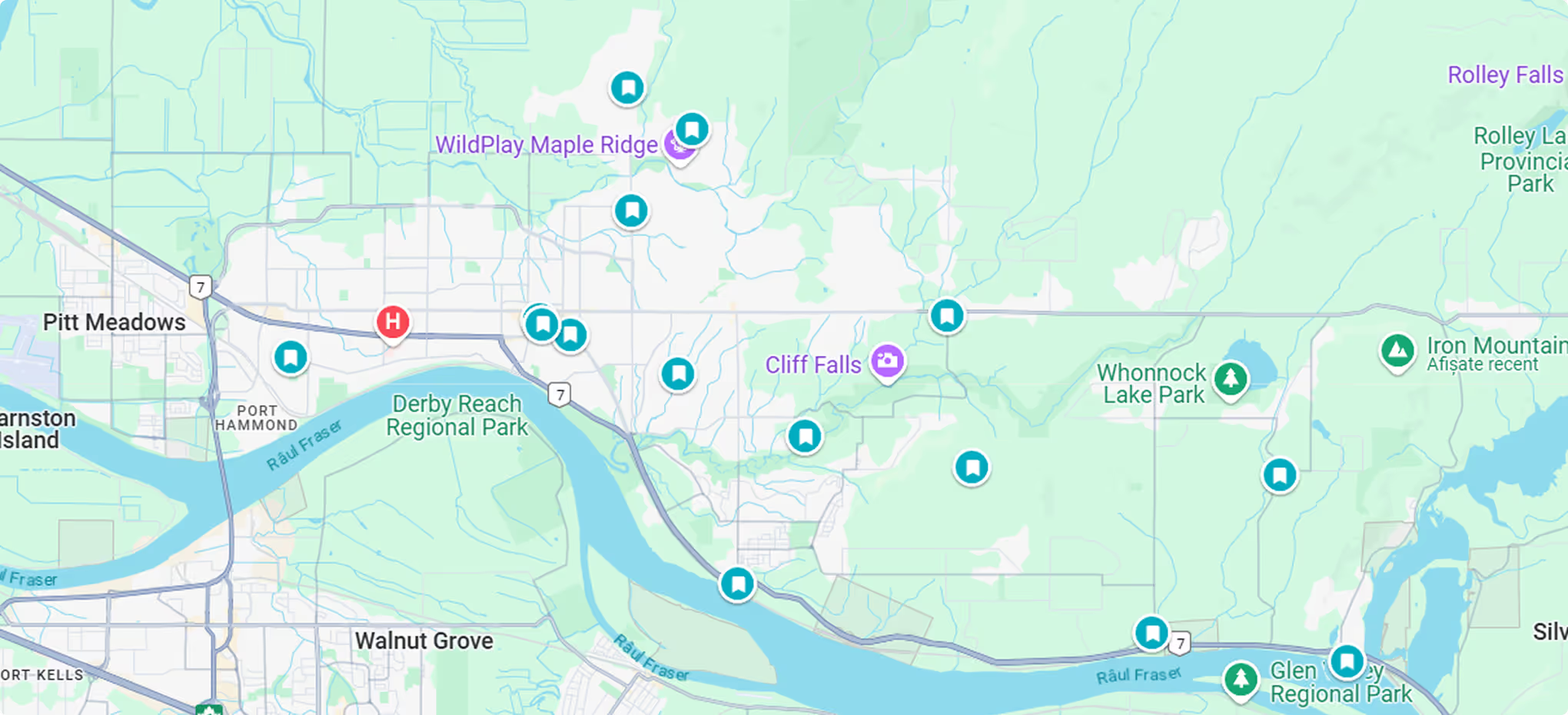
Neighbourhoods in the Fraser Valley