Never Run Cold Again: Top On-Demand Hot Water Heaters Reviewed
Why On-Demand Water Heaters Are Changing Home Comfort
Finding the best on demand hot water heater means never running out of hot water, even when the dishwasher and laundry are running. Unlike traditional tank heaters that constantly reheat 40-55 gallons of water, on-demand systems (or tankless water heaters) heat water instantly as it flows. This provides a continuous supply of hot water while using significantly less energy. For homeowners in Douglas, BC, upgrading to a tankless system means lower utility bills, more space, and an endless supply of hot water.
Quick Answer: Top Features to Look For:
• Flow Rate (GPM): 5-10 GPM for whole-house coverage; 2-5 GPM for point-of-use
• Fuel Type: Natural gas for higher output; electric for simpler installation
• Lifespan: Gas units last 20+ years; electric units 7-10 years
• Energy Efficiency: Look for Energy Star certification and condensing technology
• Temperature Control: Digital displays with precise degree settings
• Warranty: Minimum 10-year heat exchanger warranty for quality units
Whether you're dealing with an aging tank heater or are simply tired of cold showers, understanding how tankless technology works will help you make the right choice. For comprehensive guidance on all your water heating options, check out our water heater services, or contact Rep-Air Heating And Cooling to schedule a professional consultation.
A family of four can use over 100 gallons of hot water daily. A traditional tank struggles to keep up, constantly reheating stored water and risking running out during peak use. On-demand systems solve this by heating water only when you need it, delivering it at the precise temperature you set.
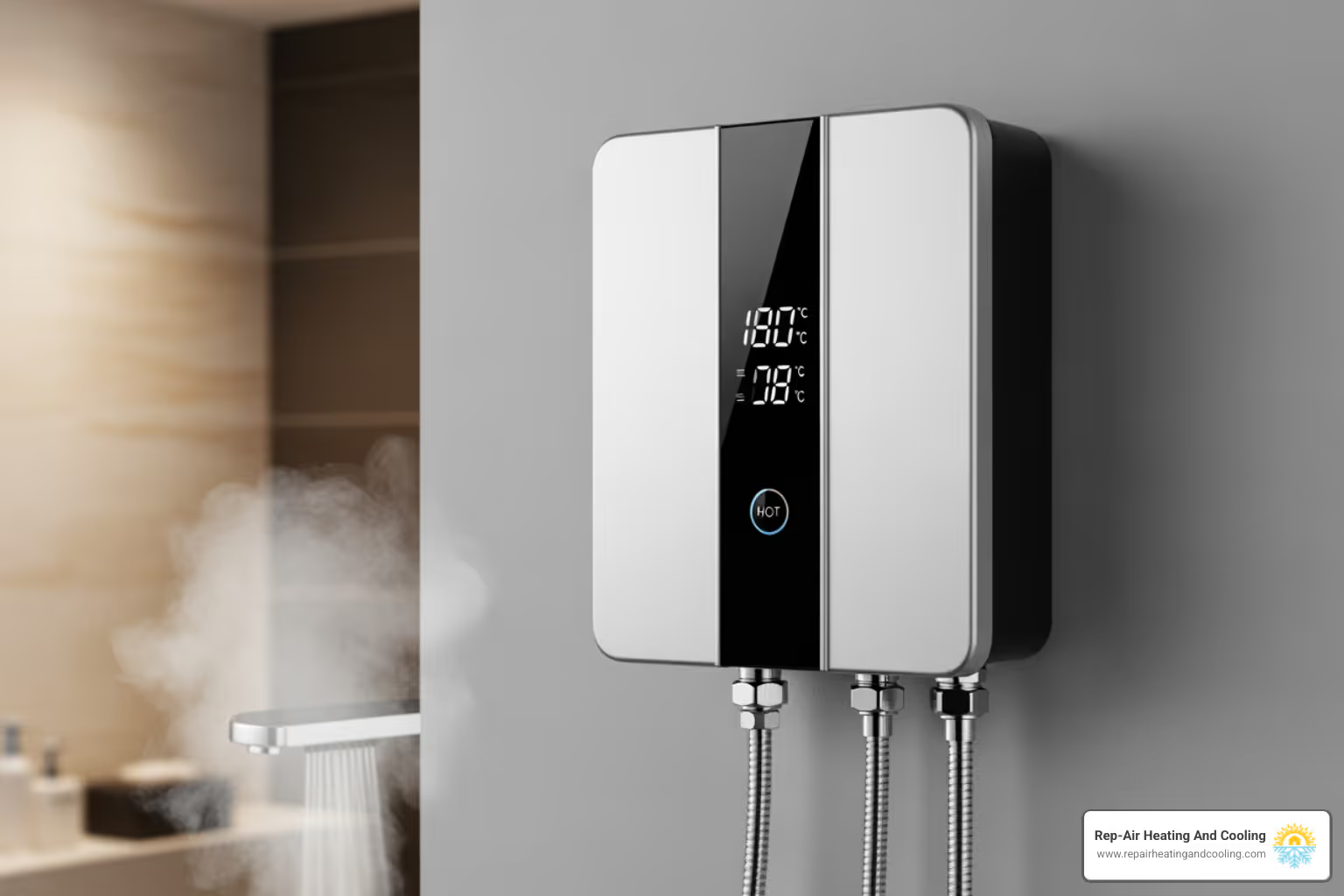
Images shown are for illustration only and do not depict specific products installed or recommended by Rep-Air Heating And Cooling.
Understanding On-Demand Water Heaters: How They Work & Key Benefits
When we talk about the best on demand hot water heater, we're discussing tankless systems. Unlike traditional tank heaters that store and constantly heat a large volume of water, tankless units are a marvel of modern efficiency. When you turn on a hot water tap, a flow sensor activates the unit. For gas models, a burner ignites and heats water as it passes through a heat exchanger. Electric models use powerful heating elements to do the same. The system instantly heats water to your set temperature and only operates when you need it.
This "on-demand" process eliminates standby heat loss, the energy wasted by traditional tanks to keep stored water hot 24/7. With a tankless system, you only pay for the hot water you use.
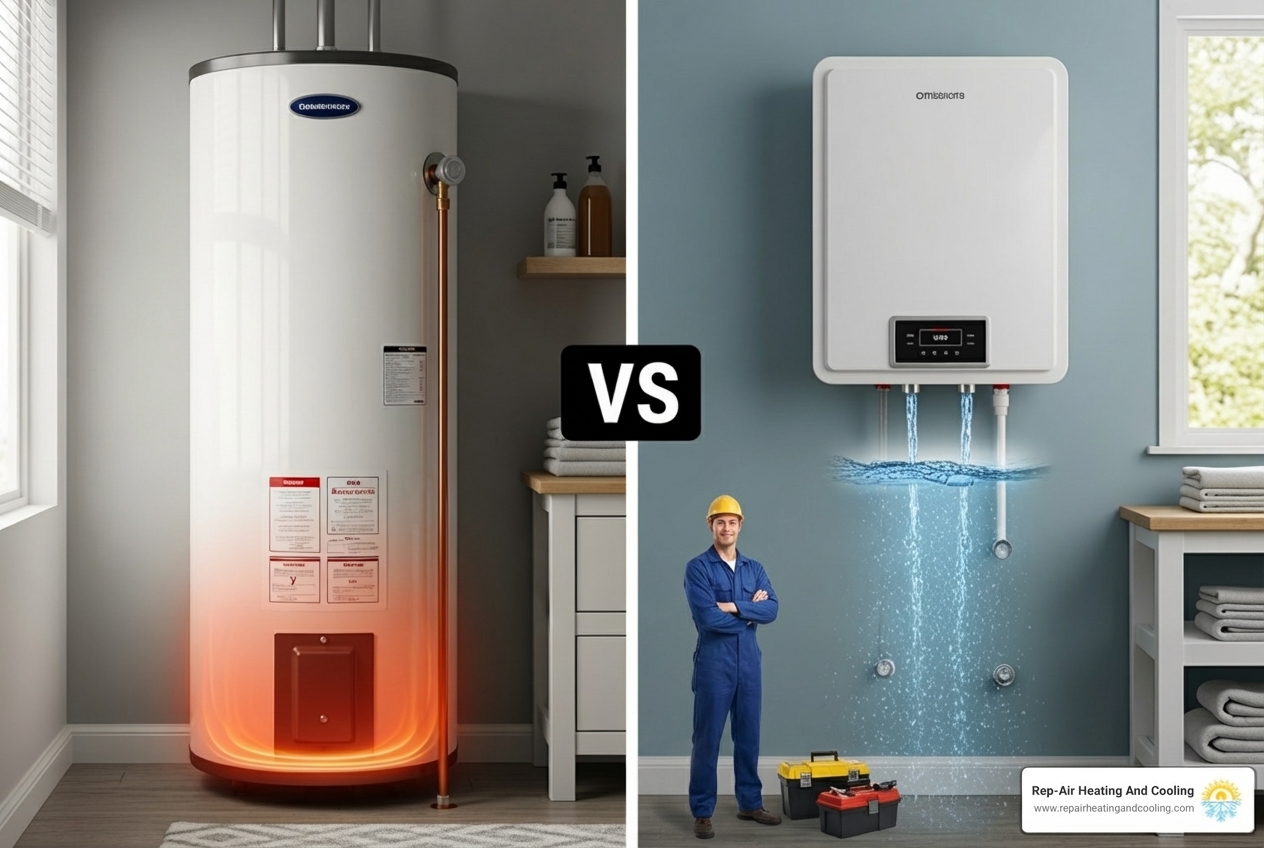
Here's a quick comparison:
• Hot Water Supply — Traditional Tank Water Heater: Limited by tank size, can run out — Tankless (On-Demand) Water Heater: Continuous, virtually endless
• Energy Use — Traditional Tank Water Heater: Heats water 24/7, standby heat loss — Tankless (On-Demand) Water Heater: Heats only when needed, no standby loss
• Lifespan — Traditional Tank Water Heater: Typically 10-12 years — Tankless (On-Demand) Water Heater: Gas: 20+ years; Electric: 7-10 years
• Size/Space — Traditional Tank Water Heater: Large, bulky tank — Tankless (On-Demand) Water Heater: Compact, wall-mounted
• Installation — Traditional Tank Water Heater: Generally simpler, lower upfront cost — Tankless (On-Demand) Water Heater: More complex, higher upfront cost
• Maintenance — Traditional Tank Water Heater: Anode rod checks, flushing — Tankless (On-Demand) Water Heater: Annual descaling, filter checks
• Risk of Leaks — Traditional Tank Water Heater: Higher risk of catastrophic leaks — Tankless (On-Demand) Water Heater: Lower risk, no large water storage
Advantages of Going Tankless
Choosing a tankless water heater brings many benefits to your home's comfort and efficiency. The primary draw is energy efficiency. By eliminating standby heat loss, these units reduce wasted energy, which leads to lower utility bills. Over its longer lifespan, the energy savings can be substantial.
Another key benefit is the continuous hot water supply. Imagine never having to rush a shower or being able to fill a large tub without the water turning cold. With a tankless system, you get hot water exactly when you need it, for as long as you need it.
Tankless units are also compact. Often the size of a small suitcase, they mount on a wall, freeing up floor space. This is a significant advantage in areas like Langley, BC, where space is valuable.
Furthermore, tankless water heaters have a longer lifespan. Gas models can last 20 years or more—two to three times longer than traditional tanks—offering a better return on your investment.
Finally, the risk of major water damage is lower. Without a large tank of stored water, the potential for a catastrophic leak is virtually eliminated. Sealed vents on gas units also prevent carbon monoxide from back-drafting into your home, making them a safe option when installed and maintained correctly. For more comprehensive insights into water heating options, you can consult a detailed Water Heater Buying Guide.
Potential Drawbacks to Consider
While the benefits are compelling, it's important to consider potential drawbacks. The most significant is typically the higher initial investment. Tankless units and their installation generally cost more than traditional tank heaters.
Installation can be more complex, as converting from a tank to a tankless system often requires upgrades to your home's gas line or electrical service, as well as new venting. Gas units need proper ventilation, and electric units demand a substantial electrical supply. This retrofitting can add to the overall project expense.
Another factor is output limitations. A tankless unit has a maximum flow rate (GPM). If multiple high-demand fixtures run simultaneously, a single unit might struggle to keep up unless it's properly sized for peak demand. This is why careful sizing is crucial.
Despite these considerations, the long-term energy savings and convenience often outweigh the initial investment for many homeowners. If you're concerned about identifying inefficiencies in your current system or planning an upgrade, Rep-Air Heating And Cooling can help you detect energy-wasting signs in water heaters.
Your Guide to Choosing the Best On-Demand Hot Water Heater
Selecting the best on demand hot water heater requires careful consideration of your household's needs. This isn't a one-size-fits-all decision. Factors like household size, peak hot water demand, and local climate play a significant role. Key metrics are Gallons Per Minute (GPM), which is the flow rate of hot water, and temperature rise, the difference between incoming cold water and your desired hot water temperature. Understanding these variables is crucial for ensuring your new heater meets your family's needs. For a detailed guide, the Energy Saver website offers resources on sizing a new water heater.
Sizing Your Unit: Finding the best on demand hot water heater for your family
Correctly sizing your tankless water heater is the secret to an endless supply of hot water. The main factor is your household's peak hot water demand, expressed in Gallons Per Minute (GPM). This is the maximum amount of hot water you might need at one time.
To calculate this, add up the flow rates of fixtures you might use simultaneously. Here are some typical flow rates:
• Shower: ~2.0 GPM
• Dishwasher: ~1.5 GPM
• Washing Machine: ~2.0 GPM
• Bathroom Sink: ~1.0 GPM
For example, if your family might run two showers (4.0 GPM total) while the dishwasher is on (1.5 GPM), your peak demand would be 5.5 GPM. You would need a unit that can deliver at least this flow rate.
The temperature rise is also critical. In colder months, the incoming groundwater temperature in areas like Langley, BC, is lower. The unit must work harder to heat this colder water, which can reduce its effective GPM. Rep-Air Heating And Cooling recommends choosing a unit that can handle your peak demand even with the coldest regional groundwater temperatures. For more guidance, explore how to choose a water heater. If you're in the Langley, BC area, we can help you find the perfect fit. Learn more about our tankless water heaters in Langley, BC.
Fuel Types: Gas vs. Electric On-Demand Heaters
A significant decision is the fuel type: gas or electric. Both have distinct advantages impacting performance, installation, and operating costs.
Natural Gas/Propane Tankless Heaters: Gas heaters are ideal for whole-house use, especially in larger homes with high water demand.
• Higher GPM Output: Gas units offer a higher flow rate (5-10 GPM), easily handling multiple showers and appliances at once.
• Lower Operating Costs: Natural gas is often a more cost-effective fuel source than electricity for heating water.
• Venting Requirements: Gas units require specialized venting to safely expel combustion byproducts, which adds to installation complexity.
• Lifespan: Gas tankless heaters have an impressive lifespan, often 20 years or more.
Electric Tankless Heaters: Electric heaters work well for smaller homes, apartments, or point-of-use applications where gas is unavailable.
• Simpler Installation: With no gas lines or venting, installation is generally simpler.
• Lower GPM Output: Electric units have a lower flow rate (2-5 GPM), making them less suitable for high, simultaneous demand.
• Electrical Panel Requirements: These units require a lot of power, often needing dedicated high-voltage circuits and a robust electrical panel.
• Lifespan: Electric tankless units typically last 7 to 10 years.
The choice depends on your existing utilities, hot water needs, and budget. For a deeper dive, the Energy.gov website provides a helpful guide on which water heater is right for you.
Key Technologies: What makes the best on demand hot water heater in 2025?
The best on demand hot water heater models integrate advanced technologies for better efficiency and convenience.
Here are key features to look for:
• Condensing Technology: A key feature for gas units, this captures extra heat from exhaust gases. It boosts efficiency to 90-98% and allows for less expensive PVC venting.
• Stainless Steel Heat Exchangers: More durable and corrosion-resistant than copper, these contribute to a longer unit lifespan.
• Built-in Recirculation: Some models include a recirculation pump to provide nearly instant hot water, reducing wait times and water waste.
• Scale Reduction Technology (SRT): Advanced units may include technology to minimize mineral scale buildup, which protects efficiency and extends the heater's life.
• Wi-Fi and Smart Controls: Modern units often connect to Wi-Fi, allowing you to adjust temperatures, monitor energy use, and receive maintenance alerts via a smartphone app.
• Digital Temperature Displays: Clear digital displays allow for precise temperature settings down to the degree.
• Self-Modulating Burners: These burners in gas units adjust their flame to match the exact hot water demand, optimizing energy use.
These technologies make tankless units more efficient and user-friendly. To explore top-rated models and feature sets, you might find insights in articles like 7 Best Tankless Water Heaters (2025).
Maximizing Your Investment: Lifespan, Maintenance, and Savings
Investing in a tankless water heater is a significant decision. Understanding its long-term value, required upkeep, and potential for savings is key to maximizing your investment. These units are designed for durability and efficiency, but they thrive with proper care. For homeowners in Mission, BC, a well-maintained tankless system can provide decades of reliable, energy-efficient hot water. Rep-Air Heating And Cooling is always here to help with your water heaters in Mission, BC.
Expected Lifespan and Essential Maintenance
A compelling feature of tankless water heaters is their longevity. Gas-burning units are built to last, with an expected lifespan of 20 years or more—often two or three times longer than a conventional tank heater. Electric tankless units typically have a lifespan of 7 to 10 years. This extended lifespan means fewer replacements and less hassle over time.
To reach this lifespan and maintain performance, annual descaling is critical. Hard water contains minerals that can build up inside the heat exchanger, forming scale that reduces efficiency and can damage the unit. During an annual service, a professional circulates a descaling solution through the unit to dissolve these deposits, restoring efficiency. In areas with very hard water, more frequent descaling or a water softener might be recommended.
Other routine maintenance includes:
• Checking and cleaning the intake filter.
• Inspecting gas lines and connections for leaks (for gas units).
• Examining vents for obstructions.
• Testing the temperature and pressure relief (T&P) valve.
Rep-Air Heating And Cooling strongly recommends professional servicing annually to ensure your unit operates safely and efficiently. For residents of Silverdale, BC, and surrounding areas, we offer expert services for your tankless water heater in Silverdale, BC.
Opening up Savings: Energy Efficiency and Incentives
The energy efficiency of tankless water heaters translates directly into long-term savings. Because they only heat water on demand, they eliminate the standby heat loss associated with traditional tanks. This inherent efficiency is why many tankless models are Energy Star certified.
A well-chosen tankless unit can noticeably reduce your water heating costs annually. It is also a good idea to inquire about potential local utility rebates or provincial incentives for energy-efficient home upgrades in British Columbia. Many utility companies offer programs that can help offset the initial investment. You can explore the broader landscape of energy efficiency incentives by visiting resources like the federal tax credit page to see what programs might apply. Always check with your local energy provider or a qualified plumbing professional to understand all available incentives in your area, such as Abbotsford, BC, or Maple Ridge, BC.
Frequently Asked Questions about On-Demand Water Heaters
Homeowners often have similar questions when considering a tankless system. Here are answers to some of the most common ones.
Can a tankless water heater keep up with a large family's needs?
Yes, a properly sized tankless water heater can easily meet a large family's needs. The key is choosing a unit with a GPM (Gallons Per Minute) rating high enough to handle your peak hot water demand. Many whole-house models can deliver 8-10 GPM or more, which is sufficient for several fixtures to run at once. For exceptionally high demand, installing two units in parallel or using point-of-use heaters can be an effective solution. Rep-Air Heating And Cooling can help you determine the right size for your home in Fort Langley, BC. Explore our services for water heaters in Fort Langley, BC.
How long does it take to get hot water with a tankless heater?
A common misconception is that "on-demand" means "instant." The water is heated instantly at the unit, but it still has to travel through your pipes to the faucet. This delay is similar to a traditional tank heater. For truly instant hot water, a recirculation pump can be installed with your tankless system. These pumps keep hot water circulating through your pipes, so it's always ready at the tap, eliminating wait times and water waste.
Is professional installation really necessary for a tankless unit?
Yes, professional installation is essential for safety, performance, and warranty validation. Attempting a DIY installation is not recommended.
Here's why:
• Gas Lines: Gas units require precise connections to prevent dangerous leaks.
• High-Voltage Electrical: Electric units demand significant power and often require dedicated circuits installed by a professional.
• Venting Requirements: Gas units must be vented correctly to safely expel combustion gases and prevent back-drafting.
• Building Codes: A professional ensures your installation complies with all local building codes in areas like Mission, BC, Abbotsford, BC, or Langley, BC.
• Safety: Improper installation can lead to pressure issues, inconsistent temperatures, or premature unit failure.
• Warranty Validation: Most manufacturers require professional installation to validate the warranty.
Rep-Air Heating And Cooling has the expertise to install your tankless water heater safely and efficiently. Our team prides itself on treating customers like family, ensuring your comfort and safety. For expert installation of tankless water heaters in Mission, BC, do not hesitate to reach out.
Conclusion: Make the Switch to Endless Hot Water
Choosing the best on demand hot water heater is a smart investment in your home's comfort and efficiency. With an endless supply of hot water, significant energy savings, and a space-saving design, the benefits are clear. While the initial investment is higher, the long-term savings, extended lifespan, and superior performance make it a worthwhile upgrade for years to come.
At Rep-Air Heating And Cooling, upgrading your home's plumbing is made simple and stress-free. Our team of dedicated professionals is committed to providing the best customer service and ensuring your transition to a tankless water heater is seamless. We serve homeowners across the Lower Mainland, British Columbia, including Douglas, BC, Abbotsford, BC, Langley, BC, and many other communities.
Ready to say goodbye to cold showers and hello to endless hot water? Let us help you find the perfect tankless solution for your home. Contact us for your tankless water heater installation in Douglas, BC today, and experience the Rep-Air Heating And Cooling difference—where your comfort is our priority, and we treat you like family.
Image shown is illustrative of the comfort benefits of a modern tankless water heater and is not a photo of an actual Rep-Air Heating And Cooling installation.
hear what our satisfied clients have to say
Neighbourhoods in the Fraser Valley