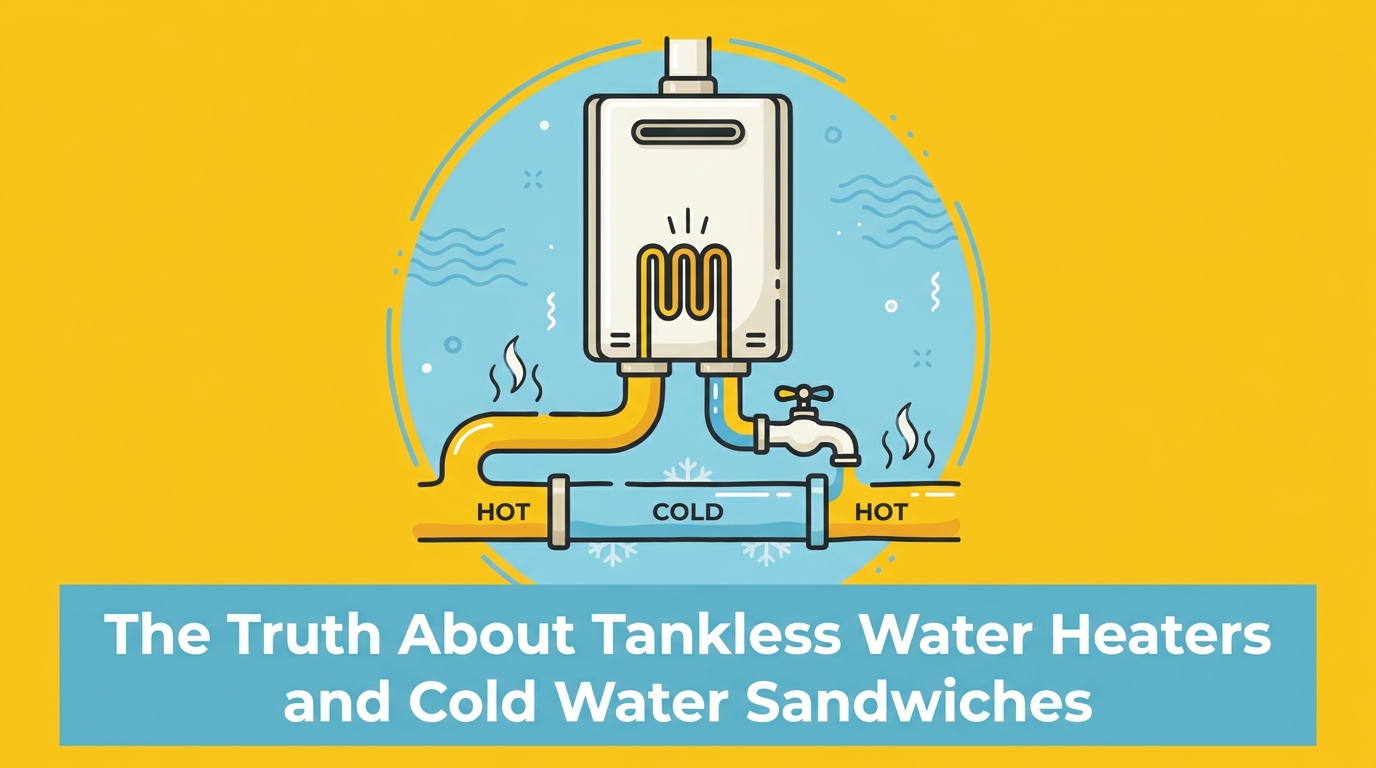
The Truth About Tankless Water Heaters and Cold Water Sandwiches
Why Did My Hot Shower Just Turn Freezing Cold?
If you have ever been hit with a sudden, freezing blast of water right in the middle of a hot shower, you are probably searching for the truth about tankless water heaters and cold water sandwiches. Is your brand-new system already failing, or is there a mechanical reason behind this jarring experience? You step into the shower, the water is perfectly warm, you turn it off for a moment to lather up, and when you turn it back on—ice water. This sudden drop in temperature is a well-known, documented mechanical phenomenon in the plumbing industry, not necessarily a sign of catastrophic failure.
Before you panic and assume your heat exchanger is broken, it helps to understand how these systems operate behind the scenes. If you need immediate assistance with your home's setup, our team provides comprehensive plumbing services to keep your water flowing comfortably.
Standard tankless units without internal buffer tanks operate strictly on demand. They do not hold a reservoir of hot water. Because they heat water precisely as it flows through the unit, any interruption in that flow changes how the internal sensors react. When you understand the physics of your plumbing lines, you can easily distinguish between a harmless mechanical quirk and a system that actually needs professional repair.
The Homeowner's Experience
Most homeowners notice this issue during very specific routines. Here is what the typical pattern looks like:
• The initial warmth: You turn on the tap, and hot water flows normally after the initial purge of cold water in the pipes.
• The brief pause: You turn off the water for thirty seconds to shave, apply shampoo, or wash the dog.
• The cold shock: You turn the water back on, feel a few seconds of warmth, and then get hit with a distinct 10-to-15-second blast of cold water.
• The return to normal: Just as quickly as it arrived, the cold water passes, and the shower returns to your desired temperature.
This exact sequence is frustrating, but it is completely predictable once you look at the mechanics of on-demand heating.
What Exactly Is a Cold Water Sandwich?
The term "cold water sandwich" sounds like a strange menu item, but it perfectly describes the physical state of the water inside your plumbing lines. To eliminate this issue, you first have to understand how water sits in your pipes. If you are also upgrading your heating systems to high-efficiency models, understanding how on-demand technology handles start-and-stop cycles is crucial for your overall home comfort.
The Anatomy of the Sandwich
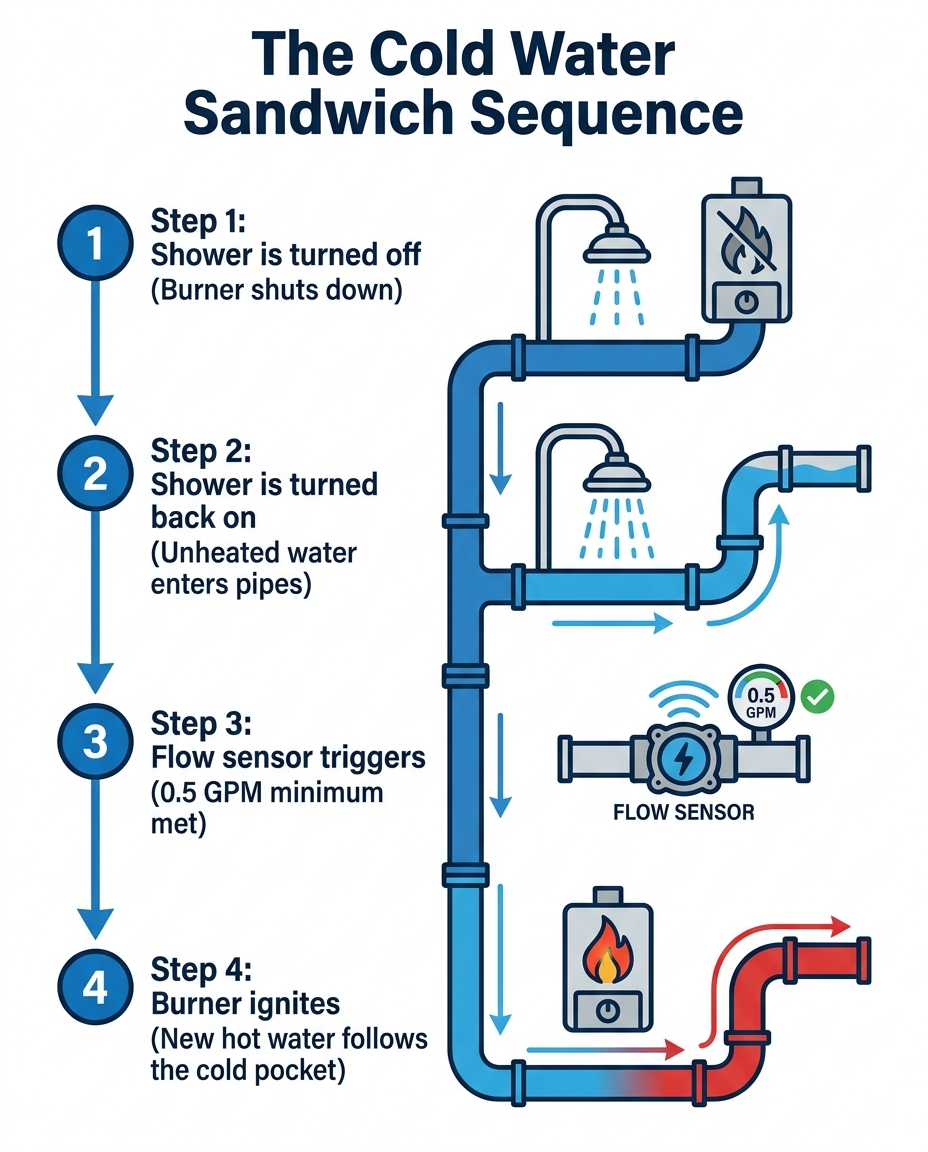
When you run a hot shower, the pipes between your water heater and your showerhead fill with hot water. If you turn the shower off temporarily, the water heater immediately shuts down its burners to save energy. However, the water already inside the pipes stays warm due to residual heat.
When you turn the shower back on, three things happen in sequence:
1. The warm water that was sitting in the pipes comes out first.
2. The water heater detects the new flow of water and takes a few seconds to ignite and heat up. During this delay, a pocket of completely unheated water slips past the heat exchanger and enters the pipes.
3. The newly heated water finally leaves the unit and follows that cold pocket.
That pocket of unheated water trapped between the older warm water and the newer hot water is the "meat" of the cold water sandwich. When it finally reaches your showerhead, you feel a distinct, temporary drop in temperature.
Why Traditional Tanks Avoid This
If you recently switched from a traditional tank to an on-demand system, this experience can catch you off guard. Traditional water heaters store 40 to 60 gallons of water kept at a constant temperature day and night. When you turn the tap on, off, and back on, you are always drawing from that same pre-heated reservoir. There is no ignition delay, and therefore, no cold water gap. Standard tankless units without internal buffer tanks trade that standby reservoir for incredible energy efficiency, but the trade-off is the slight delay in heating new water.

How Flow Sensors and Minimum Flow Rates Trigger the Chill
To really grasp why the temperature drops, we have to look inside the cabinet of your tankless unit. These systems are essentially highly advanced computers attached to powerful gas burners or electric heating elements. They remain completely dormant until they sense a demand for hot water.
The Role of the Flow Sensor
Every on-demand water heater contains a highly sensitive component called a flow sensor. This sensor acts as the gatekeeper for the heating process. To prevent the unit from firing up accidentally or running dry, the sensor requires a minimum amount of water to pass through it before it signals the computer to start the burners. For most modern residential units, this minimum flow rate is around 0.5 gallons per minute (GPM).
If you barely crack a faucet open to wash your hands, the flow might only be 0.3 GPM. The sensor will not trigger, the burners will remain off, and you will only get cold water. When you open a shower valve fully, you easily exceed the 0.5 GPM threshold, and the sensor springs into action.
The Ignition Delay
Once the flow sensor registers enough water movement, it sends a signal to the control board. The control board then opens the gas valve, triggers the igniter, and fires up the burners. The flames heat the metal heat exchanger, which then transfers that heat to the water flowing through its coils.
This entire sequence is incredibly fast, but it is not instantaneous. It typically takes between two and five seconds for the heat exchanger to reach its target temperature. During those few seconds, water is continuously flowing through the unit. Because the heat exchanger is not fully hot yet, that specific volume of water passes through unheated. That unheated volume becomes your cold water sandwich.
The "Navy Shower" Effect
This mechanical reality explains why the cold gap only happens during start-and-stop usage. If you turn the shower on and leave it running for twenty minutes, the flow sensor remains engaged, the burners stay lit, and the heat exchanger stays hot. You get endless hot water. But if you practice "Navy showers"—turning the water off to lather up and save water—you force the unit to shut down and restart, triggering a new ignition delay every single time.
The Impact of British Columbia Winters on Temperature Rise
While the mechanics of flow sensors apply to tankless systems everywhere, regional climate factors play a massive role in how noticeable the cold water sandwich effect actually is. Where you live directly impacts how hard your water heater has to work.
Understanding Delta T (Temperature Rise)
In the plumbing world, "Delta T" refers to the temperature rise—the difference between the temperature of the cold groundwater entering your home and your desired hot water temperature. If you want a 105-degree shower, your water heater has to bridge the gap between the incoming water and that target number.
During the summer, the groundwater entering your home might be a relatively mild 60 degrees. To reach 105 degrees, the heat exchanger only needs to raise the temperature by 45 degrees. It can accomplish this very quickly, meaning the ignition delay is shorter and the cold water sandwich is barely noticeable.
Frigid Groundwater Challenges
British Columbia winters with frigid incoming groundwater change the math entirely. In Mission and the Fraser Valley, winter groundwater temperatures can drop significantly, often hovering just above freezing. If the water entering your home is 38 degrees, your tankless unit now has to achieve a temperature rise of 67 degrees to give you that same 105-degree shower.
This massive Delta T forces the heat exchanger to work much harder. It takes slightly longer for the burners to bring the metal up to the extreme temperatures required to heat near-freezing water on the fly. Because the heating process takes longer, a larger volume of unheated water slips past the heat exchanger during the ignition phase. This is why homeowners in our region often find the cold water sandwich effect much more pronounced and uncomfortable during the peak of winter.
Diagnosing the Drop: Is Your Tankless Unit Actually Broken?
The most common reaction to a blast of cold water is assuming the unit has failed. While the cold water sandwich is a known quirk of standard tankless units without internal buffer tanks, it is important to know the difference between normal operation and an actual breakdown.
Normal Mechanical Quirks
If you only experience the cold blast when you turn the water off and back on quickly, and the water returns to a steady, hot temperature afterward, your unit is functioning exactly as designed. The flow sensor is doing its job, the burners are firing, and the heat exchanger is working. There is no broken part to replace in this scenario; it is simply the physics of on-demand heating.
Signs of Actual System Failure
However, if you experience any of the following symptoms, your system needs professional attention:
• Continuous cold water: If the water never gets hot, or starts hot and then runs cold indefinitely, the burners are failing to ignite.
• Inconsistent temperatures during continuous flow: If you leave the shower running and the water constantly fluctuates between hot and cold, you likely have a failing flow sensor or severe scale buildup on the heat exchanger.
• Error codes: Most modern units feature a digital display. If you see flashing numbers or letters, the system's internal diagnostics have detected a fault (such as a blocked vent or a gas supply issue).
The Danger of DIY Diagnostics
Modern tankless systems are complex appliances that mix water, electricity, and combustible gas. Attempting to tear down the unit to clean a flow sensor or inspect a heat exchanger yourself is dangerous. Misdiagnosing a normal cold water sandwich as a broken part can lead to unnecessary tampering, wasted time, and voided manufacturer warranties. Just like complex boiler service, diagnosing persistent temperature fluctuations requires professional tools, specific training, and a deep understanding of local water conditions.
Permanent Fixes: Buffer Tanks and Recirculating Pumps Explained
If you are tired of bracing yourself for a cold blast every time you wash your hair, you do not have to live with it. While you cannot change the laws of physics or the temperature of British Columbia winters, there are professional plumbing upgrades designed specifically to eliminate the cold water sandwich effect for good.
The Mini Buffer Tank Solution
A mini buffer tank is a small reservoir (usually one to two gallons) installed directly next to, or built inside, the tankless unit. This tiny tank holds a small reserve of constantly heated water. When you turn the shower off and back on, the system draws from this heated reserve during the few seconds it takes for the main burners to ignite. By the time the reserve is depleted, the tankless unit is fully fired up and delivering fresh hot water. The unheated pocket is completely absorbed by the buffer, ensuring a seamless, consistent temperature at the showerhead.
The Recirculating Pump Solution
A recirculating pump takes a different approach. Instead of holding a reserve of water at the unit, a pump keeps hot water slowly moving through your home's plumbing pipes in a continuous loop. Because the water is constantly circulating, it never has a chance to sit in the pipes and cool down, and the flow sensor remains engaged just enough to maintain the temperature. This means hot water is instantly available the moment you open the tap.
Comparing Your Options
• Primary Function — Mini Buffer Tank: Absorbs the cold water gap at the unit — Recirculating Pump: Keeps hot water moving through the pipes
• Best Used For — Mini Buffer Tank: Eliminating the ignition delay cold blast — Recirculating Pump: Reducing wait times for hot water at distant taps
• Installation Location — Mini Buffer Tank: Next to or inside the water heater — Recirculating Pump: At the heater or under the furthest sink
• Impact on Sandwich — Mini Buffer Tank: Completely smooths out temperature drops — Recirculating Pump: Prevents pipes from cooling during short pauses
Choosing between these solutions requires an assessment of your home's plumbing layout. Working with Rep-Air means you get local expertise in properly diagnosing BC-specific plumbing quirks and installing correctly sized upgrades. We understand how our regional water temperatures affect performance, and we know exactly how to integrate a tankless circulator pump or buffer tank to match your specific model and household demand.
Frequently Asked Questions About Tankless Temperature Fluctuations
Why does my tankless water heater go cold during a shower?
Your tankless water heater goes cold temporarily due to an ignition delay when the water flow is interrupted and restarted. When you turn the shower off, the burners shut down. When you turn it back on, it takes a few seconds for the burners to reignite, allowing a brief pocket of unheated water to slip into the pipes.
How do you fix a cold water sandwich?
You can fix a cold water sandwich permanently by having a professional install a mini buffer tank or a recirculating pump system. A buffer tank holds a small reserve of hot water to cover the ignition gap, while a pump keeps warm water moving through your pipes so the temperature remains consistent.
Can you put a recirculating pump on a tankless water heater?
Yes, you can add a recirculating pump to a tankless water heater, but it must be properly sized and compatible with your specific model. Some modern tankless units come with built-in pumps, while older units require external pumps and dedicated return lines to function efficiently without voiding the warranty.
What is a cold water sandwich effect?
The cold water sandwich effect is the physical trapping of unheated water between two pockets of hot water in your plumbing lines. It results in a brief, sudden blast of cold water at the tap before returning to a consistent hot temperature, commonly occurring when a faucet is quickly turned off and back on.
Will a higher flow rate fix the cold water sandwich?
While meeting the minimum flow rate is necessary to trigger the burners in the first place, simply increasing the flow rate will not fix the cold water sandwich. The only behavioral way to prevent the sandwich effect without mechanical upgrades is to keep the water running continuously throughout your entire shower.
Eliminate the Cold Water Sandwich for Good
Getting hit with a freezing blast of water mid-shower is an unpleasant experience, but it rarely means your system is broken. The truth about tankless water heaters and cold water sandwiches is that this phenomenon is a solvable mechanical quirk tied to flow sensors, ignition delays, and the reality of British Columbia winters with frigid incoming groundwater.
By understanding how your on-demand system operates, you can make informed decisions about your home comfort. You do not have to accept temperature fluctuations as a permanent trade-off for energy efficiency. If you are tired of the cold water sandwich, schedule a professional diagnostic with our team today to explore how a properly sized buffer tank or recirculating pump can deliver the seamless, endless hot water you deserve.
hear what our satisfied clients have to say
Neighbourhoods in the Fraser Valley