Descaling Your Tankless Water Heater: A Crucial Pre-Winter Maintenance Step
The Hidden Threat Looming Before Winter Hits
Pre-winter in Mission BC means chilly mornings are just around the corner, making descaling your tankless water heater: a crucial pre-winter maintenance step you cannot afford to skip. As temperatures drop, your household's reliance on consistent, reliable hot water skyrockets. Showers get longer, laundry runs hotter, and your plumbing system works overtime. Yet, a hidden threat is likely building up inside your equipment right now: mineral calcification silently choking the system's efficiency. In tankless units with narrow heat exchangers, this buildup is a concrete problem that requires immediate attention before winter demand spikes. Descaling is not just an optional chore or a springtime cleaning task; it is a non-negotiable defense against complete system failure during the coldest months of the year.
Whether you are looking to upgrade your overall home heating solutions or need professional boiler and water heating services, proactive maintenance is the key to uninterrupted comfort.
Understanding Calcification in Narrow Heat Exchangers
To understand why maintenance is so critical, you have to look at the science of how your water heater operates. Water naturally contains dissolved minerals, primarily calcium and magnesium. While these minerals are harmless to drink, they react poorly to extreme heat. When cold water enters your tankless unit and gets blasted with intense heat from the burner, those minerals precipitate—meaning they separate from the water and turn into solid deposits.
Because high-efficiency systems are engineered for maximum heat transfer, they force water through incredibly tight, intricate passages. Tankless units with narrow heat exchangers are particularly vulnerable to this mineral precipitation. As the calcium separates, it clings to the walls of these tiny copper or stainless steel pathways, creating a hard, crusty layer known as scale.
The Insulating Effect of Mineral Scale
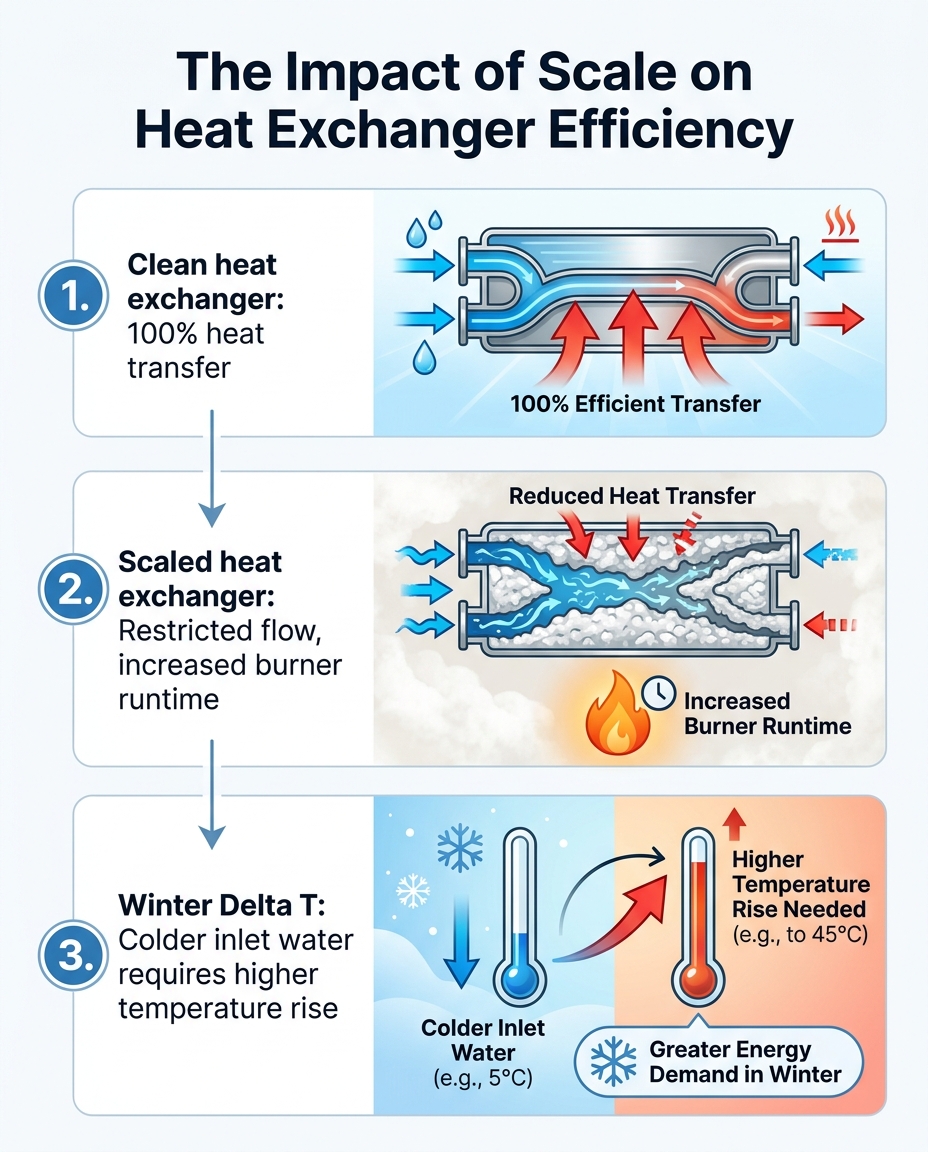
The real danger of scale is not just that it blocks water flow; it is that scale acts as a stubborn, highly effective insulator. Your heat exchanger is designed to transfer heat directly from the gas burner to the water. When a layer of mineral scale coats that metal, the heat cannot pass through efficiently.
• Increased burner runtime: Because the scale blocks the heat, the system's sensors detect that the water is not reaching the target temperature. In response, the burner fires longer and hotter to compensate.
• Component degradation: Prolonged overheating puts immense stress on the internal metal components. The heat exchanger essentially begins to bake itself, leading to metal fatigue, stress fractures, and a significantly shortened system lifespan.
• Wasted energy: You end up paying for the fuel to heat the mineral scale, rather than the water flowing to your taps.
• Clean Heat Exchanger — Heat Transfer Efficiency: 100% (Optimal) — Burner Runtime: Normal / Short cycles — Risk of Component Failure: Low
• Mild Scale Buildup — Heat Transfer Efficiency: 75% - 85% — Burner Runtime: Extended cycles — Risk of Component Failure: Moderate
• Heavy Calcification — Heat Transfer Efficiency: Under 60% — Burner Runtime: Continuous high-fire — Risk of Component Failure: High (Imminent lockout)

The Delta T Factor: Why Winter Inlet Temperatures Matter
The mechanics of scale buildup become a critical emergency when you factor in the local climate. In the plumbing world, professionals talk about "Delta T," which stands for temperature rise. Delta T is simply the difference between the temperature of the cold groundwater entering your home and the desired hot water output at your faucet. If you want a 120°F shower and the groundwater is 60°F, your water heater has a Delta T of 60 degrees.
During the pre-winter in Mission BC, the reality of chilly, damp falls and freezing winter groundwater changes the math entirely. The municipal water traveling through underground pipes drops significantly in temperature. Suddenly, that groundwater might enter your home at 40°F. Now, to reach that same 120°F shower, your water heater must produce a Delta T of 80 degrees. The unit has to work exponentially harder to bridge that larger temperature gap.
This is where the perfect storm occurs. If your heat exchanger is coated in scale, it is already struggling to transfer heat. When you combine a scaled, inefficient heat exchanger with the massive Delta T demands of Mission BC's freezing winter groundwater, the system simply cannot keep up. The burner fires at maximum capacity, the metal overheats, and the water still runs lukewarm. Clearing this scale before the deep freeze sets in is absolutely critical to surviving peak winter workloads without a sudden breakdown.
The Mechanics of a Professional Vinegar Flush
So, how do professionals safely remove this stubborn calcification? The answer lies in a specific chemical reaction, carefully managed through a professional vinegar flush. While we strongly advise against attempting this as a DIY project—handling gas appliances and pressurized water requires specific licensing and training—understanding the mechanics behind the service helps you protect your investment.
Professionals use food-grade white vinegar (acetic acid) because it is uniquely suited for the job. Vinegar is acidic enough to safely dissolve calcium carbonate, breaking it down into a harmless liquid that can be washed away, but it is gentle enough that it will not damage the sensitive copper or stainless steel of the heat exchanger.
The Professional Flushing Process:
1. System Isolation: The technician shuts off the gas and power, then uses specialized isolation valves to disconnect the unit from your home's main plumbing lines. This ensures the cleaning solution only cycles through the water heater.
2. Submersible Pumping: A submersible pump is placed in a bucket of pure white vinegar. Hoses are connected to the isolation valves, creating a closed loop.
3. Continuous Circulation: The pump pushes the vinegar through the narrow passages of the heat exchanger. As the acidic vinegar washes over the scale, it dissolves the minerals. This circulation typically runs for 45 to 60 minutes.
4. Freshwater Purge: Once the scale is dissolved, the vinegar is drained, and the system is flushed with high-volume fresh water to remove all remaining debris and acid before reconnecting it to your home.
Many homeowners ask why they shouldn't just use harsh chemical cleaners like CLR. Harsh chemicals can quickly degrade the rubber O-rings, gaskets, and seals inside the unit, leading to internal leaks and immediately voiding the manufacturer's warranty. A proper vinegar flush safely restores efficiency, which directly supports the long-term benefits of tankless hot water heaters.
A core part of our approach is a commitment to transparent homeowner education. We believe in ensuring clients understand exactly what a technician is doing during a flush and why it protects their investment. Tankless units with narrow heat exchangers are marvels of modern engineering, and knowing how they work helps you make informed maintenance decisions.
The Risks of Skipping Pre-Winter Maintenance
Ignoring the need for a descaling service might save a little time in the fall, but it sets the stage for compounding consequences when winter hits. Because tankless units with narrow heat exchangers rely on precise sensors and unrestricted flow, even a millimeter of scale can trigger a cascade of operational issues.
If you skip your pre-winter maintenance, you risk facing several disruptive problems:
• Restricted water flow: As scale narrows the internal passages, the volume of water the unit can process drops. You will notice fluctuating water temperatures, or worse, complete pressure drops when multiple fixtures are running.
• Emergency lockouts: Modern units are packed with safety sensors. If the scale causes the heat exchanger to overheat, or if the flow sensor detects a blockage, the computer will trigger an error code and shut the entire system down to prevent a fire. This always seems to happen on the coldest day of the year.
• Premature heat exchanger failure: The financial impact of ignoring scale is severe. A heat exchanger that cracks from overheating cannot be repaired; it must be replaced. The cost of a new heat exchanger often rivals the cost of an entirely new unit.
• Voided warranties: Almost all major manufacturers require proof of annual or bi-annual descaling. If a part fails due to scale buildup, the warranty claim will be denied.
The proactive advantage: A professional flush eliminates these risks entirely. It restores the unit to factory efficiency, ensures uninterrupted comfort, and gives you peace of mind knowing your plumbing is ready for whatever winter brings.
Partnering with Local Experts for Winter Preparation
Transitioning your home from fall to winter requires more than just crossing chores off a list; it requires partnering with licensed professionals who understand the specific demands of the local climate. When you schedule a flush during the pre-winter in Mission BC, you are getting much more than just a cleaning service. You are receiving a comprehensive health assessment of your entire water heating system.
While the vinegar is circulating, a licensed technician will inspect the gas pressure, check the venting for blockages, clean the inlet water filter, and test the flame rod. These are critical safety checks that homeowners simply cannot perform on their own. Technicians are trained to identify the early warning signs of wear—like a slightly corroded igniter or a failing pressure relief valve—long before they turn into midnight emergencies.
A typical pattern we see is homeowners wanting to understand their equipment better. For example, one local homeowner reached out in the spring for advice on maintaining their system. A technician answered all their questions, explained exactly how the equipment functions, and provided clear maintenance advice to keep it running smoothly. That level of transparency is standard practice. Dedicated Chilliwack heating and cooling experts prioritize walking homeowners through the system's needs.
Professional maintenance ensures safety, keeps your warranty fully compliant, and guarantees that your tankless water heater will deliver endless hot water safely, no matter how cold the groundwater gets.
Frequently Asked Questions
Why is descaling a tankless water heater important?
Descaling is important because it removes mineral buildup that blocks heat transfer and restricts water flow. Without it, the water heater has to work much harder to warm the water, which wastes energy and increases utility bills. Routine descaling prevents the internal components from overheating, ultimately extending the lifespan of your equipment.
How does scale affect a heat exchanger?
Scale acts as a thick layer of insulation between the gas burner and the water inside the heat exchanger. This forces the burner to run longer and hotter to achieve the desired water temperature. Over time, this excessive heat causes the metal of the heat exchanger to warp, fatigue, and eventually crack.
What does a vinegar flush do to a water heater?
A vinegar flush safely circulates food-grade acetic acid through the narrow passages of the unit to dissolve hardened calcium and magnesium. The acidity breaks down the mineral scale into a liquid form that is easily flushed out of the system. It restores the unit's efficiency without damaging the sensitive internal metal components or rubber seals.
What happens if you don't flush a tankless water heater?
If you fail to flush the unit, the scale buildup will eventually restrict the water flow so severely that the system will trigger an error code and lock itself out. You will experience fluctuating water temperatures, reduced water pressure, and a high risk of premature system failure. Furthermore, neglecting this maintenance typically voids the manufacturer's warranty.
How often should you descale a tankless water heater?
Most manufacturers recommend descaling a tankless water heater at least once a year. However, if your home has particularly hard water or if you have a large household with high hot water usage, you may need to schedule a flush every six months to keep the system running efficiently.
Can I use CLR to descale my tankless water heater?
No, you should never use harsh chemical cleaners like CLR to descale your unit. These chemicals are too abrasive and can quickly degrade the internal rubber O-rings, gaskets, and sensors. Using anything other than food-grade white vinegar or a manufacturer-approved descaling solution will likely void your warranty and cause leaks.
Ready to Winterize Your Water Heater?
Don't wait until the first freezing morning to find out your water heater is struggling to keep up. By understanding the mechanics of a vinegar flush, you can take control of your home's comfort and protect your heat exchanger from irreversible damage. Schedule your professional descaling tune-up today to ensure your tankless unit is fully prepared for the heavy winter workload ahead.
hear what our satisfied clients have to say
Neighbourhoods in the Fraser Valley