Do HEPA Filters Actually Work for Wildfire Smoke in the Fraser Valley?
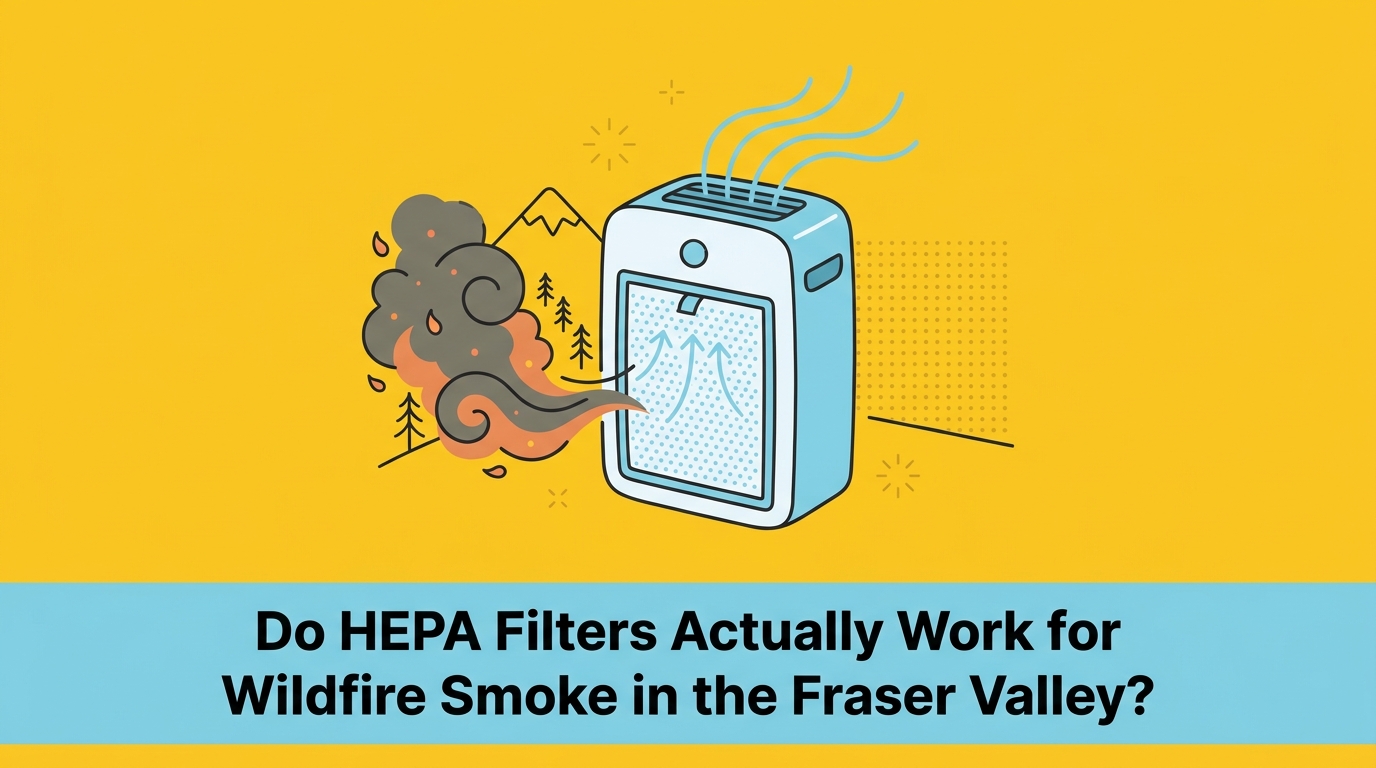
When August Wildfire Smoke Invades Your Home
As the late summer heat arrives and a familiar haze settles over the region, many homeowners ask a critical question: Do HEPA Filters Actually Work for Wildfire Smoke in the Fraser Valley? It is a natural instinct to want the absolute highest level of protection for your family when the air outside smells like a campfire. During the peak of the August wildfire season, the sky often turns an unsettling shade of orange, and the air quality drops to hazardous levels. When you look at the packaging for a True HEPA filter and see that it traps 99.97% of microscopic particles, it seems like the perfect defense against the encroaching ash and soot.
However, there is a significant catch. In our years serving the Fraser Valley, the team at Rep-Air Heating and Cooling typically sees a surge of emergency repair calls on the hottest days of the year, and the culprit is often a highly restrictive filter. Standard residential heating and cooling systems are simply not built to handle the intense airflow restriction created by hospital-grade filtration. The dense, tightly woven material required to capture microscopic smoke particles acts like a physical wall inside your ductwork. You are left with a frustrating dilemma: how do you find the right balance between breathing safe, clean air and keeping your cooling system functioning when you need it most?
If you are looking for professional HVAC services to keep your system running smoothly through the late summer heat, or if you need dedicated indoor air quality solutions tailored to our regional climate challenges, understanding how your equipment interacts with high-efficiency filters is the first step.
The PM2.5 Threat: Understanding What You're Trying to Filter
To understand why homeowners in the Fraser Valley / Mission BC area seek out high-end filtration, you first have to understand the nature of the threat. Wildfire smoke is not just an unpleasant odor; it is a complex mixture of gases and fine particles produced when wood and other organic materials burn. The primary health hazard in this smoke is particulate matter known as PM2.5.
PM2.5 refers to microscopic particles that are 2.5 microns in diameter or smaller. To put that into perspective, a single strand of human hair is about 70 microns across, making PM2.5 roughly 30 times smaller than the width of a hair. Because these particles are so incredibly tiny, they easily bypass the body's natural respiratory defenses. When inhaled, they travel deep into the lungs and can even enter the bloodstream, triggering asthma attacks, respiratory infections, and long-term health issues.
These microscopic invaders also easily infiltrate the standard envelopes of most homes. They seep in around window frames, under doors, and through tiny gaps in your home's exterior. When you realize the severity of the PM2.5 threat, upgrading to a True HEPA filter—which is certified to capture 99.97% of particles as small as 0.3 microns—feels like the most logical and responsible next step.
Why Standard Filters Fail During Smoke Advisories
Most homes are equipped with basic 1-inch fiberglass or low-MERV pleated filters. It is crucial to understand that these standard filters are designed primarily to protect the furnace and blower motor from large debris, not to purify the air for human lungs.
• Large particle focus: Basic filters easily catch dog hair, large dust bunnies, and lint, but microscopic PM2.5 smoke particles pass right through the loose fiberglass weave.
• Rapid clogging: When heavy ash and soot do manage to get caught in a standard 1-inch pleated filter, the material clogs incredibly fast. A filter meant to last three months might become completely packed with soot in just a few days during a severe smoke event.
• Loss of efficiency: Once a basic filter is clogged, it stops capturing particles entirely and simply restricts airflow, rendering it completely ineffective at improving your indoor air quality.
The Mechanical Reality: How HEPA Filters Restrict System Airflow
The problem with putting a HEPA filter into a standard residential furnace or air handler comes down to physics and mechanical design. To understand the risk, we have to look at a concept called external static pressure. This is the amount of resistance the blower motor must overcome to push and pull air through your home's ductwork, vents, and filters.
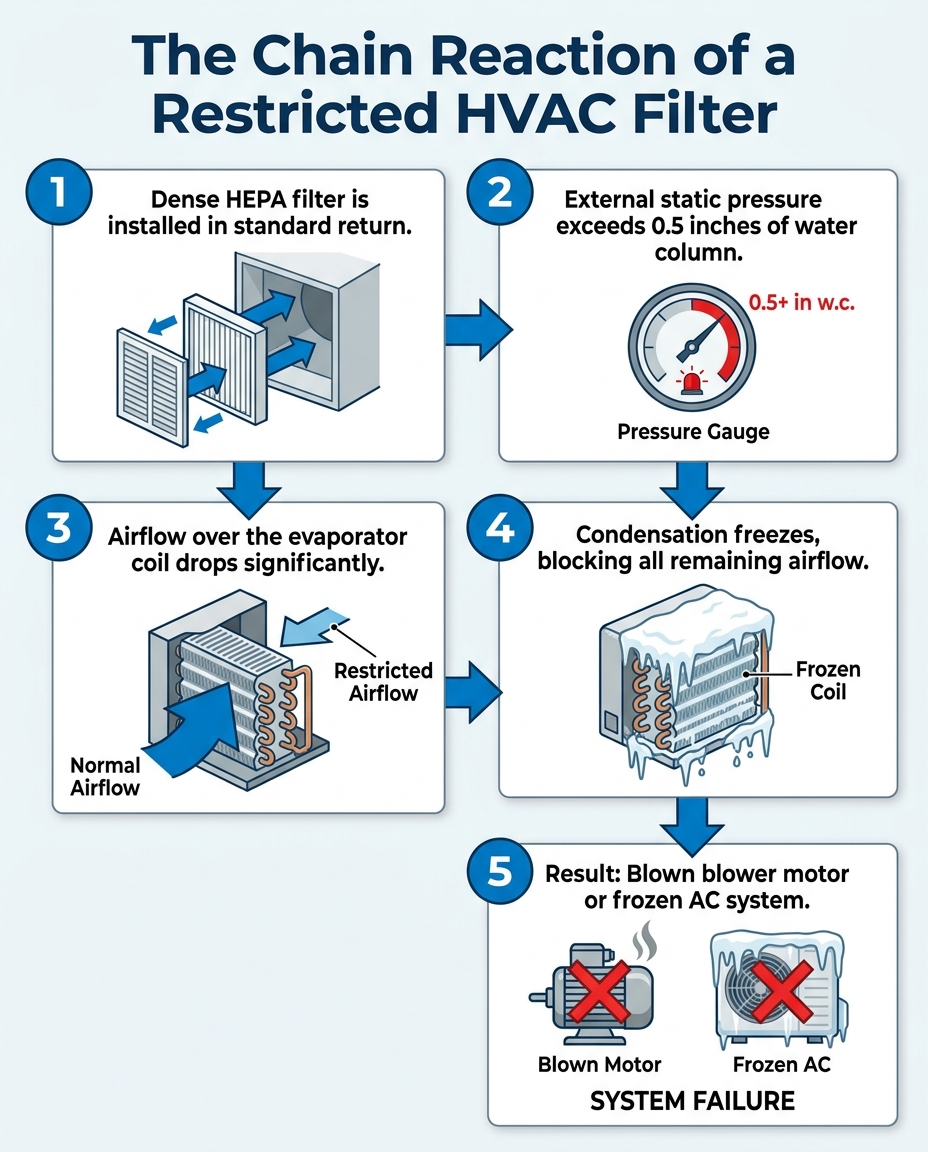
Standard residential HVAC blowers are typically engineered to operate against a maximum external static pressure of 0.5 inches of water column. Every component in your duct system—the bends in the sheet metal, the registers in your floor, and the filter itself—adds resistance. A True HEPA filter is made from incredibly dense, tightly woven glass fibers. While this density is what allows it to trap microscopic smoke particles, it also creates a massive pressure drop that almost always exceeds the 0.5-inch limit of a standard blower motor.
The quick analogy: Think about trying to breathe normally through a thin cotton t-shirt. It is relatively easy, and air moves freely. Now, imagine trying to take a deep breath through a thick, heavy wool blanket. You have to work significantly harder, and you still get far less air. That wool blanket is exactly what a HEPA filter feels like to your HVAC blower motor during the August wildfire season.
The Hidden Cost of High Static Pressure
When your system operates under extreme static pressure, the damage happens quietly but quickly behind the scenes.
• Skyrocketing energy consumption: Modern variable-speed blower motors are designed to ramp up their speed to maintain airflow when they sense resistance. Pushing against a HEPA filter forces the motor to run at maximum capacity constantly, drawing significantly more electricity.
• Premature wear and tear: Operating at maximum strain generates excess heat. This continuous high-strain operation degrades the bearings and electrical components within the motor, drastically shortening its lifespan.
• Reduced comfort: Because the air cannot move freely through the dense filter, the volume of conditioned air reaching the furthest rooms in your house drops dramatically, leaving bedrooms feeling stuffy and warm.
The Danger to Your AC: Frozen Coils and Blown Motors
The airflow restriction caused by overly dense filters goes beyond just stressing the blower motor; it directly threatens the survival of your air conditioning system. This is a critical issue we encounter daily in Mission BC, where late summer heat waves frequently overlap with poor air quality advisories. A pattern our technicians see often is homeowners accidentally suffocating their AC units with overly dense filters. You desperately need filtration because of the smoke, but you also desperately need your AC to function because of the heat.
Your central air conditioner relies on a delicate refrigeration cycle. Warm indoor air is pulled across the indoor evaporator coil, where cold liquid refrigerant absorbs the heat. For this process to work correctly, there must be a consistent, high-volume flow of warm air passing over that coil at all times. When a dense HEPA filter starves the system of air, the temperature of the evaporator coil drops rapidly.
Without enough warm air to absorb the cooling energy, the natural condensation that forms on the coil freezes solid. This creates a dangerous chain reaction. A frozen coil acts as a solid block of ice, stopping all remaining airflow. This can lead to a tripped high-limit switch, a completely burnt-out blower motor, or, worst of all, liquid refrigerant flooding back down the lines to the outdoor compressor, destroying the most critical part of your system. If you find yourself troubleshooting AC blowing warm air during a smoke event, a highly restrictive or severely clogged filter is often the primary culprit.

MERV 13 vs. HEPA: Finding the Right Balance for Residential HVAC
If HEPA filters are too restrictive for standard central air systems, how do you protect your home from wildfire smoke? The answer lies in understanding the MERV scale and finding the manufacturer-approved sweet spot for residential HVAC systems.
MERV stands for Minimum Efficiency Reporting Value. It is a standardized scale from 1 to 16 that rates a filter's ability to capture particles. While HEPA exceeds the MERV scale entirely (acting essentially as a MERV 17+), a MERV 13 filter is widely considered the optimal balance for residential systems during smoke events. MERV 13 filters are highly effective at trapping the dangerous PM2.5 smoke particles, capturing up to 90% of them on each pass, without causing the dangerous pressure drops associated with HEPA media.
As your local Mission BC experts prioritizing both indoor air quality and mechanical longevity, the Rep-Air Heating and Cooling team strongly advises homeowners to check their specific system's maximum MERV rating before upgrading. We recommend MERV 13 media cabinets over standard 1-inch filters because they provide the ideal balance of protection without overworking your blower motor. Not all older systems can handle even a MERV 13 filter without modifications.
Why Thicker Filters Perform Better
One of the most effective ways to use high-MERV filtration safely is to upgrade from a standard 1-inch filter slot to a 4-inch or 5-inch media cabinet.
• Standard 1-inch — Surface Area: Very low — Airflow Resistance: High (clogs quickly) — Replacement Frequency: Every 1-3 months
• Media 4-inch or 5-inch — Surface Area: Extremely high (deep pleats) — Airflow Resistance: Low (air moves freely) — Replacement Frequency: Every 6-12 months
Pleated media cabinets fold the filter material back and forth like an accordion, drastically increasing the total surface area. More surface area means there is more physical room for air to pass through the material. This lowers the static pressure resistance while maintaining high filtration efficiency, keeping your blower motor safe and your air clean.
Standalone Air Purifiers: A Safer Way to Use HEPA Technology
Just because you cannot put a HEPA filter directly into your furnace return does not mean you cannot use HEPA technology in your home. HEPA is highly effective for smoke removal, provided it is paired with a dedicated fan and motor designed specifically for its high resistance.
The safest and most effective strategy for Fraser Valley / Mission BC homeowners is a multi-layered approach. By separating the heavy-duty purification from your central heating and cooling, you get the best of both worlds.
• MERV 13 in the central system: Use a properly sized MERV 13 filter in your furnace or air handler to scrub the air circulating throughout the entire house continuously.
• Standalone HEPA room purifiers: Place portable, dedicated HEPA air purifiers in high-traffic areas, such as the primary bedroom and the main living room. These units have their own powerful fans built to push air through dense HEPA media without affecting your central AC.
• Whole-home HEPA bypass systems: For comprehensive protection, consider a dedicated whole-home HEPA bypass system. These units tie into your existing ductwork but use an independent fan and motor to draw a portion of the air out, scrub it through a true HEPA filter, and return it to the airstream without restricting the main HVAC blower.
Preparing Your HVAC System for Smoke Season
Waiting until the sky turns orange is the worst time to start thinking about your indoor air quality strategy. Being proactive ensures your system is ready to handle the strain of filtering heavy particulate matter while keeping your home cool.
We see the benefits of early preparation every season. During a routine spring check-up before the smoke rolled in, one local homeowner asked about upgrading their filtration. Our technician, Colin, took the time to explain exactly what he was checking, answered all their questions about safely operating the system during poor air quality days, and gave tailored advice on system maintenance. That kind of preparation makes all the difference when August arrives.
Steps to prepare for the smoke:
1. Stock up early: Purchase properly rated MERV 13 filters before the late summer smoke arrives. Local hardware stores frequently sell out the moment an air quality advisory is issued.
2. Monitor the AQHI: Watch the Air Quality Health Index closely. During active smoke advisories, you must change your filters much more frequently—sometimes every few weeks rather than every few months—due to the rapid accumulation of ash.
3. Seal the envelope: Keep windows and exterior doors tightly closed. Ensure your HVAC system thermostat fan is set to the 'ON' position rather than 'AUTO' to continuously circulate and filter the indoor air.
4. Schedule maintenance: Ensure your system is healthy enough to handle the workload by keeping up with a professional HVAC maintenance plan.
The Importance of Professional Static Pressure Testing
Before making any major changes to your filtration setup, a professional inspection is vital. A qualified technician can measure the exact static pressure of your current ductwork and filter combination. This testing removes the guesswork, ensuring that an upgraded filter will not push your system over the edge, preventing frozen coils and unexpected summer breakdowns when you need cooling the most.
Expert Solutions for Local Air Quality Challenges
Navigating poor air quality should never come at the expense of your cooling system's health. The unique environmental challenges of the Fraser Valley / Mission BC region require a thoughtful approach that balances respiratory protection with mechanical reliability.
Consulting with technicians who understand these specific local challenges is invaluable. Whether your home layout requires a simple media cabinet upgrade, a bypass purification system, or strategic standalone units, tailored solutions are available to fit your specific needs. If you live in the surrounding areas, professional HVAC services in Chilliwack and beyond can help you assess your ductwork and recommend the safest path forward for your equipment.
Protect Your Lungs and Your HVAC System This Summer
While True HEPA technology is exceptional at capturing the microscopic PM2.5 particles found in August wildfire smoke, it belongs in dedicated purifiers, not squeezed into standard furnace returns. Forcing a dense filter into an incompatible system is a fast track to a frozen air conditioner and a costly blower motor repair.
Instead, protect your family and your equipment by upgrading to safe MERV 13 media cabinets, utilizing standalone room purifiers, or installing dedicated whole-home purification systems. Now is the time to schedule an indoor air quality assessment to ensure your home is a safe, cool, and breathable sanctuary before the smoke levels peak.
Frequently Asked Questions
Can I put a HEPA filter in my furnace?
No, you should not put a True HEPA filter in a standard residential furnace. The incredibly dense material creates severe airflow restriction that exceeds the design limits of most blower motors, leading to overheating, frozen AC coils, and premature system failure.
Will a HEPA filter restrict airflow?
Yes, a True HEPA filter will severely restrict airflow in a standard HVAC system. Because the fibers are woven tightly enough to catch microscopic particles, the blower motor must work significantly harder to push air through, often resulting in a massive drop in the volume of air reaching your vents.
What is the best filter for wildfire smoke in a home HVAC system?
A MERV 13 filter is generally the best option for a home HVAC system during wildfire smoke events. It is highly effective at capturing the dangerous PM2.5 particles found in smoke without causing the extreme static pressure drops associated with HEPA filters.
Do HEPA filters remove wildfire smoke?
Yes, True HEPA filters are highly effective at removing wildfire smoke particles from the air. However, because of their density, they must be used in dedicated standalone air purifiers or specialized whole-home bypass systems that have their own powerful fans.
How often should I change my filter during BC wildfire season?
During active BC wildfire smoke advisories, you should check your filter every few weeks and change it as soon as it appears dark or clogged. The heavy volume of ash and soot in the air will cause even high-capacity filters to fill up much faster than they would during normal conditions.
What is the difference between MERV 13 and HEPA for smoke removal?
MERV 13 filters capture up to 90% of fine smoke particles and are designed to allow enough airflow to keep standard central HVAC systems running safely. True HEPA filters capture 99.97% of particles but are so dense they require specialized, dedicated fans to push air through them without damaging equipment.
hear what our satisfied clients have to say
Neighbourhoods in the Fraser Valley