How to Do an AC Tune-Up in 6 Simple Steps
Your Quick AC Tune-Up Guide for Fraser Valley Homeowners
This ac tune up guide for fraser valley homeowners covers everything you need to keep your cooling system running strong through the region's hot, smoky summers. Here's a quick overview:
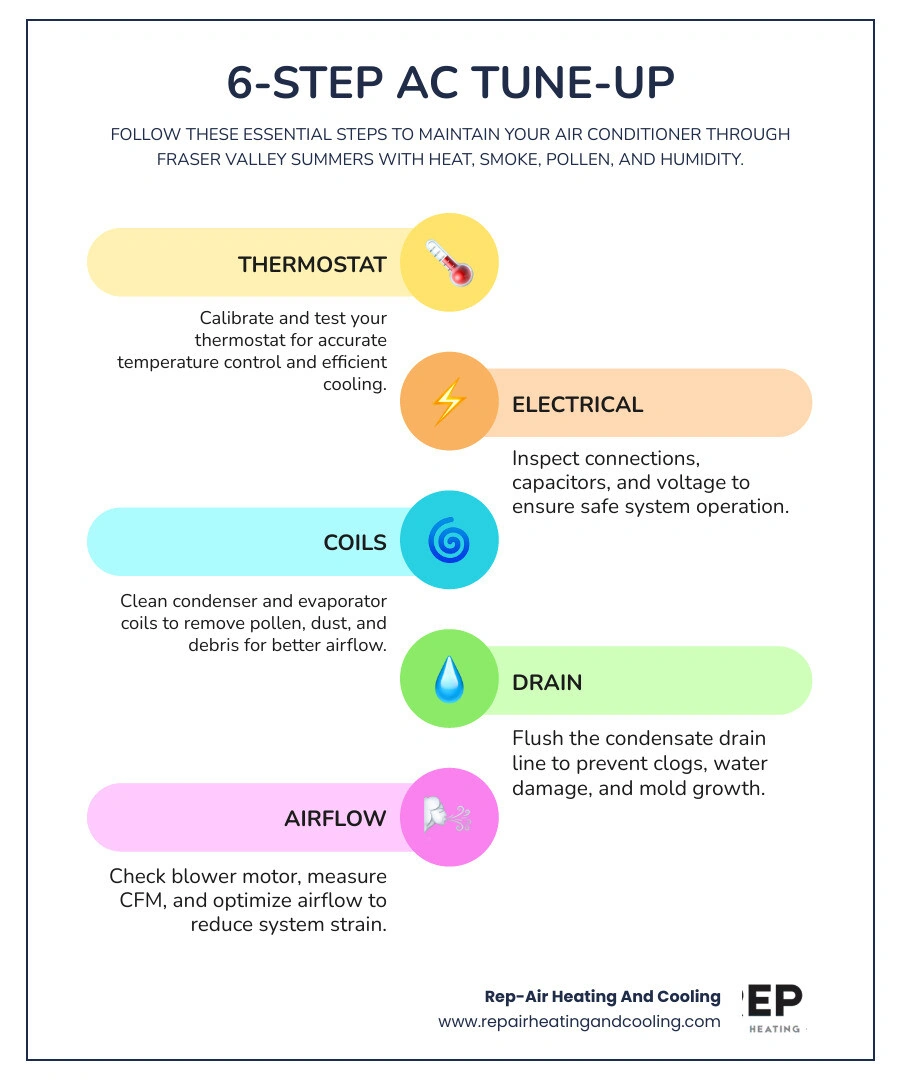
The 6 steps of a Fraser Valley AC tune-up:
1. Thermostat calibration and testing
2. Electrical connection and capacitor inspection
3. Condenser and evaporator coil cleaning
4. Condensate drain line flushing
5. Blower motor and airflow optimization
6. Refrigerant level and pressure verification
Fraser Valley summers are no joke. Temperatures regularly spike past 30°C, wildfire smoke rolls in from the interior, and spring pollen clogs outdoor units faster than most homeowners expect. Add in the region's high humidity and agricultural dust — especially around Abbotsford, BC, Chilliwack, BC, and Langley, BC — and your air conditioner is working harder than a typical urban system in Vancouver, BC.
The problem? Most AC systems sit completely idle from October through May. That's months of weather exposure, dust buildup, and component wear happening quietly while you're not paying attention. Then the first real heat wave hits, and the phone calls start.
A well-maintained air conditioner can last 15 to 20 years. A neglected one rarely gets there — and costs significantly more to run along the way. Regular professional maintenance can deliver up to a 15% improvement in system efficiency, meaning lower hydro bills and fewer emergency repair calls during the hottest weeks of summer.
The good news is that keeping your system in top shape doesn't have to be complicated. With the right checklist and a clear understanding of what Fraser Valley conditions do to your equipment, you can protect your investment and stay comfortable all season long.
Key ac tune up guide for fraser valley homeowners vocabulary:
• how an ac tune up prevents breakdowns during heat domes
• how a tune up improves efficiency and lowers bills
Why You Need an AC Tune-Up Guide for Fraser Valley Homeowners

If you live in the Fraser Valley, your home's air conditioner faces a very different set of environmental challenges than a system in downtown Vancouver, BC. Our unique geography creates a microclimate where coastal dampness meets inland heat, resulting in high humidity, rapid temperature swings, and a high volume of airborne debris.
For starters, we are surrounded by rich agricultural land. While the beautiful fields of Abbotsford, BC, Chilliwack, BC, and Langley, BC are great for local produce, they release an incredible amount of dust, soil, and organic matter into the air. When your outdoor condenser unit pulls in air to release heat from your home, it acts like a giant vacuum cleaner, sucking in this agricultural dust along with spring pollen and cottonwood fluff.
Additionally, late summers in BC have increasingly brought wildfire smoke into the valley. Wildfire smoke carries microscopic ash and soot particles that quickly clog your indoor furnace or air handler filters, forcing your blower motor to work twice as hard to push air through your home. If you want to keep your indoor air clean and healthy during these smoky periods, you must address how these local factors affect your cooling system. To learn more about tackling these specific issues, check out our guide on Air Quality Solutions for Fraser Valley Homes.
Understanding Local Climate Challenges with an AC Tune-Up Guide for Fraser Valley Homeowners
Our local weather patterns put immense physical strain on HVAC equipment. In places like Chilliwack, BC and Abbotsford, BC, winter brings high moisture levels that can accelerate corrosion on outdoor units sitting idle. When spring arrives, sudden temperature swings mean your system might be heating one week and cooling the next.
By the time summer peaks, we often face intense heat waves. Many homeowners remember when BC experienced record-shattering temperatures during recent heat domes, pushing local cooling systems to their absolute limits. An air conditioner that is slightly low on refrigerant or has dirty coils might get by on a mild 22°C June day, but it will suffer a catastrophic breakdown when asked to run continuously during a 35°C+ heat wave. Regular maintenance ensures your system has the cooling capacity to withstand these extreme events. For a deeper look at how preventive care saves your system when the heat peaks, read about How an AC Tune-Up Prevents Breakdowns During Heat Domes.
How Often to Schedule Maintenance Using an AC Tune-Up Guide for Fraser Valley Homeowners
We recommend scheduling a professional AC tune-up once a year, ideally in the spring before the first major heatwave of the season. Booking your service during the spring shoulder season (typically April or May) offers several major advantages.
First, it ensures your system is fully prepared before you need to turn it on for consistent daily cooling. Second, booking early means you avoid the mid-summer rush when HVAC technicians are busy responding to emergency no-cool calls. If a technician discovers a worn-out capacitor or a small refrigerant leak during a spring visit, it can be repaired calmly and quickly before it turns into a hot-weather emergency. Discover how planning ahead keeps more money in your pocket by reading How Early Scheduling Saves You Money on AC Tune-Ups.
The 6-Step Professional AC Tune-Up Checklist
A true, high-quality AC tune-up is far more than a quick visual inspection and a filter change. It is a highly technical, multi-point process that requires specialized tools to measure, clean, and adjust your system for peak performance. To help you understand exactly what goes on during a professional visit, let's break down the six essential steps. For a complete look at what our technicians cover, you can also read our detailed article on What Does Professional AC Service Include?.
Step 1: Thermostat Calibration and Testing
Your thermostat is the brain of your entire heating and cooling system. If it isn't calibrated correctly, your air conditioner may run longer than necessary, short-cycle (turn on and off too quickly), or fail to reach your desired comfort level.
During this step, we test the accuracy of your thermostat by comparing its reading against a highly calibrated digital thermometer. We also verify that the thermostat correctly communicates with your indoor blower and outdoor condenser. If you use a smart or programmable thermostat, we verify its settings and ensure the firmware is updated so you can maximize your monthly energy savings.
Step 2: Electrical Connection and Capacitor Inspection
Air conditioners rely on high-voltage electrical components to power the compressor and fan motors. Over time, the natural vibrations of the system can cause electrical connections to loosen, leading to arcing, burnt wires, or system failure.
We inspect all wiring, tighten electrical connections, and measure voltage and amperage draws on your motors. A key focus of this step is testing the capacitors. Capacitors act like temporary batteries that store energy to help your compressor and fan start up. Weak capacitors are the single most common cause of summer "no-cool" service calls. We measure their microfarad ratings to ensure they are within 6% of the manufacturer's specifications; if they are weak, we replace them before they fail and leave you without cooling.
Step 3: Condenser and Evaporator Coil Cleaning
Your AC doesn't actually "create" cold air; it removes heat from inside your home and dumps it outside. This heat transfer relies entirely on two coils: the indoor evaporator coil and the outdoor condenser coil.
If these coils are coated in a layer of dust, pollen, agricultural grime, or cottonwood seeds, they act as an insulating blanket. This prevents heat from escaping, forcing your compressor to run hotter, work harder, and consume up to 30% more electricity. We carefully clean the outdoor condenser coil using specialized, fins-safe coil cleaners and water pressure to wash away deep-seated dirt. We also inspect the indoor evaporator coil for any dust buildup or mold growth to ensure efficient heat exchange.
Step 4: Condensate Drain Line Flushing
As warm, humid indoor air passes over your cold evaporator coil, moisture condenses on the coil's surface—just like condensation on a cold can of pop. This water drips into a condensate pan and flows out of your home through a small drain line.
Because this environment is dark and damp, algae, mold, and slime can easily grow inside the drain line. In the Fraser Valley, agricultural dust and pet dander can also find their way into the pan, creating a thick clog. If the drain line gets blocked, water will back up and overflow, potentially causing thousands of dollars in water damage to your ceilings, walls, or furnace components. We flush the drain line with specialized clearing agents or use a vacuum to pull out obstructions, ensuring the system drains safely.
Step 5: Blower Motor and Airflow Optimization
To cool your home evenly, your system must move a precise volume of air. A dusty blower wheel or a failing blower motor can reduce indoor airflow by 20% to 30%, leading to hot spots in your home and causing the indoor coil to freeze into a block of ice.
We inspect the blower assembly, measure the motor's amperage draw to ensure it is within 10% of its nameplate rating, and clean the blower wheel if dust has accumulated on the curved blades. We also measure your system's airflow in CFM (Cubic Feet per Minute) to ensure it matches the exact requirements of your home's ductwork.
Step 6: Refrigerant Level and Pressure Verification
Refrigerant is the specialized fluid that carries heat out of your home. Your air conditioner is a closed loop, meaning it should never "consume" or run out of refrigerant. If the refrigerant level is low, it means there is a leak in the system.
Running an AC with incorrect refrigerant levels causes the compressor to overheat, drastically reduces cooling capacity, and can destroy the compressor entirely. We use digital manifold gauges to measure the system's operating pressures, calculating "superheat" and "subcooling" to verify that the charge is exactly where the manufacturer intended. If a leak is detected, we locate and repair it in compliance with British Columbia's strict environmental regulations.
DIY Maintenance vs. Professional HVAC Service
While there are several important maintenance tasks that homeowners can—and should—perform themselves, a complete AC tune-up requires professional diagnostic tools, safety training, and licensing. The table below outlines what you can safely handle on your own versus what must be left to our certified experts.
• Air Filter Replacement — DIY (Homeowner): Yes — Professional Technician: Yes — Why It Matters: Keeps airflow strong and protects indoor air quality.
• Clearing Outdoor Debris — DIY (Homeowner): Yes — Professional Technician: Yes — Why It Matters: Maintains a 2-foot clearance for proper condenser airflow.
• Visual Inspections — DIY (Homeowner): Yes — Professional Technician: Yes — Why It Matters: Catches obvious issues like pooling water or damaged insulation.
• Electrical Testing & Amperage — DIY (Homeowner): No — Professional Technician: Yes — Why It Matters: High-voltage testing requires specialized meters and safety training.
• Refrigerant Level Testing — DIY (Homeowner): No — Professional Technician: Yes — Why It Matters: Regulated work in BC; requires specialized environmental certification.
• Coil Chemical Cleaning — DIY (Homeowner): No — Professional Technician: Yes — Why It Matters: Improper cleaning can permanently damage delicate aluminum fins.
• Deep Drain Line Clearing — DIY (Homeowner): No — Professional Technician: Yes — Why It Matters: Prevents mold growth and catastrophic indoor water damage.
If you want to ensure your system gets the complete professional care it needs, especially if you live in Maple Ridge, BC, Pitt Meadows, BC, or Mission, BC, explore our specialized AC Tune-Up Maple Ridge, BC services.
Safe Homeowner Maintenance Tasks
As a homeowner, the single most important task you can perform is regularly changing your air filter. During the peak summer cooling season, check your filter once a month. If you have pets, live near active farming fields, or if we are experiencing a wildfire smoke event, you may need to replace it every 30 to 60 days. A clogged filter chokes your system's airflow, driving up your energy bills and putting unnecessary strain on the blower motor.
Additionally, keep an eye on your outdoor condenser unit. Ensure there is at least a two-foot clear perimeter around the unit. Trim back any encroaching bushes, weeds, or long grass, and clear away any fallen leaves or twigs. Keeping this area clear ensures the fan can easily exhaust heat away from your home.
Why Professional Calibration Matters
While vacuuming your outdoor unit or changing a filter is great, it cannot replace professional calibration. Modern air conditioning systems are highly sensitive machines. A system that is undercharged by even 10% can suffer a 20% drop in operating efficiency, quietly costing you money month after month.
Furthermore, handling refrigerants is highly regulated in British Columbia. Only licensed, certified technicians are legally permitted to connect gauges to refrigerant lines, test for leaks, or add refrigerant to a system. Attempting to do this yourself can void your manufacturer's parts warranty and risk damaging your compressor. Regular professional servicing is often a strict requirement to keep your system's warranty valid. To learn more about how professional care protects your long-term investment, check out our guide on how to Extend the Life of Your AC with Maintenance.
Frequently Asked Questions about Fraser Valley Cooling Maintenance
To help you get the most out of your home's cooling system, we have compiled answers to some of the most common questions we hear from homeowners across the Lower Mainland.
What are the signs that my air conditioner needs an immediate tune-up?
If your system is struggling, it will usually give you a few warning signs before it shuts down completely. Keep an ear and an eye out for:
• Weak Airflow: If the air coming out of your registers feels like a gentle whisper rather than a steady breeze, you may have a clogged filter, a dusty blower wheel, or ductwork issues.
• Warm Air: If the system is running but the air blowing from your vents isn't cold, you could be dealing with a failed capacitor, a dirty condenser coil, or a refrigerant leak.
• Unusual Noises: Squealing, grinding, rattling, or banging sounds indicate that a belt, motor bearing, or fan blade is worn out or loose.
• Short Cycling: If your AC turns on and off every few minutes without ever cooling your home to the set temperature, it is short-cycling. This puts extreme wear on your compressor and should be addressed immediately.
Will a professional tune-up lower my monthly energy bills?
Yes, absolutely! When your air conditioner's coils are clean, its electrical connections are tight, and its refrigerant charge is precisely calibrated, it doesn't have to work as hard to cool your home.
A well-tuned system runs shorter, more efficient cycles to achieve the same indoor comfort. Regular maintenance can restore lost efficiency, often lowering your monthly cooling costs by 15% to 30%. Over the course of a hot Fraser Valley summer, those savings quickly add up.
Is an annual maintenance plan worth the investment?
For the vast majority of homeowners in the Fraser Valley, a comprehensive maintenance plan is highly beneficial. These plans take the guesswork out of caring for your home's comfort systems by automatically scheduling your spring AC tune-up and your fall heating service.
Beyond the peace of mind that comes with regular maintenance, plan members typically enjoy priority scheduling during peak seasons, discounts on any repairs, and documented service history that keeps manufacturer warranties fully compliant. To see if a plan is right for your home, check out our detailed analysis: Is an AC Maintenance Plan Worth It?.
Conclusion
Your air conditioning system is one of the most significant investments you will make in your home's comfort and value. Taking care of it shouldn't be an afterthought. By following this ac tune up guide for fraser valley homeowners and scheduling regular professional maintenance, you can enjoy reliable, whisper-quiet cooling, cleaner indoor air, and lower monthly utility bills all summer long.
At Rep-Air Heating And Cooling, we treat our customers like family. Our experienced technicians are dedicated to keeping your home comfortable, safe, and efficient, no matter how hot the Fraser Valley summers get.
Don't wait for the next major heatwave to find out if your air conditioner is up to the task. Schedule your professional cooling service today and experience the peace of mind that comes with expert, friendly care.
hear what our satisfied clients have to say
Neighbourhoods in the Fraser Valley