Why We Recommend Two-Stage Furnaces for Two-Story Homes in the Fraser Valley
The Myth of the 'Bigger' Furnace for Uneven Temperatures
Many homeowners believe that if the main floor is freezing while the upstairs bedrooms are sweltering, the solution is simply to install a bigger, more powerful heating system. But throwing sheer heating power at an uneven temperature problem usually makes the imbalance much worse. If you are wondering why we recommend two-stage furnaces for two-story homes in the Fraser Valley, the answer starts with debunking the myth of raw capacity. When you upgrade to a larger unit without changing the type of technology inside it, you are just pushing the same blast of hot air into the house at a faster rate.
The classic two-story home dilemma is incredibly common during the winter months. You turn up the thermostat because you are shivering in the living room, only to realize that the second-floor bedrooms have turned into saunas. It is a frustrating cycle that leaves half the family uncomfortable at any given time. The instinct is to assume the current equipment is too weak to push air upstairs, or too weak to heat the downstairs properly. However, the root cause is rarely a lack of power. Instead, the issue lies in how long the air actually circulates through the house.
The real solution: Airflow duration, rather than raw heating power, is the true mechanical fix for uneven temperatures. A system that runs longer at a lower speed has the time needed to mix the air completely, preventing hot and cold spots from settling. If you are tired of wearing a heavy sweater on the ground floor while opening windows on the second floor, exploring professional furnace installation and heating solutions designed specifically for multi-level homes is the first step toward whole-house comfort.
The Physics of Thermal Stratification in Multi-Level Homes
To understand why your two-story home is so difficult to heat evenly, you have to look at a basic principle of physics: thermal stratification. This is the natural scientific process where warm air rises and cold air sinks. Because warm air is less dense than cold air, it will always seek the highest point in an enclosed space. In a single-story rancher, this rising heat hits the ceiling and eventually mixes back down. But in a multi-level layout, the architecture actually works against you.
The Problem: Open staircases, vaulted ceilings, and large entryways act like giant indoor chimneys. The moment your heating system pushes warm air into the rooms, that heat immediately begins looking for a way up. It bypasses the main floor living areas, funnels directly up the staircase, and pools near the ceilings of your second-story bedrooms.
The Cause: While the warm air escapes upstairs, stagnant, heavy cold air is displaced and sinks to the lowest level. If the air in your home is not actively and continuously circulating, these cold pockets settle on the ground floor. The thermostat, which is usually located on the main floor, registers this cold air and tells the system to keep running. By the time the main floor finally reaches the target temperature, the upstairs is drastically overheated.
The Solution: Standard heating systems are rarely designed to combat this specific architectural challenge out of the box. Overcoming thermal stratification in a Fraser Valley home requires a system that actively fights the natural separation of hot and cold air. You need equipment that continuously stirs the indoor environment, blending the rising heat with the sinking cold until the entire house reaches a unified, comfortable temperature.
Why Standard Single-Stage Systems Struggle with Two-Story Layouts
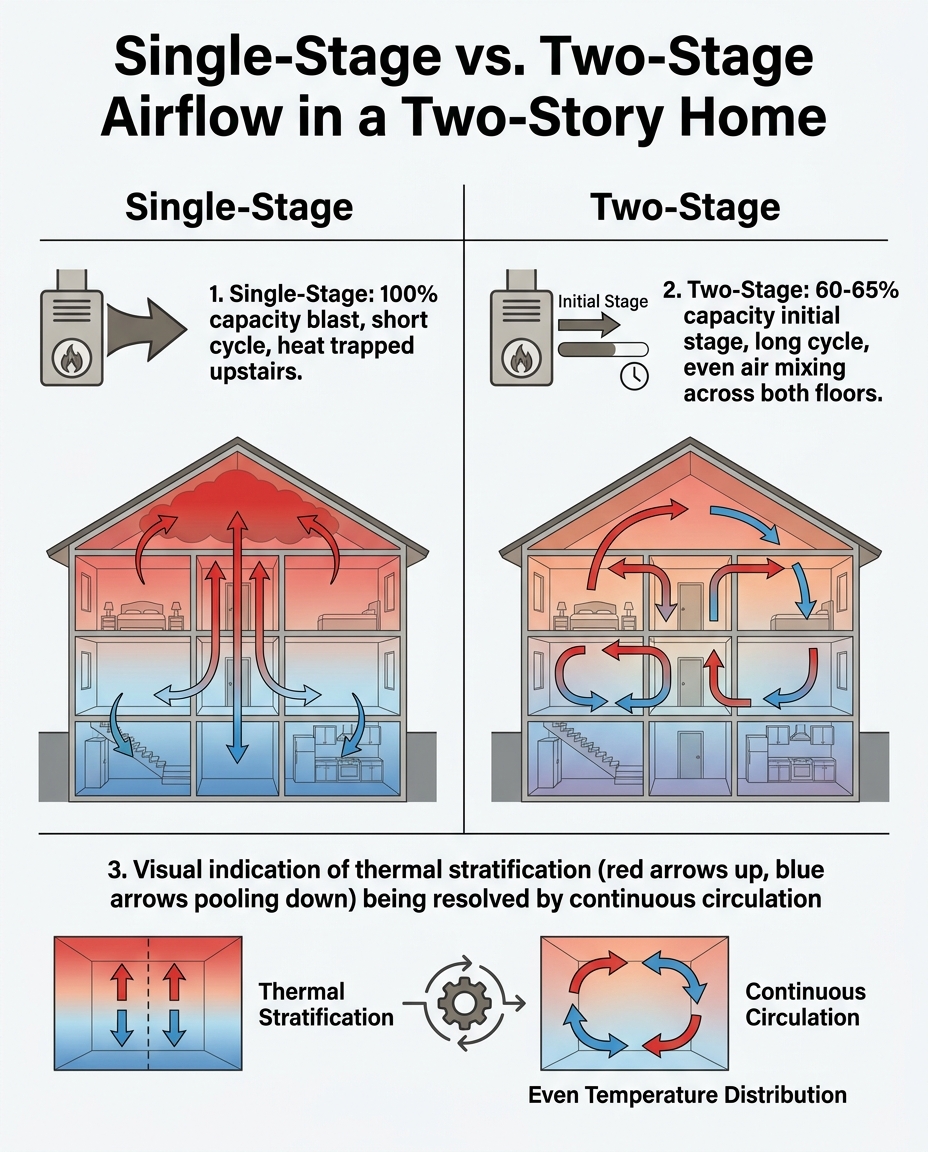
Most older homes were built with standard single-stage heating systems. A single-stage unit has exactly one speed: 100 percent ON, or completely OFF. There is no middle ground. When the thermostat calls for heat during the winter, the burners fire up at maximum capacity, and the blower motor pushes an aggressive blast of hot air through the ductwork.
This all-or-nothing approach is exactly why single-stage equipment struggles with two-story layouts. Because the unit is running at maximum capacity, it pumps a massive amount of heat into the home very quickly. The thermostat on the main floor senses this rapid influx of warm air and shuts the system down shortly after it turns on. This aggressive blast satisfies the thermostat quickly, but it completely fails to mix the air throughout the rest of the house.
This rapid on-and-off process is known as short-cycling. When a system short-cycles, it shuts down before the conditioned air can properly circulate. The hot air that was just produced immediately rises to the second floor, while the downstairs is left to chill the moment the blower motor stops. Because the cycle was so brief, the heavy, cold air resting near the floorboards was never pulled into the return vents to be reheated. Grasping this mechanical limitation is easier when understanding your furnace's sequence of operations, as it highlights exactly why a system that turns off too quickly leaves you uncomfortable.
The Mechanics of Air Mixing: How Two-Stage Furnaces Work
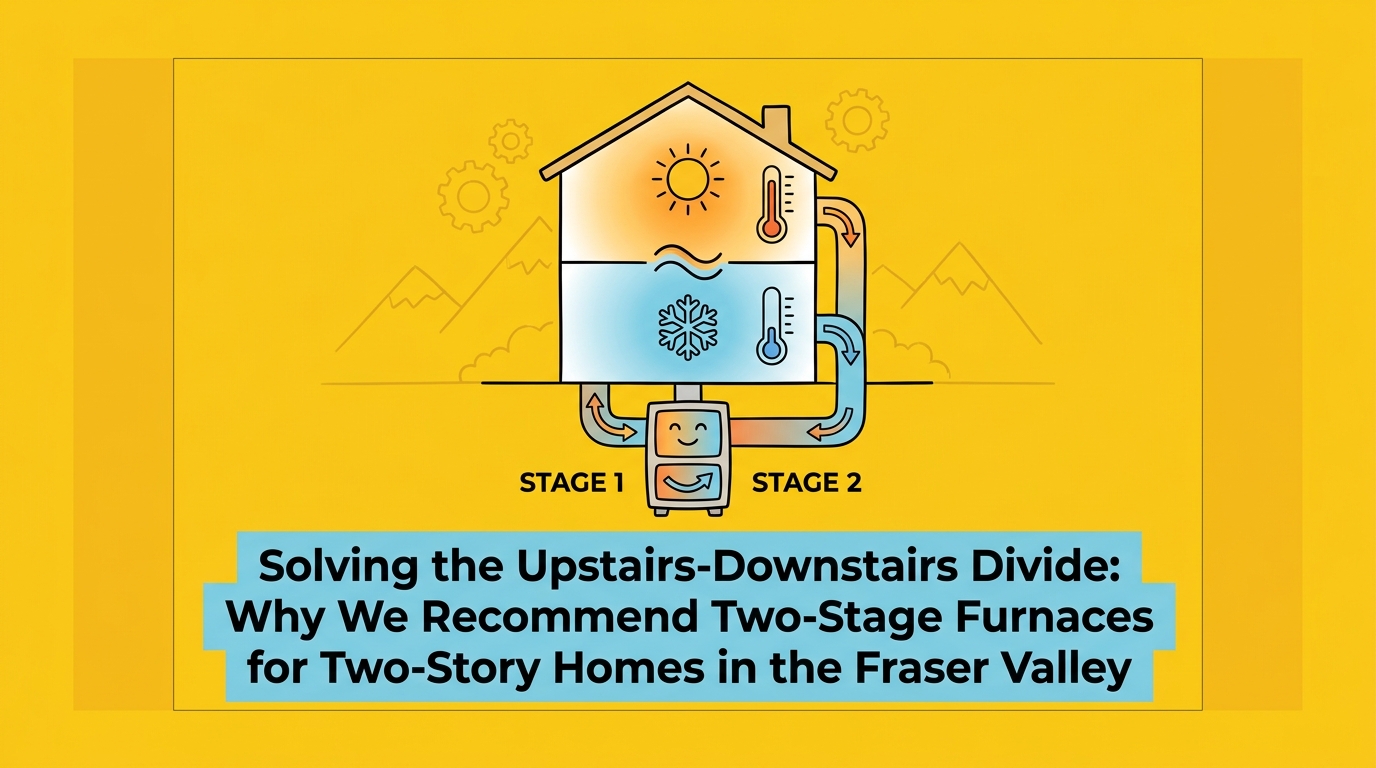
The mechanical solution to the upstairs-downstairs divide is a two-stage furnace. Unlike a standard system that only operates at full blast, a two-stage unit is equipped with a gas valve and a blower motor that can operate at two distinct levels: a low setting and a high setting. This dual-capacity design completely changes how air is distributed throughout your home during the winter.
By running on a lower speed for a longer duration, the system provides continuous air mixing across all floors. This constant circulation prevents warm air from pooling upstairs and actively pushes conditioned air evenly downstairs. Here is exactly how the two stages work together to solve uneven temperatures:
1. The thermostat detects a slight temperature drop: Instead of firing at full capacity, the system turns on in the first, lower stage.
2. Gentle airflow begins: The blower motor pushes air at a reduced speed, allowing for quiet, continuous circulation.
3. Air is actively blended: Because the cycle lasts longer, the cold air on the main floor is pulled into the return ducts, heated, and redistributed, breaking up thermal stratification.
4. The high stage waits on standby: The system only kicks into maximum gear if the outdoor temperature plummets or if you manually increase the thermostat setting by several degrees at once.
Stage One: The Sustained Comfort Cycle
The vast majority of the time, a two-stage system operates in stage one. This low setting usually runs at roughly 60 to 65 percent of the unit's total capacity. Because it is producing less heat at a slower pace, the cycle runs much longer than a single-stage blast. This sustained comfort cycle thoroughly filters and mixes the indoor air. It completely eliminates the noticeable, noisy "blast" of hot air coming from the vents, replacing it with a gentle, continuous breeze that keeps temperatures perfectly balanced between the upper and lower floors.
Stage Two: The High-Demand Response
Stage two is the system's reserve power. It operates at 100 percent capacity, just like a single-stage unit, but it only activates automatically during severe cold snaps or when recovering from a deep temperature setback (like turning the heat up when you return from vacation). This ensures the home never falls behind on heating demands during extreme weather, giving you the best of both worlds: gentle mixing for everyday comfort, and robust power when the outdoor temperature drops significantly.
Comparing Single-Stage vs. Two-Stage Performance
When you are weighing your options for a replacement, looking at a direct comparison helps clarify exactly what you are paying for. For homeowners in the Fraser Valley dealing with multi-level layouts, the performance differences are stark. The table below outlines how the two technologies handle the daily demands of heating a two-story home.
• Temperature Consistency — Standard Single-Stage System: Poor in multi-level homes; creates distinct hot and cold zones. — Two-Stage System: Excellent; continuous mixing keeps both floors within a degree of each other.
• Cycle Length — Standard Single-Stage System: Short, aggressive cycles (often 10-15 minutes). — Two-Stage System: Longer, sustained cycles (often 20-30+ minutes on low stage).
• Operating Noise — Standard Single-Stage System: Loud; kicks on with a noticeable rush of air. — Two-Stage System: Very quiet; low stage operates with a gentle, barely audible breeze.
• Component Wear-and-Tear — Standard Single-Stage System: High; frequent starting and stopping stresses the motor and igniter. — Two-Stage System: Low; fewer on/off cycles reduce mechanical stress over time.
• Energy Efficiency — Standard Single-Stage System: Lower; consumes maximum fuel every time it turns on. — Two-Stage System: Higher; low stage uses significantly less gas and electricity.
Ultimately, the two-stage model is the definitive choice for multi-level layouts because it addresses the mechanical root of the problem: air stagnation. By keeping the air moving, it physically prevents the heat from abandoning the main floor.

Combating the Damp and Chilly Regional Climate
The architectural challenges of a two-story home are heavily amplified by our specific regional weather. Winter in the Fraser Valley brings a very specific kind of cold. It is not just about the temperature dropping; it is about the damp, bone-chilling nature of the local climate that makes temperature imbalances feel significantly more severe. Moisture in the air makes the "freezing downstairs" problem feel much colder than the thermostat actually indicates.
When the indoor air holds onto that dampness, aggressive, intermittent blasts of heat from a single-stage unit are not enough to maintain comfort. Damp air requires steady, consistent heat to properly dry out and warm up. A short cycle simply does not run long enough to pull that ambient moisture out of the air or warm the physical materials (like floors and furniture) on the lower level of your home.
This is why local homes, particularly split-levels and traditional two-stories, benefit immensely from tailored Chilliwack heating services and regional expertise. A two-stage system running on its low setting provides the steady drying and heating effect required to combat damp winters. By keeping a gentle flow of warm air moving, it slowly neutralizes the damp chill that settles into the ground floor, making the entire house feel noticeably warmer and more inviting.
Architectural Matching: Fitting the Equipment to Your Home's Layout
One of the biggest mistakes made during equipment replacement is relying entirely on square footage to choose a unit. While the size of your home matters, the layout of the house dictates the necessary equipment. A 2,000-square-foot single-story rancher and a 2,000-square-foot two-story home require entirely different approaches to air distribution.
Our architectural matching approach ensures that we do not just sell "bigger" boxes based on a simplistic square-footage formula. Instead, we engineer solutions that actually push air evenly across multiple floors. This involves a comprehensive process of evaluating your home's ductwork, checking the insulation levels, and mapping out the multi-level design before ever recommending a specific unit. If your ductwork is undersized, throwing a massive single-stage unit at it will only create noise and static pressure issues, not comfort.
We are committed to thorough service, ensuring the installation genuinely solves your specific comfort complaints from the initial quote to the final walkthrough. For example, one local homeowner reached out to us this past spring when their furnace required service, frustrated by years of uneven temperatures. Our service person thoroughly assessed the entire system—looking past just the equipment box to examine the ductwork and the layout of the home—and addressed the root issue with a tailored solution. That is the difference between simply replacing a part and actually matching the mechanics to the architecture of the Fraser Valley home.
Long-Term Efficiency and Indoor Air Quality Benefits
While solving the upstairs-downstairs divide is the primary goal, upgrading to a dual-capacity system brings several secondary benefits that improve your daily life. Because these units run for longer periods at lower speeds, they push air through your system's filtration media much more frequently. Air can only be cleaned when it is moving through the filter. By increasing the circulation time, you significantly improve your indoor air quality, capturing more dust, pet dander, and winter allergens.
Furthermore, running on a lower stage consumes less fuel and electricity. It takes a massive surge of energy to ignite and blast a furnace at 100 percent capacity. By gently maintaining the temperature on the 60 percent stage, the system reduces overall winter energy waste and lowers the wear-and-tear on critical internal components.
Because these systems are highly efficient, upgrading to a high-efficiency two-stage model may qualify homeowners for various general energy incentives and provincial HVAC rebates. While program availability changes frequently, investing in advanced, energy-saving technology often opens the door to financial returns. We always advise checking current eligibility with local utility providers to see how much you could save on your upgrade.
Find the Right Heating Solution for Your Two-Story Home
You do not have to spend another winter living with a freezing downstairs and a sweltering upstairs. The discomfort you are feeling is not a requirement of owning a multi-level home; it is simply a mechanical limitation of your current equipment. A properly sized two-stage furnace is the mechanical key to balanced comfort, providing the continuous, gentle air mixing needed to eliminate thermal stratification once and for all.
If you are ready to fix the temperature divide in your Fraser Valley home, we are here to help. Reach out to explore our comprehensive HVAC services. Our team will evaluate your layout, assess your ductwork, and help you find a heating system matched perfectly to your home's unique architecture.
Frequently Asked Questions
Is a 2-stage furnace worth it for a 2-story house?
Yes, a two-stage furnace is highly recommended for a two-story house. Because it runs at a lower speed for longer periods, it continuously mixes the air across both floors. This prevents the natural tendency for heat to rise and get trapped upstairs, effectively solving the classic hot upstairs/cold downstairs problem.
How do you heat a two-story house evenly?
Heating a two-story house evenly requires continuous air circulation to combat thermal stratification. Upgrading to a two-stage or modulating furnace is the most effective mechanical solution. Additionally, ensuring your ductwork is properly sized and leaving interior doors open can help balance the airflow between levels.
Does a 2-stage furnace run all the time?
No, a two-stage furnace does not run constantly, but it does run for longer, gentler cycles than a standard unit. It operates at a lower capacity (usually around 60%) for extended periods to maintain a consistent temperature. It will still cycle off once the home's target temperature is perfectly balanced.
What is the best HVAC system for a 2-story house?
The best system for a multi-level layout is one that features variable-speed or two-stage technology. These systems excel at pushing conditioned air evenly throughout complex architectures. By avoiding the aggressive on/off cycling of single-stage units, they provide the sustained airflow necessary for whole-house comfort.
Why is my upstairs so hot and downstairs so cold in the winter?
This happens because warm air naturally rises and cold air sinks, a process called thermal stratification. In a two-story home, the heat from your vents quickly travels up the staircase to the second floor. If your furnace shuts off too quickly, it fails to mix the air, leaving the heavy, cold air trapped on the ground level.
Will a larger single-stage furnace fix my uneven heating?
No, installing a larger single-stage furnace will likely make the problem worse. A larger unit will blast hot air even faster, causing the thermostat to shut the system down even sooner. This extreme short-cycling leaves no time for the air to circulate, resulting in an even colder downstairs and a more stifling upstairs.
hear what our satisfied clients have to say
Neighbourhoods in the Fraser Valley