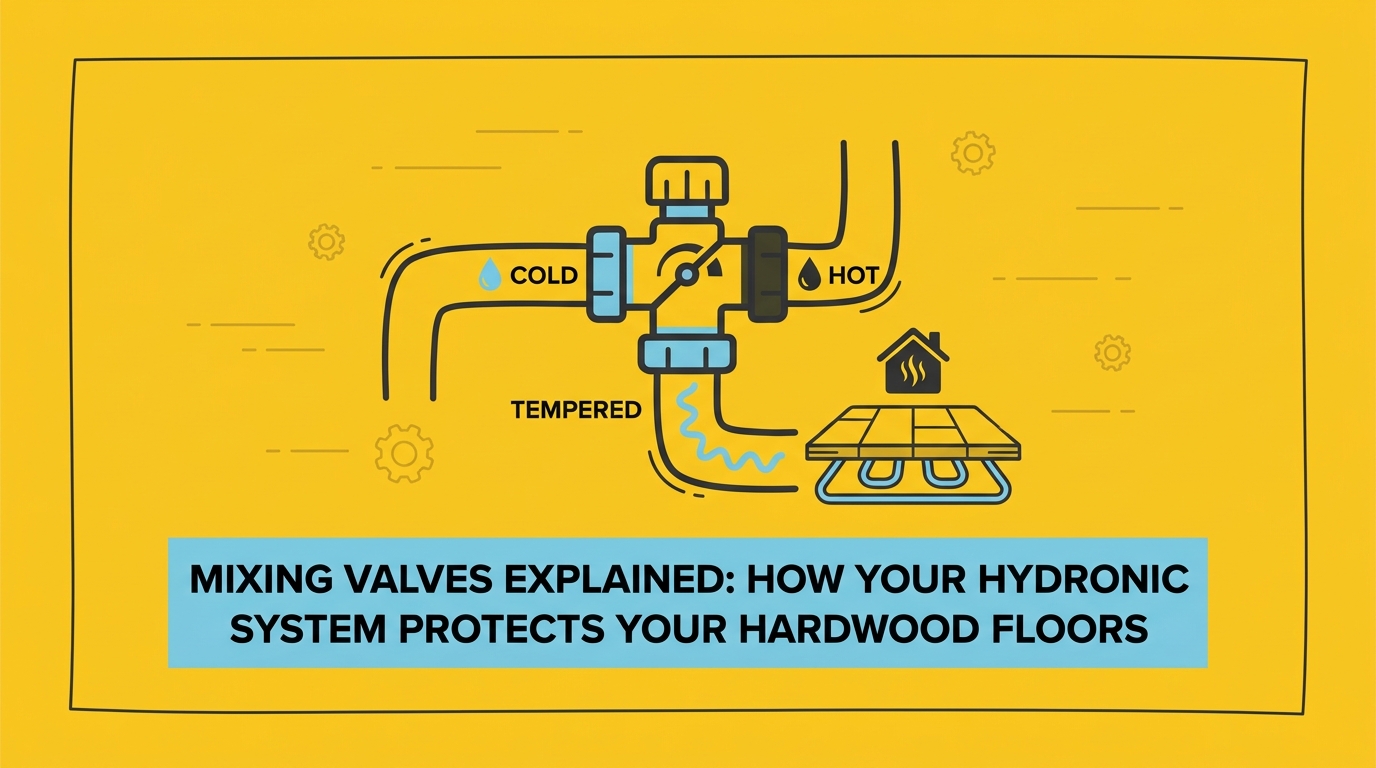
Mixing Valves Explained: How Your Hydronic System Protects Your Hardwood Floors
The Hidden Threat to Hardwood Floors Under Your Feet
You love the luxurious, even warmth of radiant heating, but without having Mixing Valves Explained: How Your Hydronic System Protects Your Hardwood Floors, you might be risking severe damage to your home's most beautiful asset. Radiant floor heating provides unmatched comfort by turning your entire floor into a gentle radiator. However, our team at Rep-Air Heating and Cooling frequently sees that this brilliant heating method introduces a hidden risk to custom hardwood flooring if water temperatures are not strictly and continuously controlled.
To keep your home safe and comfortable, we always remind our Mission BC customers that you need reliable heating systems and professional boiler services.
Boilers naturally produce water at temperatures that would instantly damage wood fibers, adhesives, and delicate finishes. The core issue lies in the fundamental incompatibility between the heat required to warm a house and the heat tolerance of natural wood. Wood is an organic, hygroscopic material, meaning it constantly interacts with the moisture and temperature of its environment. When exposed to excessive heat from below, it loses its internal moisture too rapidly, leading to permanent structural changes.
The hydronic mixing valve is the single, crucial component standing between your powerful mechanical heating equipment and your ruined flooring. This valve acts as a mandatory thermal shield. Understanding how this valve operates is essential for protecting your investment before the first signs of physical damage appear on your floors.
Industry standards strictly dictate a 120 degrees maximum safe temperature for the water flowing through the radiant loops beneath wood floors. If the water exceeds this limit, the surface temperature of the floor will climb beyond safe thresholds, baking the wood from the bottom up. Recognizing the hidden threat of untempered boiler water is the first step in ensuring your hydronic system delivers comfort without compromise.
The Three-Tier Temperature Differential in Hydronic Systems
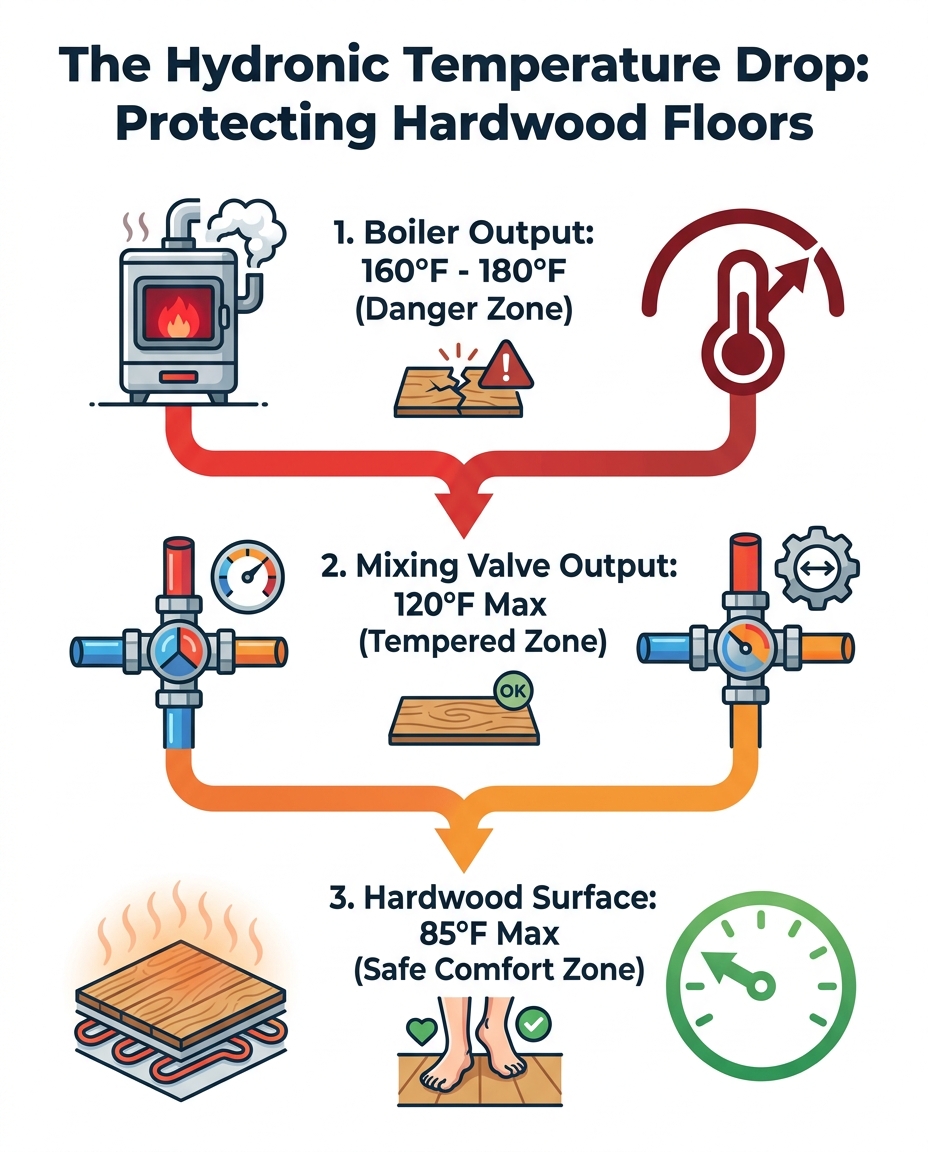
The core challenge of heating a home with a boiler while protecting hardwood floors is managing the massive difference between the heat source and the final destination. Boilers are designed to generate high-heat water, typically ranging from 160 to 180 degrees Fahrenheit. This extreme temperature is necessary for efficient energy transfer, especially when the boiler is also supplying heat to traditional baseboard radiators or indirect domestic water heaters.
However, the National Wood Flooring Association (NWFA) guidelines dictate that hardwood floor surface temperatures should never exceed 85 degrees Fahrenheit. Exposing wood to surface temperatures above 85 degrees rapidly accelerates moisture loss, breaking down the cellular structure of the planks.
To achieve a safe 85-degree surface temperature, the water flowing through the subfloor radiant loops must be capped at a much lower threshold. This is where the 120 degrees maximum safe temperature rule for radiant loop water comes into play. The system relies on a precise mechanical intervention to bridge this massive temperature gap safely.
• Boiler Output — Operating Temperature: 160°F - 180°F — Primary Function & Risk: Generates raw heat. Dangerously hot for direct contact with flooring materials.
• Mixing Valve Output (Radiant Loops) — Operating Temperature: 120°F Maximum — Primary Function & Risk: Tempered water circulates under the floor. The absolute limit to prevent subfloor baking.
• Hardwood Surface — Operating Temperature: 85°F Maximum — Primary Function & Risk: The final ambient heat transferred to the room. The safe comfort zone for wood preservation.
The mechanical intervention required to manage these three distinct temperature tiers is not a luxury; it is a structural necessity. If the boiler's raw output were allowed to flow directly into the floor loops, the resulting thermal shock would destroy the flooring installation in a matter of days. The system must actively and continuously step down the heat, bleeding off the excess energy before it ever reaches the delicate wood above.

What Does a Hydronic Mixing Valve Do?
A mixing valve, frequently referred to as a tempering valve, is the mechanical brain of your floor's temperature control system. Its primary job is to blend the scalding 180-degree supply water coming directly from the boiler with the cooler return water that has already circulated through the radiant loops. By mixing these two streams, the valve creates a perfectly tempered output.
This blending process ensures the water entering the under-floor tubing never exceeds the critical safety threshold of a 120 degrees maximum safe temperature. The operation is entirely dynamic. As the temperature of the return water fluctuates based on how much heat the room has absorbed, the valve adjusts the ratio of hot boiler water to cool return water.
There are two main types of valves used in modern residential hydronic systems: thermostatic mixing valves and motorized mixing valves.
• Thermostatic valves: These utilize a temperature-sensitive wax element inside the brass housing. As the water temperature changes, the wax expands or contracts, physically moving an internal piston to allow more or less hot water into the mix.
• Motorized valves: These rely on electronic sensors and a small actuator motor. A central control panel reads the exact temperature of the water and commands the motor to open or close the valve in microscopic increments.
Regardless of the specific technology used, both types of valves continuously modulate based on real-time temperature readings to maintain exact output. This automated tempering acts as a mechanical insurance policy, guaranteeing that only safe, controlled, and perfectly blended heat reaches the wood above. Without this constant background operation, the entire hydronic setup becomes a liability rather than a luxury.
The Physics of Hardwood Damage: Cupping, Warping, and Splitting
Wood is a highly reactive material. Even after it has been harvested, milled, kiln-dried, and finished with premium sealers, it remains hygroscopic. It continuously absorbs and releases moisture in response to its surrounding environment. Because of this natural characteristic, wood reacts violently to rapid temperature swings and excessive heat baking out its natural moisture.
When a mixing valve fails, sticks open, or loses its calibration, it sends untempered boiler water directly into the radiant loops. The floor is suddenly subjected to extreme thermal stress. The heat radiates upward, drastically raising the temperature of the subfloor and the bottom of the hardwood planks. This triggers a destructive physical reaction.
Cupping is the most common and immediate symptom of radiant heat damage. Cupping occurs when the bottom of the wood board dries out and shrinks much faster than the top surface. Because the bottom is losing mass while the top remains relatively stable, the edges of the board curl upward, creating a wavy, washboard effect across your floor. Walking across a cupped floor feels uneven, and the visual distortion is highly noticeable in natural light.
If the extreme heat persists, the damage progresses to gapping and splitting. As the wood is completely drained of its bound moisture, the planks shrink laterally, pulling away from each other and leaving wide gaps between the boards. The internal stress can become so severe that the wood fibers literally tear apart, resulting in deep splits down the center of the planks. Once wood has been pushed to the point of splitting or severe cupping from a 120 degrees maximum safe temperature violation, it cannot simply be sanded down and refinished. The structural integrity is gone, often requiring complete, costly replacement of the custom installation.
How Winter Weather Accelerates Mixing Valve Wear
Radiant systems operate very differently from traditional forced-air furnaces. They do not simply turn on, blast hot air for ten minutes, and turn off. Instead, hydronic floors modulate continuously, providing a slow, steady, and constant infusion of thermal energy to maintain indoor comfort. This continuous operation is what makes radiant heat feel so luxurious, but it also puts significant mileage on mechanical components.
During the peak winter heating season, the local climate plays a major role in system wear. In our years of servicing hydronic and radiant floor heating systems across the Fraser Valley and Mission BC, our technicians have seen firsthand how the cold, damp winters force these systems to run continuously for months on end. The boiler fires constantly to combat the near-freezing outdoor temperatures and high humidity.
Because the system is under maximum load, the mixing valve is forced to make thousands of microscopic adjustments daily. Every time the boiler cycles or a zone thermostat calls for heat, the valve's internal thermostatic element must expand and contract to blend the water perfectly. This continuous mechanical workload significantly increases the risk of scale buildup from hard water minerals or general component fatigue inside the brass housing.
Our team always emphasizes that proper seasonal preparation is essential to ensure the valve's internal thermostat responds accurately when the system is under maximum load. By preparing your hydronic floor system for its first fall firing, you can verify that the valve hasn't seized up over the idle summer months. A sticking valve during the first major cold snap is a primary cause of unexpected flooring damage we encounter.
Warning Signs Your Tempering Valve Needs Professional Attention
Because the mixing valve operates silently in the mechanical room, a failure can go unnoticed until physical damage appears on the floorboards above. Catching a calibration issue early is the only way to prevent costly repairs. Based on the countless radiant heating service calls our Rep-Air Heating and Cooling technicians handle, we advise homeowners to be vigilant for the following symptoms.
• Unusually hot zones: If the floor feels uncomfortably hot to walk on barefoot, or noticeably warmer than it has in previous winters, this is the first red flag of a tempering failure. A properly functioning radiant floor should feel neutral or gently warm, never hot.
• Uneven heating across rooms: If one zone is sweltering while another remains cold, it can indicate the valve is sticking or failing to blend water properly, disrupting the balanced flow of the entire hydronic loop.
• Boiler short-cycling: If your boiler is turning on and off rapidly (short-cycling), it may be struggling against a seized mixing valve that is blocking proper flow, causing the boiler's internal safety limits to trip.
• Unusual mechanical noises: Whining, whistling, or grinding noises coming from the piping near the boiler often accompany flow restrictions and temperature issues caused by a failing valve.
The most important rule: Never attempt to adjust, clean, or bypass a mixing valve yourself. These components require specialized knowledge of hydronic pressures and temperatures. Improper calibration by turning the adjustment knob just a few degrees too far can instantly send destructive 180-degree water into the flooring, ruining your investment in hours.
Why Professional Calibration is Your Flooring Insurance Policy
A single, professionally calibrated valve safeguards a massive investment in custom hardwood flooring. When you view the mixing valve through this lens, routine maintenance is no longer just an HVAC chore; it is a critical asset protection strategy for your home.
Our specialized technicians approach hydronic systems with a high degree of precision. We do not guess at water temperatures by feeling the pipes. Instead, we use advanced thermal imaging cameras and precise hydronic pressure gauges to verify that loop water temperatures remain strictly at or below the 120 degrees maximum safe temperature threshold. We measure the supply side, the return side, and the mixed output to ensure the differential is exact.
During a recent winter cold snap right here in Mission, one of our Rep-Air technicians quickly assessed a homeowner's sudden heating issue where the system was failing to regulate properly. By identifying the mechanical fault and resolving it on the spot, our team restored the system to safe operating temperatures without risking the home's interior finishes.
We highly recommend investing in routine preventative maintenance, which includes clearing internal scale from the valve body, checking the responsiveness of the thermostatic wax elements, and verifying that the boiler's output communication is functioning correctly. As a team with deep local expertise in complex hydronic and boiler systems, Rep-Air Heating and Cooling is specifically trained to ensure high-value assets are protected from improper mechanical setups. Having an expert clearly explain your system's operation provides the peace of mind that your home's most beautiful features are fully protected.
Frequently Asked Questions About Radiant Heat and Hardwood
What temperature should water be for radiant floor heating?
Water entering radiant floor loops under hardwood should generally not exceed 120 degrees Fahrenheit. This specific limit guarantees that the heat radiating upward is gentle enough to protect the materials above. Maintaining this 120 degrees maximum safe temperature ensures the floor surface stays at or below the safe maximum of 85 degrees, preventing moisture bake-out.
Can radiant heat damage hardwood floors?
Yes, if the water temperature is not properly tempered by a functioning mixing valve, excessive heat will rapidly dry out the wood. This sudden loss of moisture causes the planks to shrink, leading to cupping, warping, and splitting. However, properly installed and maintained systems with functioning mixing valves pose absolutely no threat to hardwood.
What does a mixing valve do on a boiler?
It blends hot boiler supply water (often 180 degrees) with cooler return water to lower the temperature before it enters the radiant floor loops. It acts as a mandatory safety mechanism to prevent dangerously hot water from damaging the radiant tubing, the subfloor, or the finished flooring of the home. Without it, the system would deliver destructive levels of heat.
Why is my radiant floor too hot?
A floor that feels uncomfortably hot to the touch usually indicates a failed, stuck, or improperly calibrated mixing valve. When the valve fails to blend in enough cool return water, raw boiler heat flows directly into the floor. This requires immediate professional diagnosis to prevent irreversible flooring damage.
How often should a hydronic mixing valve be inspected?
Mixing valves should be inspected annually as part of routine boiler and hydronic system maintenance. Regular checks ensure the thermostatic elements haven't degraded and that hard water scale hasn't jammed the internal piston. Annual testing verifies the valve will perform accurately during the heavy demands of winter.
Protect Your Investment with Expert Hydronic Care
Your hydronic system should provide luxurious, silent comfort, not anxiety over damaged flooring. By understanding the mechanics of your heating setup and recognizing the critical role of the tempering valve, you take control of your home's safety. Ensuring your mixing valve is properly calibrated is the single most effective way to protect your hardwood from the harsh realities of the peak winter heating season.
If you have noticed uneven heating, hot spots on your floor, or simply want the peace of mind that comes with professional verification, do not wait for visible damage to appear. Reach out to your Chilliwack heating experts at Rep-Air Heating and Cooling to schedule a comprehensive inspection. Let our qualified technicians verify your system is running safely, efficiently, and perfectly tempered all season long, so you can continue to enjoy the true comfort of radiant heat. Keeping Mixing Valves Explained: How Your Hydronic System Protects Your Hardwood Floors in mind ensures your beautiful home remains pristine for years to come.
hear what our satisfied clients have to say
Neighbourhoods in the Fraser Valley