Why Your Hydronic Heating System is Losing Pressure (And Where the Water is Going)
Are You Constantly Topping Up Your Boiler Pressure?
Is your boiler struggling to keep your house warm, leaving you wondering exactly why your hydronic heating system is losing pressure (and where the water is going)? Here at Rep-Air Heating and Cooling, we know that waking up to cold baseboards during the peak of a Mission, BC winter is a stressful experience for any homeowner. You head down to the utility room, check the boiler, and see that the pressure gauge has dropped yet again. It is incredibly frustrating to have to constantly manually top off your system with water just to get through a chilly night, knowing that the fix is only temporary.
The real challenge in this situation is knowing what components you can safely inspect yourself versus knowing when a hidden issue demands professional intervention. While there are a few visual checks a homeowner can safely perform on exposed boiler parts, resolving the root cause of a repeated pressure drop requires expert diagnostics. If your system is struggling to maintain pressure, professional heating services can pinpoint the exact failure and restore your home's warmth reliably.
The Closed-Loop Mystery: Why Water Doesn't Just 'Evaporate'
One of the most common misconceptions about radiant heating is that boilers naturally "use up" or "consume" water over time, similar to how a room humidifier eventually runs dry. The short answer is: they do not. A hydronic heating system is a completely sealed, closed loop. It is designed to heat and recirculate the exact same water through your pipes, radiators, and boiler unit day after day, year after year.
How a Closed Loop Operates
Because the system is sealed off from the outside atmosphere, the water inside cannot simply evaporate into the air. Under normal, healthy operating conditions, the water volume remains constant. The boiler heats the fluid, a circulator pump pushes it through the distribution piping to warm your rooms, and the cooled water returns to the boiler to be heated again. There is no natural exhaustion of the water supply.
What the Gauge is Telling You
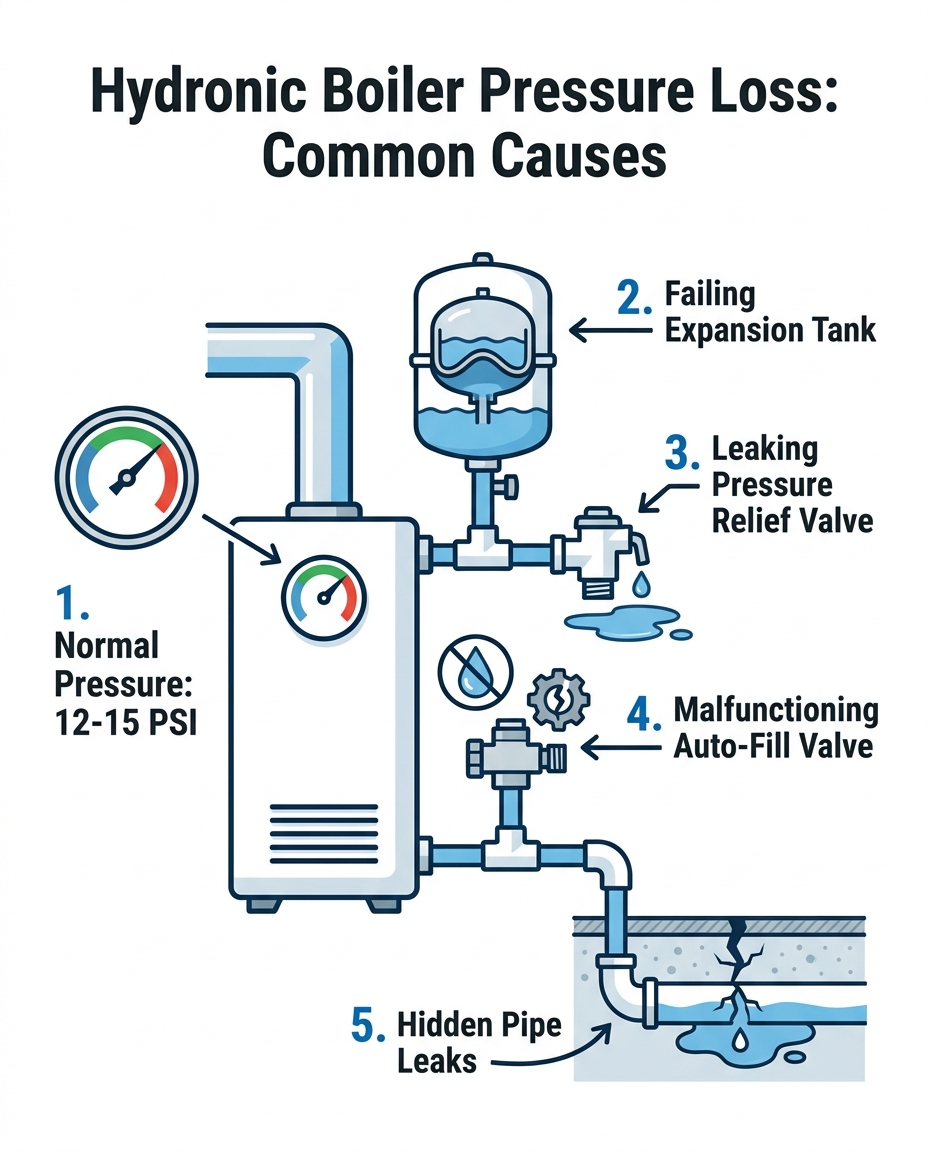
To understand what is going wrong, you first need to know what normal looks like. Most residential hydronic systems are designed to operate at around 12 to 15 PSI (pounds per square inch) when cold, rising slightly as the water heats and expands. If you notice a low pressure gauge reading (typically dropping below 12 PSI), it means one of two things is happening: water is actively escaping the sealed system, or the water pressure is being mismanaged by a failing internal component. The gauge is your early warning system that the closed loop has been compromised.
Primary Causes of Hydronic Boiler Pressure Loss
In our years of diagnosing boiler issues across the Fraser Valley, we've found that when a hydronic system repeatedly loses pressure, the culprit almost always traces back to one of four primary failure points. Understanding these common culprits can help you communicate more effectively with your technician.
• Failing expansion tank: The tank may become waterlogged and lose its internal air charge, preventing it from managing thermal expansion.
• Malfunctioning auto-fill valve: The valve designed to automatically replace minor natural pressure variations becomes clogged or fails to open.
• Leaking pressure relief valve: A safety component that begins discharging water unnecessarily due to a weak spring or system over-pressurization.
• Hidden system leaks: Pinhole leaks developing in concealed distribution pipes, baseboards, or under-floor radiant loops.
Symptom and Cause Breakdown
Different component failures often present with slightly different clues. Here is a quick guide to what certain symptoms usually point toward:
• Puddle directly under the boiler discharge pipe — Likely Component Issue: Leaking Pressure Relief Valve (PRV)
• System pressure spikes when heating, then drops rapidly — Likely Component Issue: Failing or Waterlogged Expansion Tank
• Gauge drops very slowly over several weeks with no visible water — Likely Component Issue: Malfunctioning Auto-Fill Valve or Hidden Pinhole Leak
• Unexplained damp spots on ceilings or floors — Likely Component Issue: Hidden System Leak in Distribution Piping

How to Safely Perform Visual Checks on Your Expansion Tank
The expansion tank is a crucial component of your boiler system. As water heats up, it expands in volume. Because water cannot be compressed, that extra volume needs a place to go to prevent the pipes from bursting. The expansion tank contains a rubber bladder with pressurized air on one side and system water on the other, acting as a shock absorber for this thermal expansion. When the tank fails, pressure fluctuates wildly, often causing the relief valve to dump water, which leads to an overall pressure loss.
While testing the internal pressure of the tank requires specialized tools, there are safe visual checks you can perform during the winter heating season to see if the tank is the source of your trouble.
1. Locate the tank: Find the small, usually grey or green, pill-shaped tank suspended from the piping above or beside your boiler.
2. Inspect the exterior: Look closely at the outside of the tank. Check for signs of heavy rust, corrosion, or weeping water around the seams and connection points. A rusty tank is often a failing tank.
3. Perform the "tap test": Using a metal tool like a screwdriver handle, gently tap the top half of the tank, and then tap the bottom half. The top half (where the air charge lives) should sound hollow. The bottom half (where the water enters) should sound solid. If the entire tank sounds dull and solid, it is likely completely waterlogged and has failed.
Strict Safety Warning: Never attempt to repressurize the expansion tank with an air compressor, and never try to bleed or remove the tank yourself. The water inside is scalding hot and under pressure. Replacing an expansion tank requires isolating the system, draining it safely, and installing the new part to code, a job strictly for a licensed professional.
Identifying Issues with the Auto-Fill and Pressure Relief Valves
If your expansion tank appears healthy, the next components to visually inspect are the auto-fill valve and the pressure relief valve. These two brass valves work together to keep the system's pressure balanced, but they can easily fail due to age or hard water scaling.
The Auto-Fill Valve
The auto-fill valve (or pressure reducing valve) is connected to your home's main water supply. Its job is to automatically monitor the boiler's pressure and trickle in small amounts of fresh water if the pressure dips slightly. If this valve becomes clogged with mineral scale or sediment, it will fail to open. When that happens, even minor, natural system fluctuations aren't replenished, resulting in a low pressure gauge reading (typically dropping below 12 PSI) that you have to fix by manually opening the bypass valve.
The Pressure Relief Valve (PRV)
The pressure relief valve is an essential safety device. If the pressure inside the boiler climbs too high (usually above 30 PSI), this valve opens to dump water and relieve the stress on the pipes. However, the internal spring can weaken over time, or a piece of debris can get stuck in the valve seat. When this happens, the PRV will constantly drip or leak water out of the system. Visually inspect the copper pipe connected to the PRV that runs down toward the floor. If you see a puddle of water beneath it, or if the pipe feels hot to the touch when the boiler is running, the valve is leaking system water.
The quick fix you should avoid: Never attempt to force a dripping pressure relief valve closed, and never cap the end of the discharge pipe. Doing so removes the boiler's only safety mechanism against dangerous over-pressurization.
The Hidden Danger of Concealed Pipe Leaks
If you have visually inspected the expansion tank, the auto-fill valve, and the pressure relief valve, and everything is completely dry, you are likely dealing with the most concerning cause of pressure loss: a hidden leak within the distribution piping.
Because hydronic systems route hot water throughout the entire house, a leak can happen anywhere. Tiny pinhole leaks in copper pipes or older baseboard units are notoriously difficult to find. Because the water inside the pipes is so hot, a small leak will often release steam or a tiny trickle of water that evaporates into the surrounding air before it ever forms a visible puddle on the floor. You might only notice a faint, sweet metallic smell or subtle bubbling paint on a baseboard cover.
The risks of letting a hidden leak persist are significant. Beyond the slow, structural water damage occurring behind your walls, a sudden system shutdown leaves your home vulnerable. In Mission, BC's cold and damp winter climate, a sudden boiler shutdown due to pressure failure dramatically increases the risk of rapid pipe freezing inside walls. If the boiler locks out because the pressure dropped to zero during a freeze, the standing water in the pipes can freeze, expand, and cause catastrophic pipe bursts throughout the house.
Locating these hidden breaches requires professional diagnostic tools, such as thermal imaging cameras and acoustic leak detectors. During a recent winter service call right here in Mission, our team at Rep-Air Heating and Cooling helped a homeowner who noticed an unexplained pressure drop that standard visual checks couldn't solve. Our technicians arrived, expertly identified a hidden leak along with a broken pipe segment within the system, and completely repaired the breach to permanently restore system pressure. If you are comparing radiant floor and baseboard hydronic heating systems, it is worth noting that hidden leaks in under-floor radiant loops require highly specialized equipment to locate without damaging the flooring.
When to Stop Troubleshooting and Call in the Experts
Knowing exactly when to step back and call a professional is the best way to protect your heating system from further damage. As a general rule, if your visual checks reveal heavy rust on the expansion tank, a dripping pressure relief valve, or if your system requires you to manually top up the water pressure more than once per heating season, it is time to call for help.
Blindly replacing parts based on a hunch often leads to wasted money and recurring problems. Our licensed technicians possess the high-level diagnostic expertise required to objectively test closed-loop systems, isolate the precise cause of the pressure drop, and find hidden hydronic leaks safely. They will test the actual air charge in the expansion tank, verify the incoming water pressure at the auto-fill valve, and ensure the system is properly bled of air after repairs are made.
You do not have to wait for a low pressure gauge reading (typically dropping below 12 PSI) to take action. By enrolling in a regular maintenance plan, a professional can proactively test these critical valves and tanks every year, catching weak components before they cause a sudden loss of heat on the coldest night of the year.
Frequently Asked Questions
Why does my boiler keep losing pressure but there is no leak?
If your boiler is losing pressure but you cannot find a visible leak, the issue is likely internal or hidden. The most common culprits are a failing expansion tank that is causing pressure spikes, a malfunctioning auto-fill valve that isn't replenishing minor natural fluctuations, or a pinhole leak behind a wall where the hot water evaporates before forming a puddle. A professional pressure test is required to isolate the exact cause.
Is it dangerous if boiler pressure is low?
Modern boilers are equipped with low-water cutoff switches that safely shut the system down if pressure drops too low, preventing the boiler from firing without water and damaging the heat exchanger. However, the real danger of low boiler pressure is the resulting loss of heat. During freezing weather, a system lockout can allow the ambient temperature in your home to drop rapidly, risking frozen and burst domestic water pipes.
How often should you have to top up boiler pressure?
In a healthy, properly functioning closed-loop hydronic system, you should rarely have to top up the pressure manually. Needing to add water once a year at the start of the heating season is generally acceptable due to microscopic natural losses. However, if you are topping up the system every few months, weeks, or days, there is an active failure that needs professional repair.
How do I check my boiler expansion tank?
You can perform a safe visual check by looking for rust, corrosion, or water weeping around the tank's seams. You can also perform a "tap test" by gently tapping the top and bottom of the tank with a screwdriver handle; the top should sound hollow (air) and the bottom should sound solid (water). If the entire tank sounds solid, it is waterlogged. Never attempt to remove or repressurize the tank yourself.
Can a faulty circulating pump cause a drop in boiler pressure?
A faulty circulating pump typically causes circulation issues, resulting in cold radiators while the boiler itself stays hot, rather than a raw drop in system pressure. However, if the seals or flanges around the circulating pump degrade and begin to leak water onto the floor, that physical loss of water will eventually cause the system's overall pressure to drop.
What happens if my boiler pressure drops to zero?
If your boiler pressure drops to zero, the system has lost a significant amount of water and the built-in safety mechanisms will trigger a system lockout. The boiler will refuse to ignite to protect the heat exchanger from cracking or melting due to dry firing. You will have no central heating until the leak is found, the system is repaired, refilled, and properly bled of trapped air.
Professional Boiler Repair When You Need It Most
Understanding why your hydronic heating system is losing pressure (and where the water is going) is the first step in protecting your home from winter breakdowns. If your gauge keeps dropping despite your best efforts, do not wait for a complete system lockout. Contact our team for expert boiler repair and service to secure accurate diagnostics, resolve hidden leaks, and restore reliable, lasting warmth to your home.
hear what our satisfied clients have to say
Neighbourhoods in the Fraser Valley