Identifying Premature Heat Exchanger Wear Before Winter Hits Mission
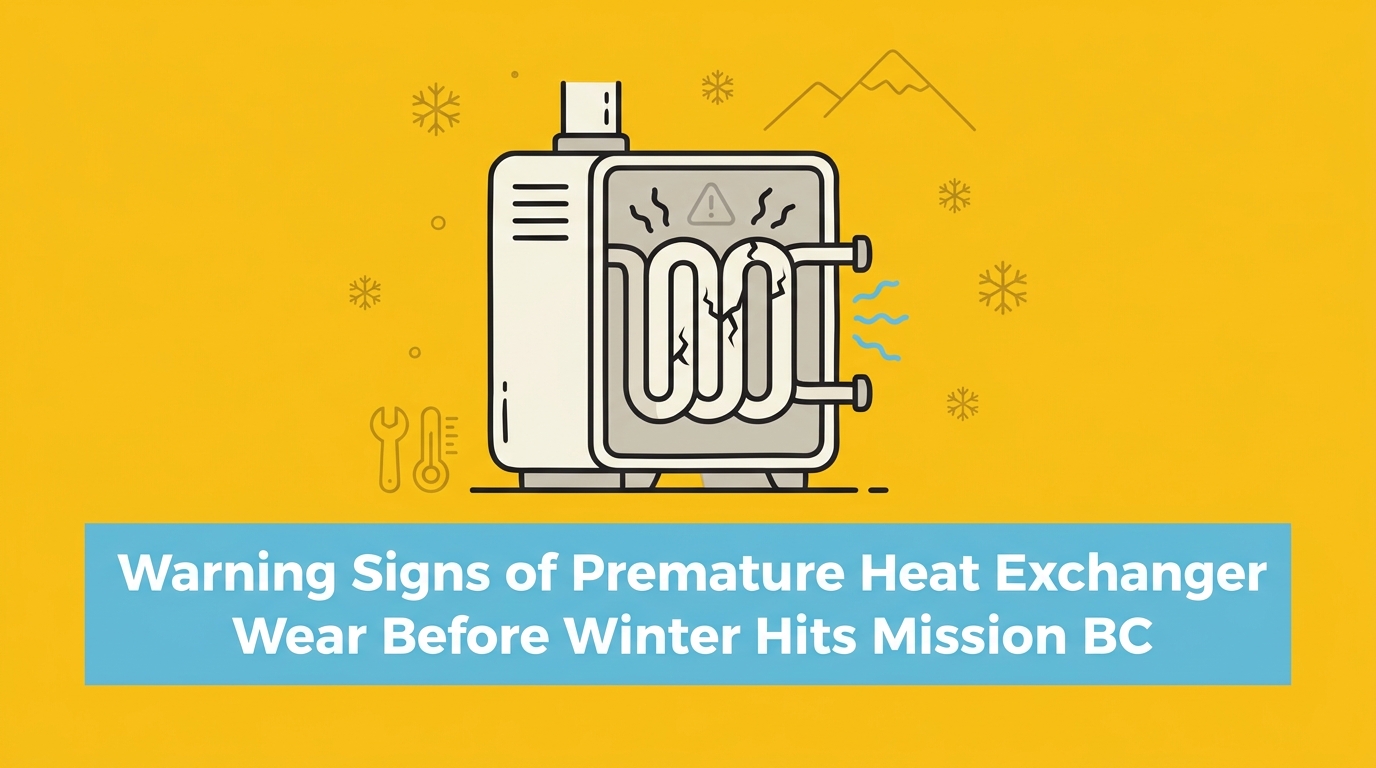
Preparing Your Home for the Cold: The High Stakes of Undetected Furnace Wear
As the transition from late-summer (typically late August to early September) brings a distinct chill to the air, our team at Rep-Air Heating and Cooling notices homeowners naturally begin testing their heating systems. Identifying premature heat exchanger wear before winter hits Mission BC becomes the most critical safety check on your seasonal preparation list. The heat exchanger is the hidden core of your furnace, responsible for keeping toxic combustion gases safely separated from the clean air circulating through your living spaces. When this vital component suffers from undetected premature wear—specifically rust and hairline cracks—it introduces a severe carbon monoxide risk into your home.
To protect your household, professional heating services and a comprehensive preventative HVAC maintenance plan are your strongest lines of defense against invisible winter hazards.
Many homeowners assume that if the furnace turns on and blows warm air, the system is perfectly safe. However, the stakes are incredibly high when it comes to internal corrosion. Knowing exactly when safe, exterior visual signs warrant an immediate professional inspection is the key to preventing a mid-winter emergency. Before the freezing temperatures arrive and force your system to run around the clock, taking a proactive approach to furnace safety can save you from catastrophic equipment failure and dangerous air quality issues.
Understanding the Heat Exchanger and Thermal Stress
To understand why a furnace becomes unsafe, you first need to understand the mechanics of the heat exchanger itself. This component acts as an impermeable metal shield. Inside the shield, natural gas burns and creates immense heat alongside toxic byproducts like carbon monoxide. The metal absorbs this heat. On the outside of the shield, your blower motor pushes clean indoor air across the hot metal, warming the air before it travels through your ductwork. The two airflows must never mix.
In our experience servicing everything from older 80% AFUE standard-efficiency models to modern 96%+ AFUE high-efficiency furnaces across Mission BC, the intense physics of thermal stress remain a constant. With every single heating cycle during a cold winter, the metal heats up and expands. Once the thermostat reaches the target temperature, the burners shut off, and the metal rapidly cools and contracts.
Over years of operation, this extreme thermal stress inevitably leads to metal fatigue. Think of it like bending a paperclip back and forth repeatedly; eventually, the metal weakens and snaps. In a furnace, this fatigue spawns invisible hairline cracks that compromise the system's safety.
• Normal Operation — Impact on Heat Exchanger Metal: Routine expansion and contraction with minor wear — Safety Risk Level: Low (Requires annual checks)
• Prolonged Thermal Stress — Impact on Heat Exchanger Metal: Metal fatigue, weakening structural integrity — Safety Risk Level: Moderate (Nearing end of lifespan)
• Hairline Cracks — Impact on Heat Exchanger Metal: Fractures open during heating cycles — Safety Risk Level: Severe (Immediate CO hazard)
Understanding this cycle highlights why age is a significant factor in furnace safety. Even the most robust metal components cannot indefinitely withstand the daily punishment of extreme temperature fluctuations.
How Damp Off-Seasons Accelerate Metal Corrosion
Thermal stress is only half of the equation. The environment where your furnace lives plays a massive role in how quickly the metal degrades. Mission BC's cold, damp winters and humid off-seasons specifically accelerate rust and corrosion on dormant metal heat exchangers. When a furnace sits idle during the warmer, more humid months, it becomes vulnerable to environmental moisture.
During our humid April through June off-season, basements, utility closets, and crawlspaces often trap humidity. This moisture naturally condensates on the cold, dormant metal components inside your furnace cabinet. Because the system is not actively running to burn off this condensation, the water sits on the surface of the heat exchanger for months at a time.
This prolonged surface moisture causes oxidation—the chemical reaction that creates rust. Rust eats away at the thickness of the metal, creating pitted, weakened areas that are far more susceptible to cracking once the thermal stress of winter begins. This off-season degradation is exactly why our technicians stress that pre-winter checks are absolutely vital.
Common areas where off-season moisture causes damage:
• The burner assembly: Moisture causes surface rust that can clog burner ports.
• The primary heat exchanger: Condensation pools in the bends of the metal tubes, thinning the steel.
• The secondary heat exchanger: In high-efficiency models, acidic condensation can back up if drains are clogged.
• The exhaust flue: Humid air flowing backward down the chimney can introduce excess water into the cabinet.
Safe Exterior Visual Checks to Perform Right Now
While only a licensed technician can diagnose the internal components, homeowners hold the first line of defense. By performing a quick visual assessment during the 4-to-6-week window before the first freeze, you can spot the warning signs of internal decay before turning the system on for the season.
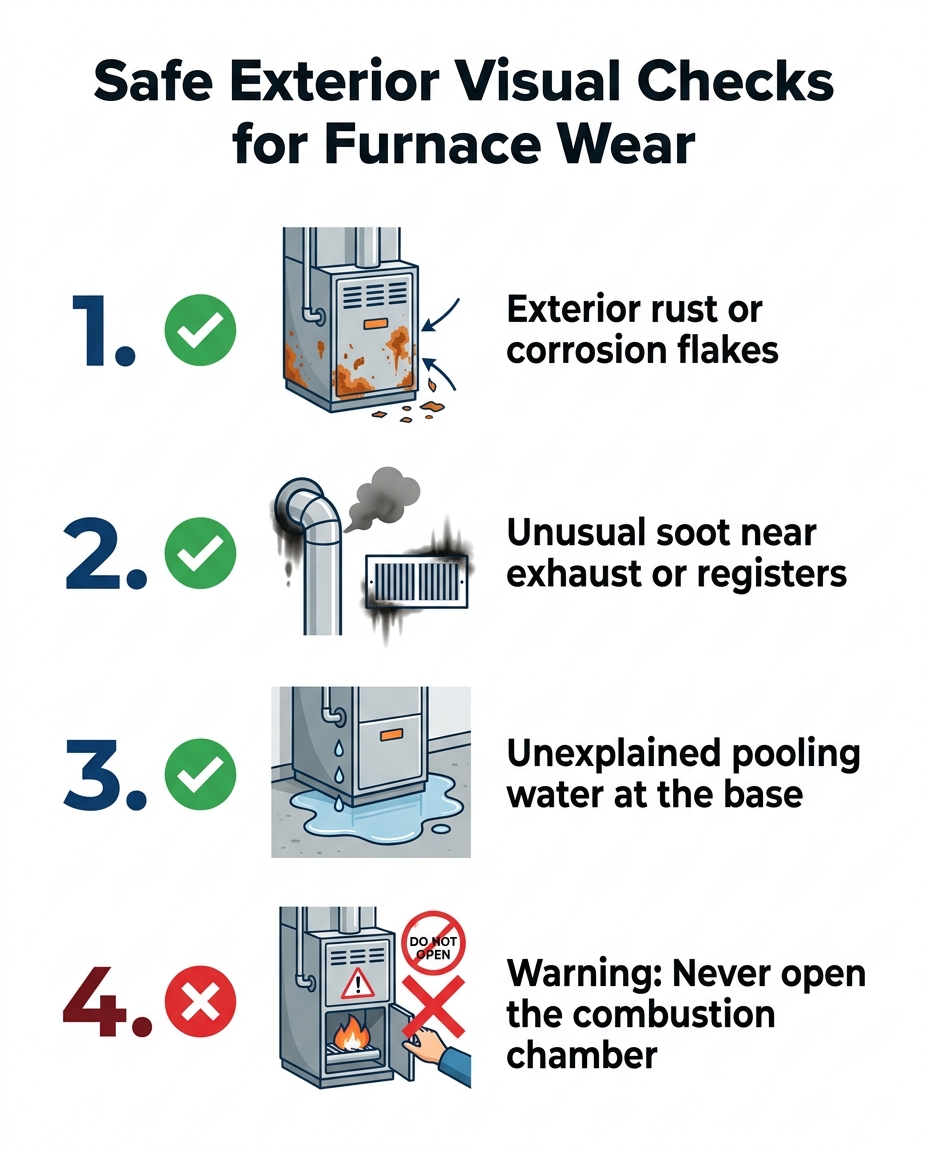
The strict safety rule: Homeowners should only ever inspect the exterior of the unit. Never remove the service panels to inspect the combustion chamber yourself.
• Visible rust or corrosion flakes: Look around the base or the exterior casing of the furnace. If you see orange or brown flakes on the floor beneath the unit, it often indicates the internal metal is shedding rusted layers.
• Unusual soot buildup: Inspect the area near your floor registers and the exterior exhaust vent. Black, powdery soot means the furnace is experiencing incomplete combustion, a primary driver of heat exchanger failure.
• Unexplained pooling water: Check for moisture around the base of the heating system. While high-efficiency furnaces produce condensation normally, water pooling on the floor suggests a blocked drain or a rusted-through secondary heat exchanger.
Observing any of these signs means it is time to call a professional immediately. These symptoms often overlap with the general signs it's time to replace your furnace, making early detection crucial for budgeting and safety.
When Visual Signs Point to a Larger Issue
Exterior rust is usually just the tip of the iceberg for internal corrosion. If you can see rust on the outer casing, the internal components have likely been degrading for years. We always remind our customers that these visual checks are early warnings, not conclusive diagnoses. They tell you that a deeper, professional look is required.

The Invisible Threat: Carbon Monoxide and Hairline Cracks
The primary reason heat exchanger wear is treated as an emergency is the threat of carbon monoxide (CO) exposure. Carbon monoxide is a byproduct of burning natural gas. It is completely colorless, odorless, and tasteless, making it impossible to detect without specialized equipment or functional CO alarms in your Mission BC home.
The most deceptive nature of hairline cracks is how they behave based on temperature. We frequently find that in furnaces approaching the 12-to-15-year mark, these microscopic fractures contract and remain tightly closed when the metal is cold. A visual inspection with a flashlight might miss them entirely. However, the moment the furnace ignites and the metal gets hot, the heat exchanger expands. The cracks stretch open wide.
Once those cracks open, the high pressure from the blower motor interacts with the combustion chamber. Toxic CO gases are forced out of the sealed chamber, mixing directly with the breathable air circulating through your ductwork. Because this only happens while the system is actively heating, the danger scales with the severity of the winter weather.
For homeowners facing severe, unrepairable wear, replacing the furnace is the only safe option. Many choose to upgrade to entirely different heating technologies to avoid combustion risks altogether. Exploring modern heat pump services provides a high-efficiency alternative that uses electricity to transfer heat, completely eliminating the risk of carbon monoxide leaks. (Federal tax credits and provincial utility incentive programs may apply to qualifying heat pump installations—be sure to verify current programs with your utility provider).
The Firm Boundary: Why Combustion Analysis Requires a Professional
It is natural to want to verify a problem yourself before calling for help, but furnace diagnostics carry a firm boundary. Opening the combustion chamber or attempting DIY diagnostics is extremely dangerous. Tampering with gas valves, burner alignments, or the heat exchanger shield can create leaks where none existed before.
A professional combustion analysis is the only definitive way to verify the integrity of a heat exchanger. This process requires highly specialized, calibrated equipment that measures the exact chemical composition of the exhaust gases.
The professional diagnostic process our team utilizes typically involves:
1. Draft Measurement: Ensuring the exhaust is properly pulling gases out of the home rather than spilling them back inside.
2. Flue Gas Analysis: Using an electronic probe to measure the exact parts per million (PPM) of carbon monoxide in the exhaust stream.
3. Visual Camera Inspection: Utilizing a flexible, high-definition borescope camera to snake through the curved tubes of the heat exchanger, looking for light passing through cracks.
4. Airflow Pressure Testing: Checking for pressure imbalances that indicate the blower is pushing air into the combustion chamber.
Just last winter in the Hatzic neighborhood, our team responded to a furnace failure where the system was simply not working correctly. A Rep-Air technician arrived, identified a compromised heat exchanger through proper diagnostics, explained the necessary fix clearly, and provided ongoing maintenance tips. This ensured the homeowner understood how to maintain the system safely without ever risking exposure to internal components.
Securing Your Home's Safety with Expert Diagnostics
The window to catch these invisible issues is closing rapidly as the cold weather approaches. Waiting until the first freezing night to turn on an unchecked furnace is a gamble with your household's safety and comfort.
A comprehensive pre-winter safety inspection goes far beyond simply changing the air filter. It is a meticulous evaluation of every moving part, electrical connection, and safety switch inside the cabinet. The primary goal of these inspections is to definitively rule out carbon monoxide risks before the unit is subjected to heavy daily usage.
Working with our dedicated team means you receive thorough, safety-first inspections by local experts specifically trained to detect hidden carbon monoxide risks to protect families. We understand the specific toll that the regional climate takes on HVAC equipment. By scheduling your inspection between September and October, you secure the peace of mind that comes from knowing your heating system is structurally sound, highly efficient, and completely safe to operate.
Frequently Asked Questions About Heat Exchanger Safety
What are the visual signs of heat exchanger wear?
The most common visual signs of heat exchanger wear include exterior rust, corrosion flakes near the base, unusual soot around registers, and pooling water. If you notice orange flakes dropping from the furnace casing or black powdery soot near the exhaust, the internal metal is likely degrading. These exterior signs warrant an immediate professional inspection before further use in Mission BC.
Why is a cracked heat exchanger a carbon monoxide risk?
A cracked heat exchanger is a severe carbon monoxide risk because cracks allow toxic combustion gases to escape the sealed chamber and mix with the breathable air circulating through the home. When the metal heats up, the cracks expand, and the blower motor forces those harmful gases directly into your ductwork. This bypasses the exhaust flue, pushing invisible, odorless poison into your living spaces.
Can a cracked heat exchanger be repaired?
In our experience, a cracked heat exchanger cannot be safely repaired and requires complete replacement of the component or the entire furnace. Welding or patching the high-stress metal is not a viable or code-compliant solution due to the extreme thermal expansion it undergoes daily. Replacing the part restores the safety boundary between combustion gases and your indoor air.
Is it safe to run a furnace with a cracked heat exchanger?
Absolutely not. Running it risks immediate carbon monoxide exposure, and the system must be shut down until replaced. Even a microscopic hairline crack will expand under heat, releasing toxic gases into your home. If a professional diagnoses a cracked heat exchanger, they are legally obligated to disable the furnace to protect your household from poisoning.
How does a heat exchanger get cracked?
Constant expansion and contraction from heating and cooling cycles causes metal fatigue over time, leading to cracks. Just like bending a piece of metal repeatedly will eventually cause it to snap, the daily thermal stress of winter heating weakens the steel. Additionally, off-season rust and poor airflow can accelerate this weakening process.
Take Action Before the First Freeze
Knowing the visual signs of rust, soot, and moisture empowers you to act quickly when your heating system shows signs of distress. However, while surface-level awareness is vital, only a licensed professional can provide the final word on your heat exchanger's safety. Between late-summer and early fall, taking proactive steps ensures you aren't caught off guard by a dangerous breakdown mid-winter.
Don't wait for the cold to test your system's limits. Secure your preventative HVAC maintenance plan today to guarantee a safe, warm, and worry-free winter for your entire household.
hear what our satisfied clients have to say
Neighbourhoods in the Fraser Valley