The Tipping Point for a 400 Amp Panel: When Electrifying Your Home Requires a Major Service Upgrade
Escaping Gas Dependency: The Hidden Electrical Bottleneck
Your gas bills are climbing, and you are ready to transition your home to clean, efficient electric power, but understanding The Tipping Point for a 400 Amp Panel: When Electrifying Your Home Requires a Major Service Upgrade is the first hurdle you must clear. Transitioning from fossil fuels to full electric heating and modern appliances is a major goal for homeowners today. However, the primary bottleneck in this process is rarely the appliances themselves. Instead, the hidden roadblock is your home's existing electrical infrastructure.
When you start adding high-draw equipment to your home, you introduce a critical decision point: understanding the exact electrical load math to know if a standard panel can survive the winter. At Rep-Air Heating and Cooling, our team frequently sees this exact scenario when Mission BC homeowners face severe Fraser Valley winter cold snaps, which serve as the ultimate stress test for your home's electrical capacity. If you are planning a complete gas-to-electric conversion, you must ensure your system can handle the peak demand without failing. Navigating this transition safely requires professional residential electrical services to assess your current capacity. This overview will walk you through the math behind home electrification, but remember that official load calculations are legally required and must be performed by a certified professional, not through a DIY calculator.
Decoding the 80% Rule: The Reality of Continuous Load Limits
The problem: Many homeowners look at their main breaker, see "200 Amps, " and assume they have a full 200 Amps of usable power available at any given moment. This assumption leads to overloaded panels, tripped main breakers, and significant safety hazards.
The cause: The Canadian Electrical Code (CEC) strictly regulates how much power a panel can safely handle over extended periods. Under the CEC, any electrical draw lasting longer than three hours is classified as a "continuous load." Because electricity generates heat as it moves through wires and breakers, running a panel at its absolute maximum capacity for hours on end will cause the components to overheat, potentially leading to electrical fires. To prevent this, the code enforces the 80% rule.
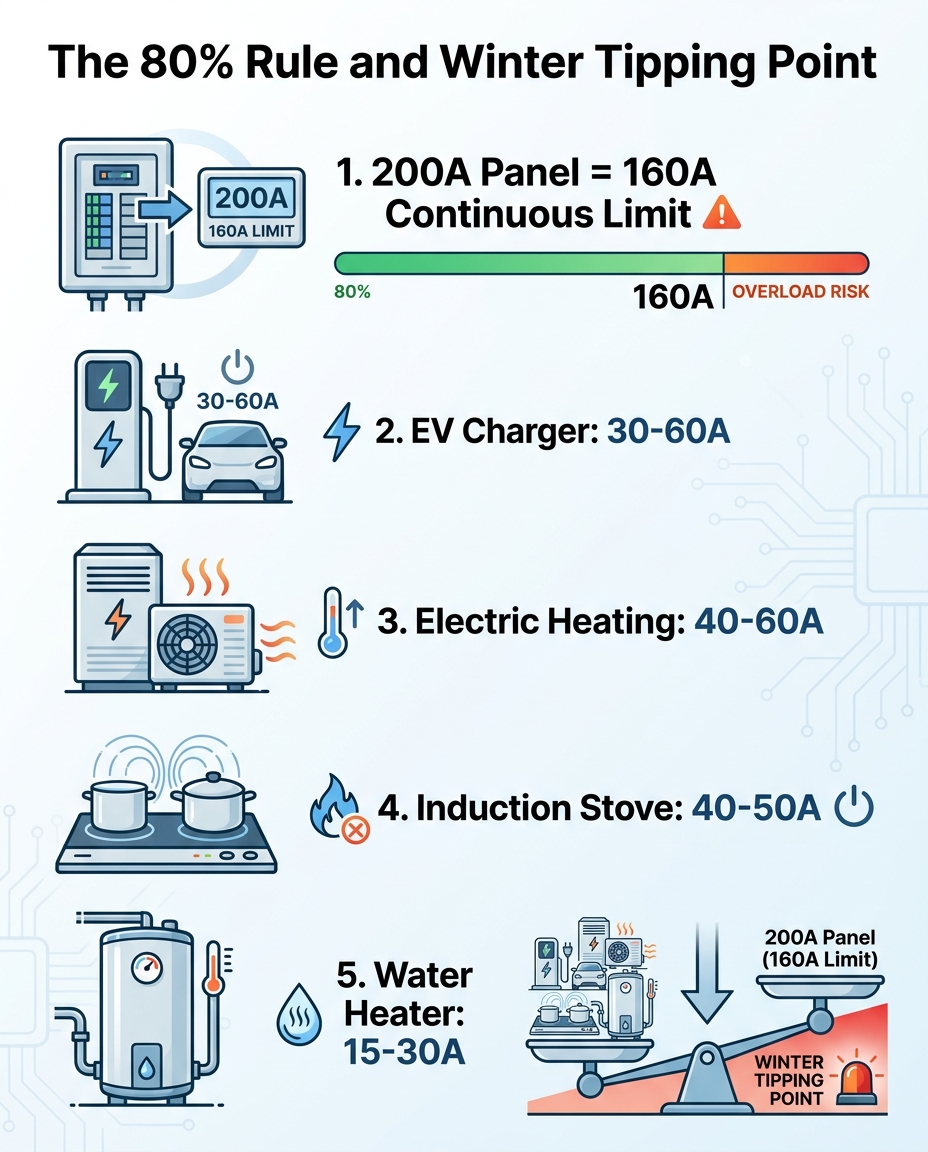
The solution: In our years of upgrading electrical systems across the Fraser Valley, we always emphasize that you must calculate your home's capacity based on its continuous load limit, not its peak limit. A standard 200 Amp panel can only safely sustain 160 Amps of continuous load. If your electrification plans push your continuous draw past 160 Amps, you are legally and practically required to upgrade. Understanding the difference between 200 and 400 amp panels is foundational here, as a 400 Amp service safely supports up to 320 Amps of continuous load, giving you massive headroom for modern appliances.
Why the 160-Amp Ceiling Matters
The 160-Amp ceiling is not a suggestion; it is a hard physical and legal limit based on the thermal dynamics of your electrical system.
• Thermal expansion: As current flows, copper and aluminum wiring heat up and expand. Breakers are designed to trip before this heat melts the wire insulation.
• CEC safety mandates: The 80% rule provides a 20% safety buffer to account for voltage fluctuations and ambient temperature changes in your utility room.
• Budgeting your power: When you start stacking continuous loads, like a heating system running all night, that 160-Amp budget disappears much faster than you might expect.
• 100 Amp — Peak Capacity: 100A — Continuous Load Limit (80% Rule): 80A — Typical Home Profile: Older homes, gas heating, gas appliances, no EV.
• 200 Amp — Peak Capacity: 200A — Continuous Load Limit (80% Rule): 160A — Typical Home Profile: Modern homes, mixed gas/electric, single EV charger.
• 400 Amp — Peak Capacity: 400A — Continuous Load Limit (80% Rule): 320A — Typical Home Profile: Fully electrified homes, electric heating, multiple EVs.
The Heavy Hitters: Adding Up High-Draw Modern Appliances
To understand why a 200 Amp panel often falls short during a full home electrification project, you have to look at the specific amperage draws of the equipment you are installing. Older homes were built when the biggest electrical draw was an electric dryer or an oven. Today, the landscape of residential power consumption looks entirely different.
Electric Vehicle Chargers (30-60A): Level 2 EV chargers are the most common addition to modern homes. Depending on the model and the charging speed you select, these units draw between 30 and 60 Amps. Because vehicles typically charge overnight for more than three hours, this is always classified as a continuous load.
Electric Heating Systems (40-60A): When installing a new electric heat pump or an electric furnace, the power requirements are substantial. While heat pumps are highly efficient, they often rely on auxiliary electric resistance heat strips during extreme cold. These backup strips alone can draw 40 to 60 Amps to keep your home warm when temperatures plummet.
Induction Stoves (40-50A): Transitioning away from a gas range means installing a high-powered induction or electric radiant stove. These appliances require a dedicated 40 to 50 Amp circuit to operate multiple burners and the oven simultaneously.
Heat Pump Water Heaters (15-30A): Replacing a gas hot water tank with a hybrid heat pump water heater adds another dedicated load. While they are efficient, their recovery cycles still require a 15 to 30 Amp circuit, depending on whether they are running in pure heat pump mode or using their backup electric elements.
The Cumulative Effect on Your Panel
When you add these base numbers together, the math becomes highly restrictive. An EV charger (40A) plus an electric heating system (50A) plus an induction stove (40A) and a water heater (20A) equals 150 Amps. You are already brushing up against the 160-Amp continuous limit of a 200 Amp panel: and this calculation has not even factored in your lights, refrigerator, dishwasher, microwave, or living room electronics. When our technicians evaluate older properties throughout Mission BC, we see them struggle the most with these modern additions because their original panels were simply never designed to support this volume of simultaneous high-draw equipment.

The Winter Tipping Point: When the 'Diversity Factor' Fails
The problem: Electrical engineers and code inspectors use a concept called the "diversity factor" when calculating panel loads. The diversity factor is the safe assumption that you will never use every single electrical device in your home at the exact same time. You aren't usually running the vacuum, the blender, the air conditioner, and the oven simultaneously. Under normal conditions, this diversity factor allows a 200 Amp panel to comfortably power a modern home.
The cause: The diversity factor completely falls apart during extreme weather. Fraser Valley winter cold snaps are the exact catalyst that forces all your high-draw appliances to run at the same time. Consider a typical January evening when the temperature drops below freezing: You arrive home from work and plug in your EV to charge. You turn on the induction stove to cook dinner. Your family takes evening showers, forcing the heat pump water heater into a high-draw recovery cycle. Most importantly, the bitter cold forces your electric heating system to run non-stop, potentially engaging its high-amperage backup heat strips.
The solution: This simultaneous peak demand eliminates the diversity factor entirely. Your panel is no longer benefiting from staggered usage; it is taking the full, combined brunt of your home's heaviest electrical loads all at once. This specific scenario pushes the panel far past its 160-Amp continuous limit, causing the main breaker to trip and leaving your home without heat in the middle of winter. This mathematical certainty is exactly why our team at Rep-Air Heating and Cooling frequently recommends a 400 Amp upgrade for fully electrified homes in our colder climate.
Navigating Canadian Electrical Code (CEC) and 400 Amp Upgrades
Upgrading to a 400 Amp service is not a simple breaker swap. It is a major infrastructure project that alters how your home connects to the utility grid. Because of the complexity and the safety risks involved, this process is heavily regulated.
1. Utility Coordination: A 400 Amp upgrade requires heavier utility service lines coming from the street to your house. The utility company must be involved to disconnect the power, upgrade the physical wires, and install a new, higher-capacity meter base.
2. Dual Panel Installation: In residential applications, a 400 Amp service is typically split into two separate 200 Amp panels. This provides massive physical space for new breakers and cleanly divides the home's electrical load.
3. Official Load Calculations: The CEC dictates strict load calculation formulas that must be officially documented. A licensed professional must submit a detailed breakdown of your home's square footage, appliance loads, and continuous draw expectations.
4. Permitting and Inspection: You cannot perform a service upgrade without pulling the proper BC electrical permits. Once the work is complete, a provincial inspector must verify that the installation meets all CEC safety mandates before the utility company restores power.
Because this process is so rigorous, our licensed technicians at Rep-Air Heating and Cooling handle official load calculations and manage the BC permitting process to ensure safe home electrification. Major electrical upgrades can feel disruptive, but our professional team will always prioritize your family's comfort. For example, one local family recently reached out to us during the summer needing an expedited schedule for their home service work because they had a newborn and a mother recovering from a C-section. A dedicated company like ours will go out of our way to accommodate urgent needs like this, safely accelerating the timeline without cutting corners on code requirements. If you are planning Langley electrical upgrades, partnering with our licensed team ensures the project moves smoothly from the initial utility request to the final inspection.
The Role of Official Load Calculations
You might be tempted to use a free online calculator to determine your panel size, but those tools are insufficient for real-world application.
• Permitting requirements: Online calculators cannot be submitted for official electrical permits. Inspectors require stamped, verified calculations from certified professionals.
• Continuous load compliance: Inspectors specifically look at how continuous loads are budgeted. If the math shows you exceeding the 80% rule, the permit will be denied.
• Safety risks: Bypassing proper calculations and trying to squeeze too many high-draw appliances onto a 200 Amp panel poses severe fire risks and voids your homeowner's insurance.
Structuring Your Home Electrification and Upgrade Timeline
A successful transition away from gas requires strategic planning. If you buy a new electric furnace and an induction range before assessing your electrical panel, you might find yourself stuck with appliances you cannot legally install.
Assess capacity first: Before you purchase any high-draw equipment, have a certified electrician perform a formal load calculation. This tells you immediately if your current panel has the headroom for your plans or if a 400 Amp upgrade must be factored into your project budget.
Plan for utility timelines: Upgrading your main service requires coordination with your local utility provider. Depending on their backlog, scheduling the disconnect and the installation of new service lines can take several weeks. Factor this waiting period into your overall renovation timeline.
Leverage available incentives: The push toward decarbonization means there is often financial support available for homeowners making the switch. Generic energy rebates, tax credits, and utility incentive programs frequently exist to support home electrification efforts. While specific programs change year to year, it is always worth exploring home electrification rebates to see if your panel upgrade or heat pump installation qualifies for generic federal or provincial support. Always verify current programs with your utility provider or a tax professional.
Schedule during milder seasons: Because a major service upgrade requires the utility company to cut power to your home for several hours (or sometimes a full day), it is highly advisable to plan these upgrades during the spring or fall. You want to avoid losing power during the peak heat of summer or the freezing temperatures of winter.
Frequently Asked Questions About Home Electrification Loads
How many amps does a fully electric house need?
A fully electric house usually exceeds 200 Amps due to the simultaneous demand of heating, cooking, and EV charging. When you combine an electric furnace, a heat pump water heater, an induction range, and a Level 2 car charger, the combined load is substantial. For modern, fully electrified homes, our electricians almost universally recommend upgrading to a 400 Amp service to ensure adequate capacity.
What is the continuous load limit of a 200 amp panel?
The continuous load limit of a 200 Amp panel is 160 Amps. This is based on the 80% rule mandated by the Canadian Electrical Code, which states that any load running for more than three hours cannot exceed 80% of the breaker's rating. Comparing 200 Amp vs 400 Amp continuous load limits shows that a 400 Amp panel doubles this capacity to a safe 320 Amps.
Do I need a 400 amp panel for an all-electric home?
Often yes, especially in colder climates where heating demands peak alongside other appliances. If your electric heating system has to run continuously during a winter freeze while you are also charging a vehicle and cooking dinner, a standard 200 Amp panel will likely overload. A 400 Amp panel provides the necessary headroom to run all your modern appliances simultaneously without tripping the main breaker.
Can I upgrade my 200 amp service to 400 amp?
Yes, you can upgrade your service through a professional installation involving utility coordination and new panel installations. This process requires a certified electrician to perform an official load calculation, pull the necessary provincial permits, and work with your utility company to install heavier service lines. The final setup usually involves replacing your single panel with two 200 Amp panels.
What happens if I overload my electrical panel during winter?
If you overload your panel, the main breaker will trip to prevent the wiring from overheating, shutting off all power to your home. Sustained overloading without a properly functioning breaker poses severe fire risks due to the extreme heat generated in the wires. In the middle of winter, a tripped main breaker also means an immediate loss of heating, which can lead to frozen pipes and an uncomfortable home.
Take the Guesswork Out of Your Home's Electrical Capacity
Clear electrical math is the foundation of a safe, fully electric home. Moving away from gas dependency is a fantastic step for your property's efficiency, but it requires respecting the hard limits of your current infrastructure. Understanding the tipping point of your panel prevents dangerous overloads and unexpected winter power interruptions when you need your heating system the most. Before you invest in new appliances, take the time to explore professional load calculation options to validate your electrification plans. A certified assessment from our team at Rep-Air Heating and Cooling will give you the exact numbers you need to move forward with confidence.
hear what our satisfied clients have to say
Neighbourhoods in the Fraser Valley