Why Is My Furnace Blowing Cold Air? Diagnostics and Defrost Cycles Explained
Why Is My Heating System Suddenly Blowing Cold Air?
Are you looking for home maintenance tips and troubleshooting because your vents are suddenly blasting a chill into your living room, even though the thermostat is calling for heat? It is a jarring experience that immediately raises concerns about broken equipment. At Rep-Air Heating and Cooling, our team frequently helps homeowners navigate this exact issue during the damp winter months in the Fraser Valley. We know firsthand that a malfunctioning system can quickly turn a comfortable home into an unlivable space, making heating reliability a top priority for local families.
Before assuming the worst, it is important to understand the decision point you are facing: distinguishing between a simple thermostat error, a normal system self-preservation cycle, and a true mechanical failure that requires professional heating repair. Not every instance of cool air indicates a broken unit. In many cases we see in the field, the equipment is functioning exactly as designed to protect itself from the elements.
This guide provides a comprehensive roadmap for diagnosing a heating system that is blowing cold air. We will cover safe, do-it-yourself checks, explain the mechanics behind normal defrost cycles, and outline exactly when it is time to stop troubleshooting and call in our experts for comprehensive HVAC services.
First Steps: Checking Your Thermostat Settings
When ambient temperatures hovering between 2°C and 5°C with high humidity start creeping into your home, the first instinct is to assume a major mechanical breakdown has occurred. However, the most common culprit our technicians find behind cold air coming from your vents is actually the simplest: your thermostat settings. Before opening any access panels or calling us for a service visit, you must verify how your thermostat is communicating with the indoor blower motor.
The Difference Between ON and AUTO
Modern thermostats feature a fan setting that typically toggles between two primary modes: "ON" and "AUTO." Understanding the distinction between these two settings is the first step in diagnosing airflow temperature issues.
• The "AUTO" Setting: When the fan is set to AUTO, the blower motor only engages when the furnace burners are lit or the heat pump compressor is actively heating the air. The fan shuts off as soon as the heating cycle completes, ensuring that only warm air circulates through your ductwork.
• The "ON" Setting: When the fan is set to ON, the blower motor runs continuously, 24 hours a day, regardless of whether the system is actively generating heat. This is useful for filtering indoor air or balancing temperatures between floors, but it has a noticeable side effect during winter.
Why the Blower Motor Matters
If your thermostat fan is set to ON, the system will continue to pull air from your return vents and push it through your supply vents even between heating cycles. Because this air is not being actively heated by the burner or compressor, it will feel cool to the touch—simply because room-temperature air moving across your skin creates a wind-chill effect.
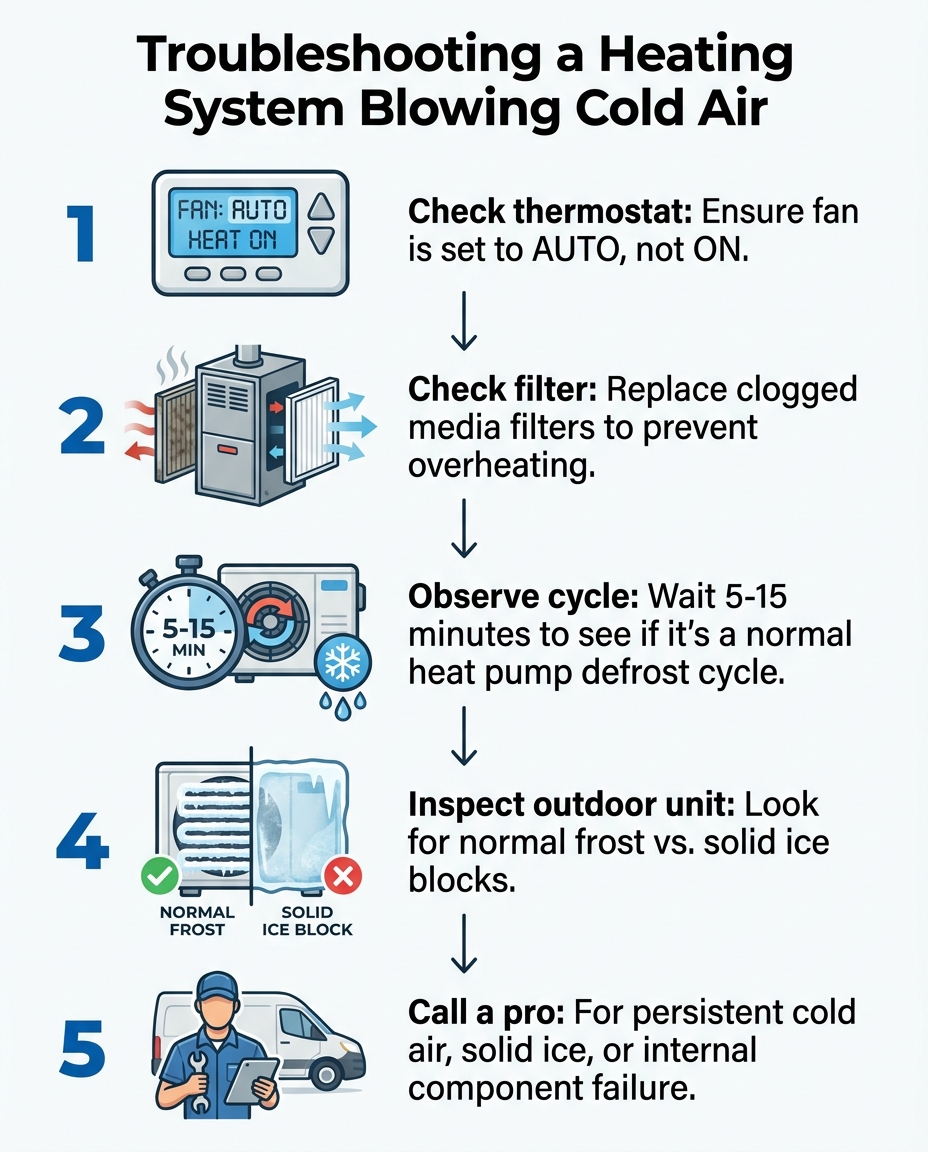
To rule out this simple fix, walk over to your thermostat and verify that the fan switch is set to AUTO. If the system was set to ON, switch it back, wait for the next heating cycle to initiate, and check the temperature of the air at the vents. If the air is now warm, you have successfully resolved the issue without needing a service call.
Is It a Furnace Issue or a Normal Heat Pump Defrost Cycle?
Many homeowners use the terms "furnace" and "heater" interchangeably, but knowing exactly what kind of equipment you have is critical for accurate troubleshooting. If your home relies on a heat pump rather than a traditional gas furnace, blowing cold air might not be a malfunction at all. It is often a sign that the system is performing a necessary self-preservation function.
Understanding the Heat Pump Defrost Cycle
Unlike gas furnaces that burn fuel to create heat, heat pump systems extract ambient heat from the outside air and transfer it indoors. During the winter, the outdoor coil acts as an evaporator, absorbing heat. As it does this, the surface temperature of the coil drops below freezing. Any moisture in the air condenses on the coil and quickly turns to frost.
To prevent this frost from building up into a solid block of ice that would choke off airflow and destroy the compressor, the heat pump enters a defrost cycle. During this 5 to 15-minute period, the system temporarily reverses its operation. It shifts into cooling mode, taking heat from inside your home and sending it to the outdoor unit to melt the frost.
Why It Feels Cold Indoors
Because the system is technically in cooling mode during a defrost cycle, it may temporarily blow cooler air indoors. Many systems utilize auxiliary electric heat strips to warm this air before it reaches your vents, but if those strips are delayed or malfunctioning, you will feel a distinct chill for a few minutes. Once the outdoor coil is clear of frost, the reversing valve shifts back, and normal heating resumes.
The Role of Mission BC's Microclimate
Frequent defrosting is a normal function, not a malfunction, under certain weather conditions. In our years of servicing HVAC systems across the region, we've found that Mission BC's specific microclimate creates the exact conditions that force frequent, normal defrost cycles. When ambient temperatures hovering between 2°C and 5°C with high humidity surround the outdoor unit, there is a massive amount of moisture in the air but temperatures are just cold enough to freeze on contact with the coil. During these specific weather patterns, your system may need to defrost every 60 to 90 minutes to survive.
How Clogged Air Filters Cause Overheating and Cold Air
If you have a traditional gas furnace and have ruled out the thermostat settings, the next most common cause of cold air is a severely restricted airflow problem. A dirty media filter does more than just lower your indoor air quality; it fundamentally alters the internal temperatures of your heating equipment.
The Mechanics of Airflow Restriction
Your furnace requires a constant, precise volume of air moving across its heat exchanger to operate safely. The heat exchanger is the metal component that gets incredibly hot as gas burns inside it. As the blower motor pushes return air over the outside of the heat exchanger, the air absorbs the heat and carries it into your ductwork.
When a media filter becomes clogged with dust, pet dander, and debris, the blower motor cannot pull enough air through the system. Without sufficient airflow to carry the heat away, the heat exchanger begins to rapidly overheat.
How the High Limit Switch Protects Your Home
To prevent the overheating heat exchanger from cracking or causing a fire hazard, modern furnaces are equipped with a safety device called a high limit switch. When this sensor detects that internal temperatures have exceeded safe operating parameters, it immediately shuts down the gas burners.
However, the limit switch leaves the blower fan running. It does this intentionally to push room-temperature air over the overheated heat exchanger to cool it down as quickly as possible. From the homeowner's perspective, the furnace sounds like it is running normally, but the vents are blowing cold air because the burners have been locked out.
Checking and replacing the media filter is a safe, essential DIY troubleshooting step. In fact, during many of our winter service visits at Rep-Air Heating and Cooling, our technicians encounter this exact issue. We always make it a point to clearly explain to the homeowner how a severely clogged filter caused their system to overheat, demonstrating the simple fix of replacing the media filter. Keeping a clean filter installed, especially during the damp winter months when the system runs frequently, prevents this safety lockout from occurring.
Internal Component Failures: Flame Sensors and Ignition Issues
If your thermostat is set correctly, your filter is clean, and your system is not a heat pump in a defrost cycle, the cold air is likely the result of an internal mechanical or electrical failure. These issues disrupt the furnace sequence of operations and require professional intervention.
The Role of the Flame Sensor
The flame sensor is a thin metal rod located directly in the path of the furnace burners. Its sole job is to verify that a flame is actually present when the gas valve opens. Over time, carbon buildup and microscopic dust particles can coat the sensor, insulating it. When the thermostat calls for heat, the gas valve opens and the burners ignite, but the dirty sensor fails to detect the flame.
For safety, the furnace control board will immediately shut off the gas valve to prevent raw gas from flooding your home. The blower motor may continue to run to clear any residual gas from the combustion chamber, resulting in cold air blowing from the vents.
Pilot Light and Electronic Ignition Failures
Similarly, if your furnace utilizes a hot surface ignitor or a pilot light that fails to light the gas, the system will enter a safety lockout. The sequence of operations is strictly controlled; if step two (ignition) fails, step three (sustained heating) will never occur, leaving the fan to circulate unheated air.
Why Professional Diagnosis is Mandatory
Diagnosing and replacing internal electrical or gas components requires a licensed professional. An expert technician can properly test refrigerant pressures, electrical continuity, and gas flow safely without risking carbon monoxide exposure or electrical shorts. When our Rep-Air Heating and Cooling team responds to a winter service call for internal repairs, we walk the homeowner through exactly how the equipment operates, explaining the repair process so our customers fully understand their furnace and its specific repair needs. Relying on a professional during the damp winter months ensures the repair is done correctly and safely the first time.
Visual Cues: Normal Frost vs. Solid Ice Blocks
For homes utilizing heat pumps, visual inspection of the outdoor unit is one of the most effective ways to differentiate normal winter operation from a mechanical failure requiring service. Heavy precipitation and near-freezing temperatures in the Fraser Valley make visual inspections critical for catching freezing issues early.
Identifying Normal Winter Frost
When ambient temperatures hovering between 2°C and 5°C with high humidity surround the unit, a light layer of white frost on the outdoor coil is entirely normal. This frost should look similar to the frost you might see on your car windshield on a chilly morning. It will accumulate evenly across the fins and should completely melt away after the system completes a 15-minute defrost cycle, leaving a puddle of water around the base of the unit.
Recognizing Mechanical Failure
Solid ice, on the other hand, is never normal. If the frost turns into a thick, solid block of clear or opaque ice that encases the coil, fan blades, or compressor, the system has failed. This indicates a true mechanical failure, such as low refrigerant levels, a failing outdoor fan motor, or a broken defrost control board that is failing to initiate the melting cycle.
If you observe solid ice, we advise turning off the system immediately at the thermostat. Continuing to run an iced-over unit will eventually crush the internal coils or burn out the compressor. Switch your thermostat to "Emergency Heat" (which utilizes the indoor electric resistance strips) and schedule professional heating services in Langley or the surrounding areas.
• Light, white frost — Description: Looks like windshield frost; evenly distributed across the outer coil fins. — System Status: Normal Operation — Required Action: Wait 15 minutes to see if the defrost cycle melts it away.
• Steaming from top — Description: Vapor rising from the outdoor unit accompanied by a "whoosh" sound. — System Status: Normal Operation — Required Action: None. The system is actively melting frost in defrost mode.
• Thick, solid ice — Description: Opaque or clear ice encasing the coil, sometimes reaching the fan blades. — System Status: Mechanical Failure — Required Action: Turn system off, switch to emergency heat, and call a professional.
• Ice not melting — Description: Frost or ice remains completely unchanged after 30+ minutes of operation. — System Status: Mechanical Failure — Required Action: Turn system off to prevent compressor damage and schedule service.

Frequently Asked Questions About Furnaces Blowing Cold Air
Why is my furnace running but blowing cold air?
The most common reasons are the thermostat fan being set to 'ON' instead of 'AUTO', or a clogged air filter causing the limit switch to trip. When the fan is set to ON, it blows room-temperature air constantly, even when the burners are off. If the filter is clogged, the furnace overheats, shuts down the gas for safety, but leaves the fan running to cool the system down.
Is it normal for a heat pump to blow cold air during defrost?
Yes, during a defrost cycle, the system temporarily reverses to melt outdoor frost, which can result in cooler air blowing indoors for 5 to 15 minutes. This is a built-in self-preservation feature designed to protect the outdoor compressor from ice damage during the damp winter months.
How do I know if my heating system is stuck in defrost mode?
If the system blows cold air for longer than 15-20 minutes and solid ice remains on the outdoor unit, it may be stuck in defrost mode and require professional service. A functioning system should complete its cycle and return to normal heating within a maximum of 15 minutes, leaving a puddle of melted water near the outdoor unit.
Will a dirty filter cause a furnace to blow cold air?
Yes, a dirty filter restricts airflow, causing the heat exchanger to overheat. The system shuts off the burners for safety but leaves the fan running, blowing cold air. Replacing the filter regularly is one of the most critical steps in maintaining consistent heating performance and preventing safety lockouts.
How long should a normal heat pump defrost cycle last?
A standard defrost cycle typically lasts between 5 and 15 minutes before the system automatically returns to normal heating mode. The exact duration depends on the amount of frost accumulation and the ambient outdoor temperatures at the time the cycle is initiated.
When should I turn off my heating system if it's blowing cold air?
Turn off the system if you observe a solid block of ice on the outdoor unit that doesn't melt, or if the system continuously blows cold air after you've checked the thermostat and filter. Continuing to run a system with severe ice buildup or internal mechanical failures can lead to catastrophic compressor or heat exchanger damage.
Get Expert Heating Diagnosis Without the Mess
While verifying your thermostat settings and replacing dirty air filters are easy DIY checks, persistent cold air or solid ice accumulation requires expert diagnosis. Navigating the damp winter months with a failing heating system is stressful, but getting professional help doesn't have to be. A professional technician can safely test electrical components, verify refrigerant pressures, and restore your system's functionality.
We know that scheduling a service call during wet, muddy BC winters can cause anxiety about keeping your home clean. That is why we stand by our Drop-Cloth and Bootie Promise, ensuring that every service visit from Rep-Air Heating and Cooling is clean, respectful, and leaves your home exactly as we found it. If your system is struggling to keep you warm, do not wait for a complete breakdown. Get clear answers from a local expert and restore your home's comfort today.
hear what our satisfied clients have to say
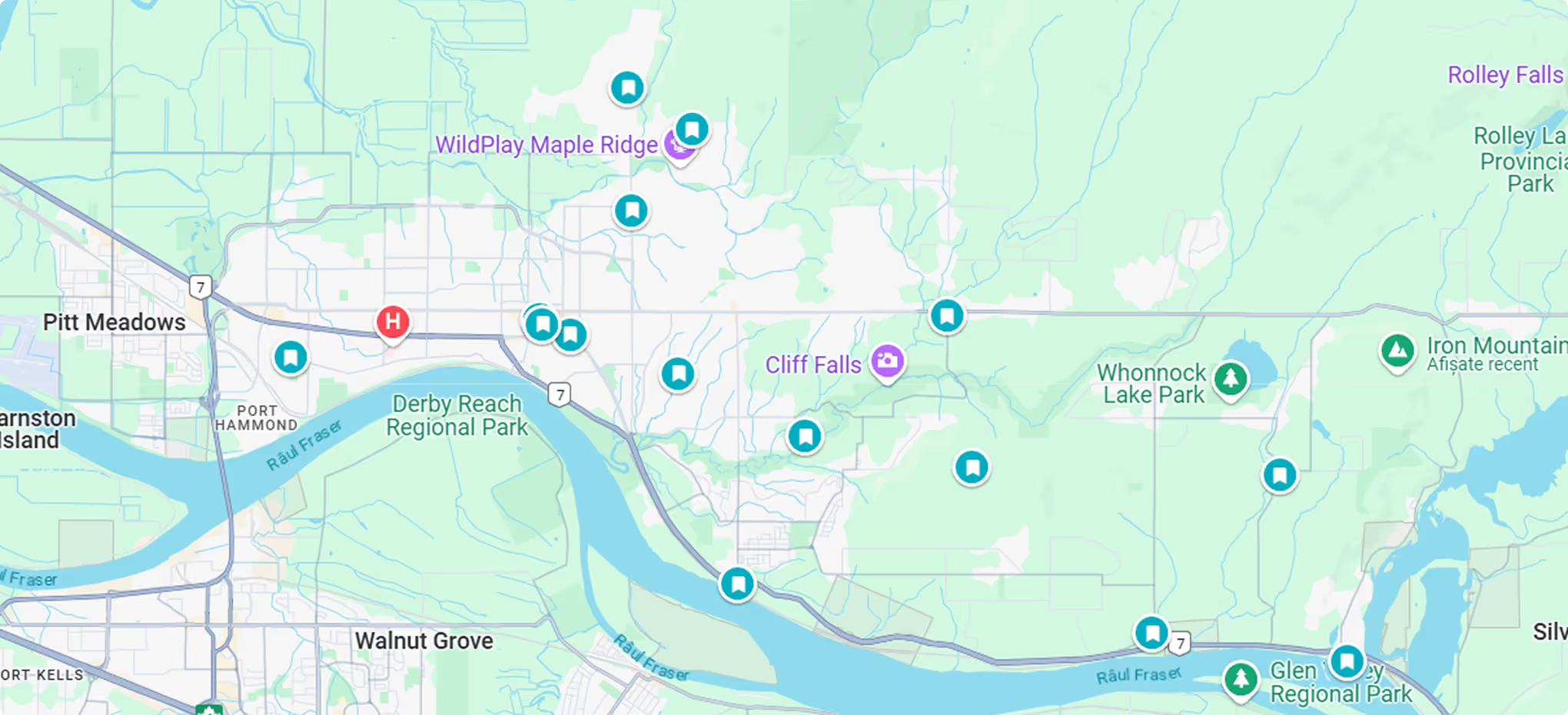
Neighbourhoods in the Fraser Valley