
Hardwired vs Plug-in EV Chargers: What We Recommend for Langley Garages
The EV Charging Dilemma for Local Homeowners
If you are researching Hardwired vs Plug-in EV Chargers: What We Recommend for Langley Garages, you might be surprised to learn that setting up a home charging station is rarely a simple plug-and-play upgrade. A common myth among new electric vehicle owners is that charging at home is as easy as buying a unit, mounting it to the wall, and plugging it into a standard heavy-duty outlet. However, the reality of managing high-voltage continuous electrical loads in a residential setting is far more complex.
The core of this dilemma lies in solving a very concrete problem: determining the safest, most reliable, and most efficient Level 2 charging method for your specific residential garage setup. Homeowners face a critical decision point. You must choose between a permanent, fully hardwired charging station that maximizes amperage and continuous-load safety, or a portable plug-in unit that utilizes a standard receptacle. Making the wrong choice can lead to frustratingly slow charging speeds, tripped breakers, or even severe electrical hazards.
To navigate this complex electrical landscape, it helps to partner with experts in residential electrical services. Consulting with qualified Langley electricians ensures your home is equipped to handle the rigorous demands of modern electric vehicles without compromising the safety of your property.
The technical reality: EV chargers pull massive amounts of power for hours at a time. This is not like running a microwave or a television. The sustained draw places an immense strain on your home's electrical panel, wiring, and connections. In the following sections, we will break down the technical comparison between hardwired and plug-in setups based on maximum speed, local electrical codes, and the unique climate factors that affect garage installations.
Understanding Your Two Main Installation Options
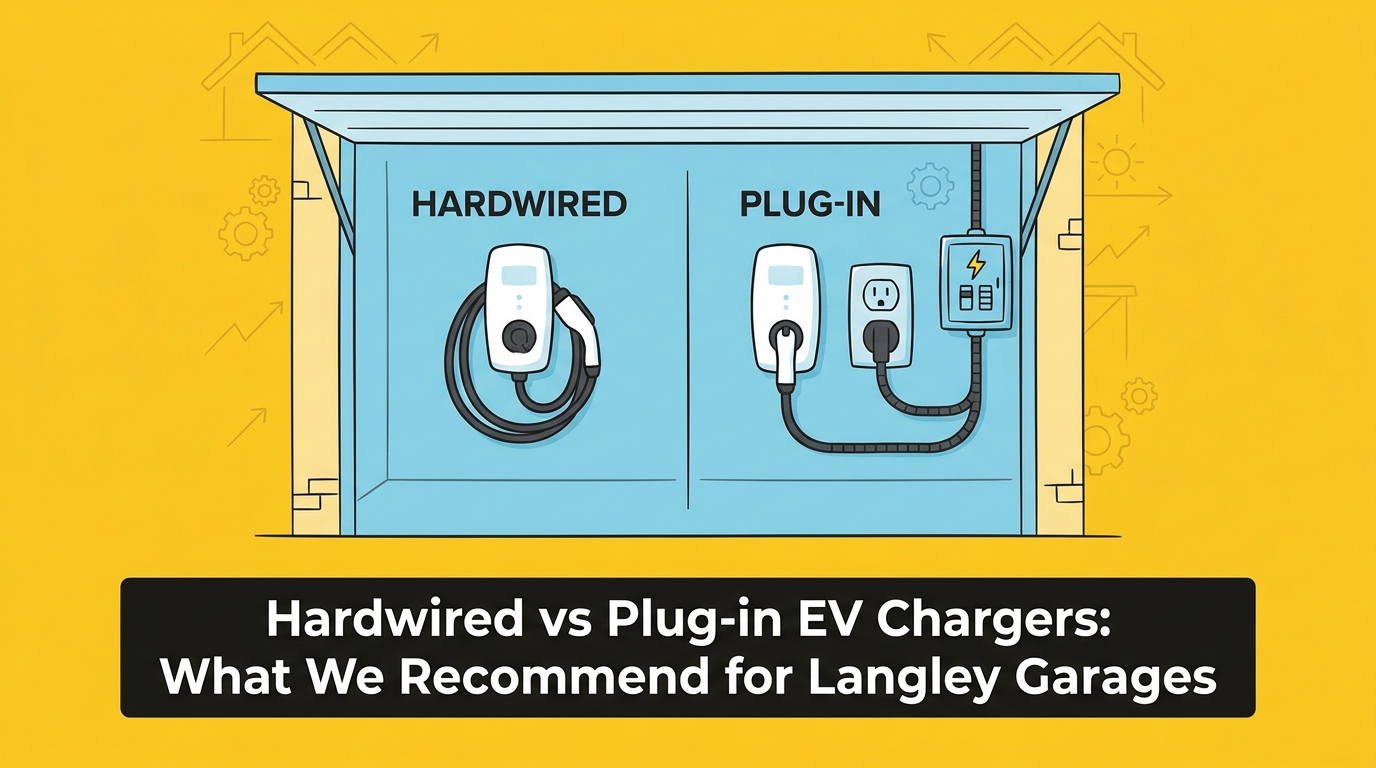
Before diving into the complex electrical codes and load calculations, it is important to establish a clear baseline of what each installation method actually entails. Both methods deliver Level 2 charging speeds, which operate on a 240-volt circuit—the same voltage used by heavy appliances like electric ranges and clothes dryers. However, the way the power travels from your home's electrical panel to the vehicle differs significantly between the two approaches.
The shared requirement: Regardless of which path you choose, both options require a dedicated, high-voltage circuit installed by a professional. You cannot simply tap into an existing lighting or standard outlet circuit. The difference lies entirely at the endpoint—where the charger meets the wall.
The Plug-In Approach
The plug-in method utilizes a specialized high-voltage outlet, almost universally the NEMA 14-50 receptacle. In this setup, the electrician runs wiring from the breaker panel to a wall-mounted box containing the receptacle. The EV charging unit comes with a thick power cord and a matching plug, allowing you to physically plug the unit into the wall.
• Portability advantage: The primary appeal of this setup is flexibility. If you move to a new house or want to take the charger to a secondary property, you can simply unplug the unit from the wall and take it with you.
• Component quality matters: Because EV charging demands sustained power, standard builder-grade receptacles are highly prone to melting under the stress. This setup strictly requires heavy-duty, industrial-grade components to safely manage the heat generated during an overnight charge.
• Maintenance access: If the charging unit itself fails, replacing it is as simple as unplugging the broken unit and plugging in a new one, without requiring an electrician to disconnect the wiring.
The Hardwired Approach
A fully hardwired EV charging station eliminates the physical plug and the wall receptacle entirely. Instead, the electrician runs the wiring directly from the home's electrical panel straight into the internal terminal block of the charging unit itself. The unit is permanently affixed to the wall.
• An unbroken connection: By removing the plug and receptacle, you remove two physical connection points. Fewer connection points mean less electrical resistance, which translates directly to less heat generation and a significantly lower risk of thermal failure.
• Aesthetic benefits: Hardwired systems generally result in a much cleaner, streamlined look on your garage wall. There are no bulky plugs or thick cables hanging down to a separate outlet box.
• Permanence: While the unit is permanently attached to the home, removing it in the future still only requires a brief service call to cap the wires safely.
Speed and Power: Pushing the Limits of Continuous Load
One of the most significant differences between a NEMA 14-50 receptacle setup and a hardwired installation is the maximum charging speed they can safely deliver. To understand why this limitation exists, we must look at how electrical codes define continuous loads.
Electric vehicle charging is classified as a "continuous load" because it draws maximum power for more than three hours at a time. The 80% continuous load rule dictates that a circuit can only be loaded to 80% of its total breaker capacity for continuous use. Here is how that rule affects your charging speeds in a step-by-step breakdown:
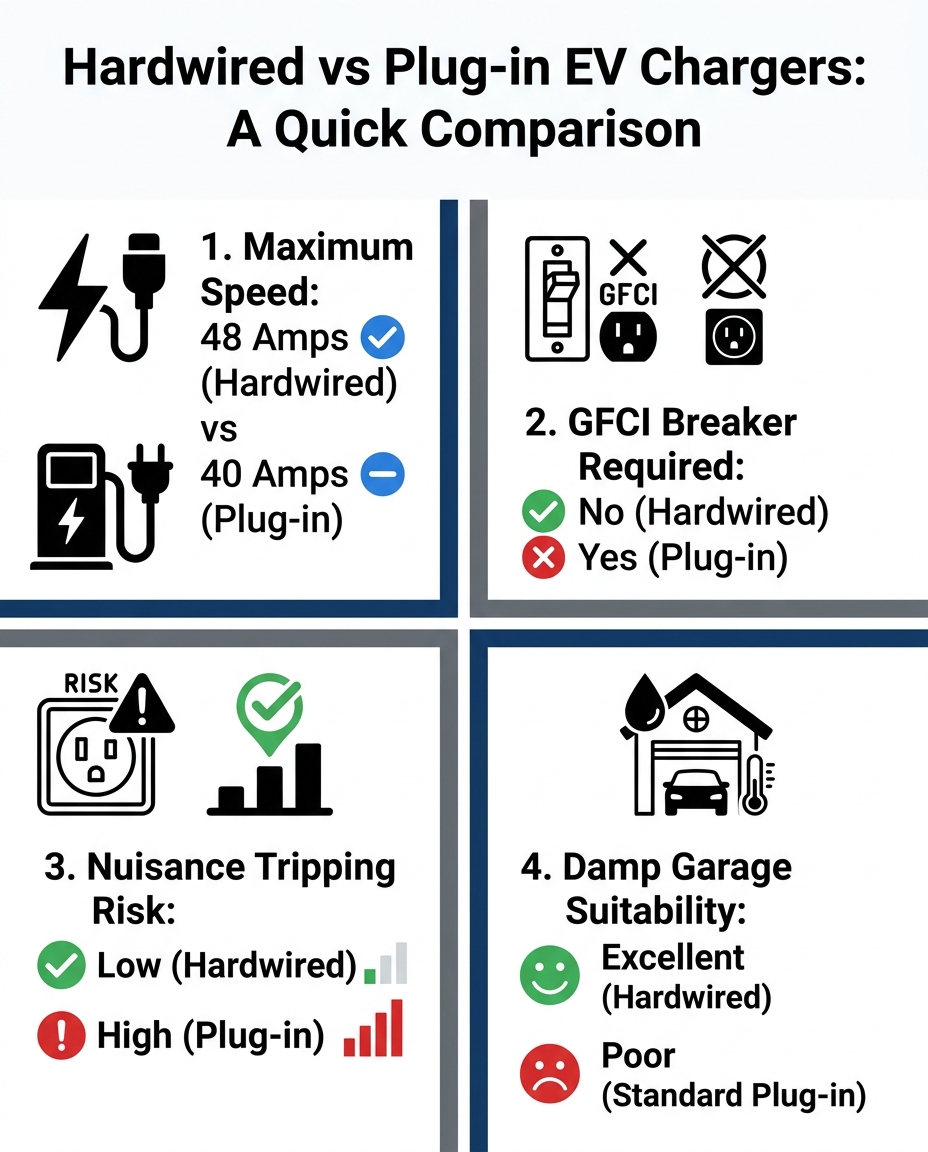
1. Calculating the Plug-In Limit: A NEMA 14-50 receptacle is rated for a maximum 50-amp circuit. Applying the 80% rule, the absolute maximum power a plug-in charger can draw is 40 amps (which equals about 9.6 kW of power). For many drivers, 40 amps is sufficient for overnight charging, but it leaves performance on the table for vehicles capable of accepting faster charge rates.
2. Unlocking the Hardwired Advantage: Because hardwired chargers do not rely on a 50-amp rated plug, they can be installed on larger dedicated circuits. If your panel has the capacity, an electrician can install a 60-amp breaker and hardwire the unit directly. Applying the 80% rule to a 60-amp circuit allows the charger to deliver a full 48 amps (11.5 kW). This difference can shave hours off the time it takes to fully recharge a large-battery electric truck or SUV.
3. Assessing Panel Capacity: Maximizing your charging speed to 48 amps requires significant available capacity in your home's main electrical panel. Older homes with 100-amp or even standard 200-amp services may struggle to support this massive additional load while running an electric furnace, a hot tub, or an electric range simultaneously. In many cases, achieving top-tier charging speeds safely will require a service upgrade, such as upgrading to a 400 amp panel, to ensure the home's total electrical infrastructure is not overwhelmed.
The takeaway on speed: If your priority is adding the maximum number of miles to your vehicle's range per hour of charging, the hardwired approach is the only way to safely bypass the 40-amp limitation of standard plug-in setups.
Navigating BC Electrical Codes and GFCI Requirements
When planning a charging station in Langley, local electrical codes play a massive role in dictating which installation method will provide a reliable experience. The Canadian Electrical Code (Section 86) and guidelines from Technical Safety BC have specific rules regarding Electric Vehicle Energy Management Systems and high-voltage receptacles.
The Problem: Many homeowners who install a NEMA 14-50 receptacle for their EV charger find themselves waking up to a vehicle that stopped charging halfway through the night. This frustrating phenomenon is known as "nuisance tripping," where the breaker in the main panel shuts off the power seemingly without cause.
The Cause: Recent updates to the electrical code mandate that all 240-volt receptacles located in a garage or outdoors must be protected by a Ground Fault Circuit Interrupter (GFCI) breaker at the panel. This rule is designed to protect people from shocks in damp environments. However, almost all modern Level 2 EV chargers already feature their own built-in GFCI safety mechanisms. When the GFCI breaker in the electrical panel detects the self-testing signals from the GFCI inside the EV charger, the two systems conflict. The panel breaker misinterprets the charger's safety check as an actual electrical fault and trips the circuit, cutting off power to the car entirely.
The Solution: Hardwiring the charger completely bypasses this specific code requirement. Because a hardwired unit is permanently connected and does not use a physical receptacle, the code does not require a GFCI breaker at the panel. The charging unit relies on its own internal, highly calibrated safety systems. By choosing a hardwired installation, you eliminate the overlapping safety mechanisms, effectively curing the nuisance tripping problem and ensuring your vehicle actually charges uninterrupted through the night.
How Coastal Weather Impacts Your Garage Electronics
Beyond electrical codes and load limits, the physical environment of your garage plays a surprisingly large role in the longevity and safety of your charging equipment. The climate context is especially relevant for homeowners in the Fraser Valley.
The reality of Langley winters: The region is known for its damp, rainy, and highly humid winter months. Most residential garages are unheated and poorly insulated, meaning the air inside the garage closely mirrors the damp coastal conditions outside. Over the course of a long, wet winter, moisture and condensation easily build up on cold surfaces inside the garage.
The degradation of plug-in receptacles: When a NEMA 14-50 receptacle is exposed to high humidity and fluctuating temperatures, the metal contacts inside the plug begin to oxidize. Over time, this oxidation creates microscopic layers of resistance on the metal prongs. When you push 40 amps of continuous electrical current through oxidized, resistant contacts for eight hours straight, the resistance generates extreme heat. This is the primary reason why plug-in receptacles in unheated, damp garages are prone to melting, smoking, or even catching fire after a few years of regular use.
The weather-sealed advantage: Hardwired EV chargers offer a vastly superior safety profile in damp environments. Because the electrical connections are made deep inside the weather-sealed casing of the charging unit, they are completely isolated from the humid garage air. There are no exposed metal prongs or wall receptacles to oxidize. For a coastal climate where dampness is unavoidable, eliminating the exposed plug is one of the most effective ways to weather-proof your high-voltage charging setup.
Side-by-Side Comparison: Which Setup Wins?
To synthesize the technical data, let's look at a direct comparison between the two methods. When evaluating a NEMA 14-50 receptacle against a direct hardwired connection, clear differences emerge in performance, safety, and local code compliance.
• Maximum Charging Speed — Plug-In (NEMA 14-50 Receptacle): Limited to 40 Amps (9.6 kW) — Hardwired Connection: Up to 48 Amps (11.5 kW) or higher
• Hardware Failure Points — Plug-In (NEMA 14-50 Receptacle): Higher (Plug, receptacle, and breaker) — Hardwired Connection: Lower (Direct unbroken connection)
• BC Code GFCI Requirement — Plug-In (NEMA 14-50 Receptacle): GFCI Breaker Required (High risk of conflict) — Hardwired Connection: No GFCI Breaker Required at the panel
• Nuisance Tripping Risk — Plug-In (NEMA 14-50 Receptacle): High (Due to overlapping GFCI systems) — Hardwired Connection: Very Low (Relies on internal charger safety)
• Damp Garage Suitability — Plug-In (NEMA 14-50 Receptacle): Poor (Prone to oxidation and thermal risks) — Hardwired Connection: Excellent (Weather-sealed internal wiring)
• Portability — Plug-In (NEMA 14-50 Receptacle): Excellent (Can be unplugged and moved easily) — Hardwired Connection: Poor (Permanently affixed to the wall)
The definitive verdict: While the plug-in method offers the convenience of portability, the hardwired approach wins decisively in every category related to safety, charging speed, and long-term durability. For a permanent residential installation, hardwiring removes the weakest links in the electrical chain.

Ensuring a Safe, Code-Compliant Setup
Regardless of the method you lean toward, setting up an EV charger is never a weekend DIY project. The continuous thermal loads generated by electric vehicles pose extreme fire risks if the wiring is not sized correctly or if the connections are not secured to precise specifications.
The danger of standard components: It cannot be overstated that standard dryer outlets are not built to withstand EV charging. A cheap receptacle bought off the shelf at a hardware store is designed to run a dryer for 45 minutes at a time, not a vehicle for ten hours. If a plug-in setup is absolutely necessary for your situation, it requires specialized industrial-grade components that are engineered specifically for continuous heat dissipation.
The importance of torque specifications: High-voltage wiring expands and contracts as it heats up and cools down during the charging cycle. If the lugs inside the panel or the charger are not tightened using a specialized torque screwdriver to the exact inch-pound specifications required by the manufacturer, the connections will eventually vibrate loose. Loose connections create electrical arcing, which is a leading cause of electrical fires.
Why local expertise matters: Working with certified local electricians who deeply understand BC electrical codes guarantees a safe, compliant installation. Professionals ensure that load calculations are performed accurately, the proper permits are pulled, and the home is protected against continuous load hazards. When planning any major home electrical upgrades, relying on qualified experts is the only way to ensure your property remains safe and fully insured.
Frequently Asked Questions About Home EV Charging
Is it better to hardwire an EV charger or plug it in?
Hardwiring is generally better for safety, maximum charging speed, and avoiding GFCI nuisance tripping. A hardwired connection eliminates the physical receptacle, which removes a common failure point that can melt or degrade under continuous electrical loads. While a plug-in setup offers portability, a hardwired unit provides a much more stable and reliable long-term charging experience for daily use.
Does a plug-in EV charger need a GFCI breaker?
Yes, current electrical codes require GFCI protection for 240V receptacles located in garages or outdoors. This mandate is meant to protect against shocks in potentially damp environments. However, because most EV chargers have their own internal GFCI safety systems, pairing them with a GFCI breaker at the panel often leads to conflicting signals and frustrating nuisance tripping that stops the charging process.
What is the maximum amperage for a plug-in EV charger?
Due to the 80% continuous load rule, a charger utilizing a 50-amp NEMA 14-50 receptacle is limited to 40 amps of output. Electrical codes mandate that devices running for longer than three hours cannot exceed 80% of the circuit's total rated capacity. To achieve faster charging speeds like 48 amps, the unit must be hardwired on a dedicated 60-amp circuit.
Can I leave my EV charger plugged in all the time?
Yes, you can leave your EV charger plugged into the wall receptacle all the time, but the receptacle itself must be built to handle it. Standard residential receptacles can degrade over time if subjected to constant thermal cycling and moisture in an unheated garage. If you plan to leave a unit permanently plugged in, an industrial-grade receptacle is absolutely required to prevent the contacts from oxidizing and overheating.
Are there rebates available for installing an EV charger?
Various provincial and utility incentive programs may apply to qualifying EV charger installations. These programs frequently change and can help offset the cost of both the charging unit and the required electrical panel upgrades. Homeowners should always verify current programs with their local utility provider or a tax professional before beginning the installation process to ensure all eligibility criteria are met.
Ready to Power Up Your Vehicle Safely?
A clear, technical breakdown of charging speeds, safety profiles, and electrical requirements provides a definitive recommendation for a safe and efficient home setup: hardwiring is the superior choice for modern garages. By choosing a hardwired installation, you eliminate the overlapping GFCI requirements that cause nuisance tripping, bypass the 40-amp limit of standard plugs, and protect your home from the thermal risks associated with degrading receptacles in damp environments.
Stop guessing about local code requirements, continuous load rules, and your home's current panel capacity. Making the right choice for your garage requires professional insight and precise electrical calculations. When you are ready to finalize your decision on Hardwired vs Plug-in EV Chargers: What We Recommend for Langley Garages, reach out to local electrical experts for a comprehensive panel assessment and a secure, code-compliant installation quote.
hear what our satisfied clients have to say
Neighbourhoods in the Fraser Valley