Upgrading from 1-Inch to 4-Inch Media Filters: Is the Modification Worth It?

The High-MERV Dilemma: Are Standard Filters Choking Your HVAC System?
Slapping the highest-rated pleated filter you can find into a standard furnace slot doesn't automatically improve your home's air—in fact, it might be quietly suffocating your equipment. Upgrading from 1-Inch to 4-Inch Media Filters: Is the Modification Worth It? At Rep-Air Heating and Cooling, we hear homeowners across Mission BC ask this exact question when they realize that dropping a dense, high-efficiency filter into a standard slot doesn't just trap dust; it actively traps airflow. In our experience, the modern push for better indoor air quality has led to a major mechanical conflict inside residential ductwork.
If you are exploring indoor air quality solutions, you must balance filtration capability with mechanical safety.
The False Promise of Dense 1-Inch Filters
Standard 1-inch filter racks were originally designed decades ago for one primary purpose: keeping large debris like pet hair, heavy dust, and carpet fibers out of the furnace blower and heat exchanger. They were never engineered to purify the air you breathe. When we visit homes for routine maintenance, our technicians frequently see homeowners attempting to upgrade their air quality by purchasing 1-inch filters with high MERV (Minimum Efficiency Reporting Value) ratings, inadvertently creating a massive roadblock for their HVAC system.
The concrete problem is that HVAC systems struggle heavily with high airflow restriction, reduced efficiency, and blower motor strain when forced to pull air through these dense 1-inch pleated filters. The tight weave required to catch microscopic particles leaves very little room for air to pass through. This brings homeowners to a critical decision point: whether the upfront ductwork modification to have our team install a custom 4-inch media filter cabinet is mechanically and practically justified over continuing to swap out standard 1-inch filters every few weeks.
The Physics of Airflow Restriction and Static Pressure
To understand why a 1-inch high-efficiency filter is so problematic, we have to look at the physics of how air moves through your ductwork. The key metric our diagnostic team looks at is static pressure. In accessible terms, static pressure is the resistance to airflow within the ductwork. Your furnace or air handler is essentially a giant air pump; it has to push air through the supply ducts and pull air through the return ducts. The filter sits right in the middle of that return path, acting as a deliberate obstruction.
Addressing this mechanical reality is a core component of our professional heating system services.
Understanding Inches of Water Column
Static pressure is measured in "inches of water column" (in. w.c.). Most residential HVAC systems are designed to operate safely at a total external static pressure of about 0.5 in. w.c. When evaluating the MERV 8 to MERV 13 static pressure differences in a 1-inch format, the numbers we record in the field are alarming. A standard 1-inch MERV 8 filter might add 0.15 in. w.c. of resistance. However, dropping a 1-inch MERV 13 filter into that same slot can easily spike the resistance to 0.30 or even 0.40 in. w.c. all by itself—consuming almost the entire pressure allowance for the whole duct system before the air even reaches the equipment.
Symptoms of a Choked System
When static pressure pushes beyond the manufacturer's safe limits, the system begins to exhibit clear signs of distress. If you are using a dense 1-inch filter, our service team recommends watching for these operational red flags:
• Weak airflow at the vents: The blower simply cannot pull enough air through the dense filter material, resulting in sluggish air delivery to distant rooms.
• Longer run times: Because less conditioned air is reaching the living spaces, the thermostat takes much longer to satisfy, forcing the system to run continuously.
• Uneven temperatures: Rooms furthest from the blower motor will stay noticeably hotter in the summer and colder in the winter due to inadequate air velocity.
• Short-cycling: In severe cases, the furnace heat exchanger may overheat due to a lack of airflow, triggering the high-limit safety switch and shutting the system down prematurely.
Surface Area: The 4-Inch Media Filter Advantage
The solution to high static pressure isn't to abandon high-quality filtration; the solution is to change the geometry of the filter itself. We always recommend a 4-inch pleated media filter because it solves the airflow restriction problem by vastly increasing the total surface area of the filtering material. By making the filter four times as deep, manufacturers can pack significantly more pleated fabric into the same vertical and horizontal footprint.
This structural advantage translates directly to better air conditioning performance and heating efficiency.
The Geometry of Deep-Pleated Media
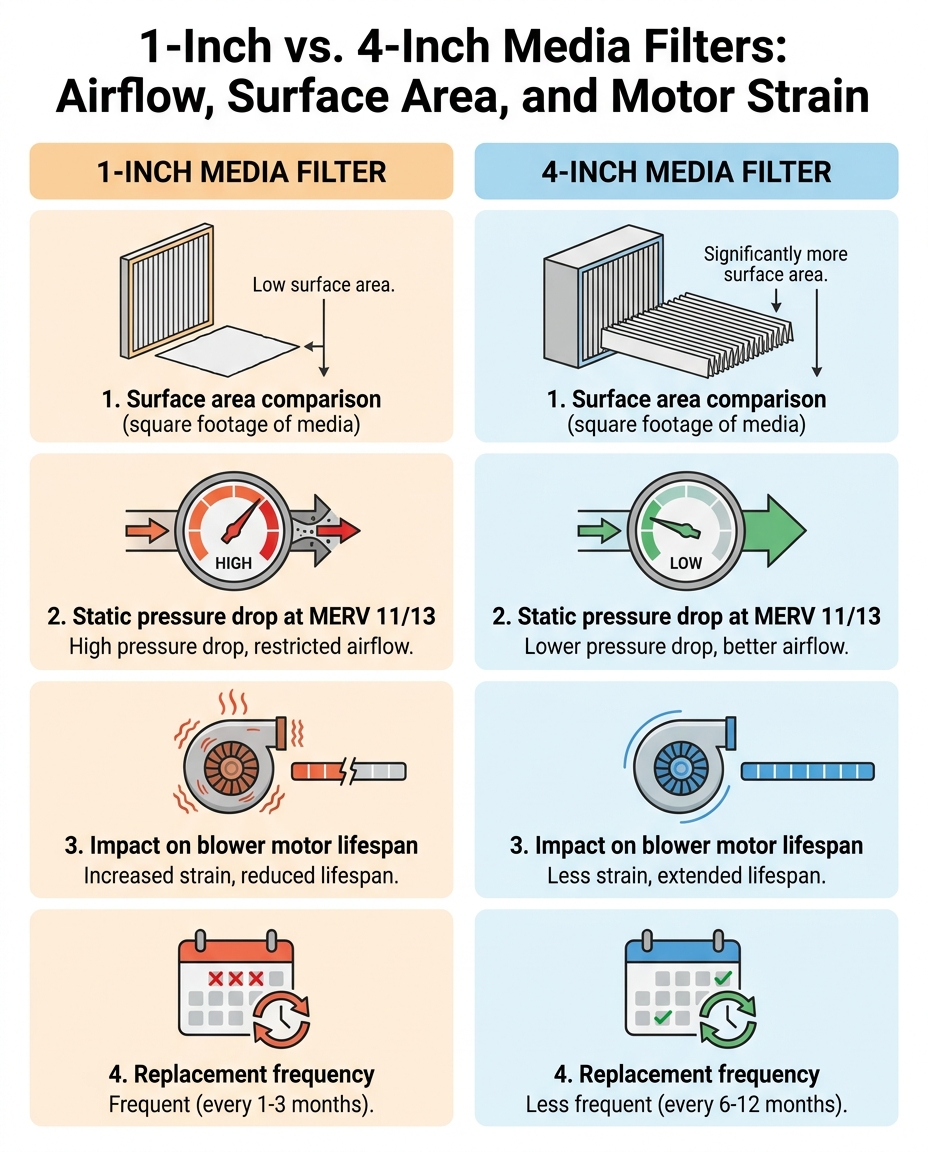
Think of it like trying to breathe through a single paper towel versus breathing through a large, unfolded bedsheet. The larger the surface area, the easier the air passes through, even if the material itself is densely woven. This increased surface area allows a 4-inch cabinet to accommodate high-MERV filtration (MERV 11 to MERV 13) with a significantly lower pressure drop than a basic 1-inch MERV 8 filter.
Side-by-Side Comparison
To clearly illustrate why our team advocates for this modification, we can compare the physical attributes of the two filter formats:
• Total Surface Area — Standard 1-Inch Filter (MERV 11+): Very low (tightly packed, shallow pleats) — 4-Inch Media Filter (MERV 11+): Extremely high (deep, extended pleats)
• Airflow Restriction — Standard 1-Inch Filter (MERV 11+): High (acts as a chokepoint) — 4-Inch Media Filter (MERV 11+): Low (allows air to pass freely)
• Static Pressure Impact — Standard 1-Inch Filter (MERV 11+): Often exceeds safe equipment limits — 4-Inch Media Filter (MERV 11+): Stays well within manufacturer specifications
• Replacement Frequency — Standard 1-Inch Filter (MERV 11+): Every 1 to 3 months — 4-Inch Media Filter (MERV 11+): Every 6 to 12 months
• Equipment Protection — Standard 1-Inch Filter (MERV 11+): Poor (strains blower motor) — 4-Inch Media Filter (MERV 11+): Excellent (reduces mechanical wear)

Protecting Your Blower Motor from Premature Failure
While most homeowners focus on air purification, our HVAC technicians view the 4-inch upgrade primarily as a critical mechanical safeguard. The blower motor is the heart of your ventilation system, and its lifespan is directly tied to the amount of resistance it faces every time it turns on.
Variable-Speed Motors vs. High Static Pressure
Modern furnaces and air handlers are frequently equipped with Electronically Commutated Motors (ECM), also known as variable-speed motors. These intelligent motors are programmed to deliver a specific volume of air (CFM). If a dense 1-inch filter restricts the intake, the ECM will automatically ramp up its RPMs to compensate and force the required air through the bottleneck.
This overcompensation comes at a steep cost. The motor consumes excess electricity and, more dangerously, generates excessive heat. Heat is the natural enemy of electrical components. A motor that constantly runs hot because it is fighting a restrictive filter will experience premature bearing wear and eventual electronic module failure. Framing the cabinet modification as an investment in equipment longevity is accurate; it is a proactive step we strongly recommend to prevent catastrophic mechanical breakdowns.
The True Cost of Overheating
Our emergency dispatch team at Rep-Air Heating and Cooling received a call during a recent summer heatwave when a local family's system failed unexpectedly. With a newborn in the home and a mother recovering from a C-section, waiting days for a repair in stifling heat was not an option. We prioritized an earlier appointment to restore their cooling quickly. Situations like this underscore why preventing motor strain is so critical—when a blower motor burns out from fighting high static pressure, it often happens during periods of extreme weather when the system is running the most, leaving vulnerable families without climate control when they need it most.
Tackling Particulate Matter Safely Year-Round
The need for high-MERV filtration is heavily influenced by regional climate factors. As local HVAC experts serving Mission, BC, we know firsthand that our environment presents unique challenges that demand robust air purification without compromising system airflow.
Understanding these environmental variables is key to knowing how your HVAC affects indoor air quality.
Combating PM2.5 During Wildfire Events
The British Columbia wildfire season introduces heavy particulate matter (PM2.5) into the outdoor air, which inevitably seeps into residential living spaces. These microscopic smoke particles are small enough to bypass the body's natural respiratory defenses. During these intense summer months, high-capacity filtration is an absolute necessity to maintain healthy indoor air.
To capture PM2.5 effectively, a filter must carry a rating of MERV 11 to MERV 13. As established earlier, deploying a MERV 13 filter in a 1-inch slot is mechanically unsafe for the blower motor. A 4-inch media cabinet is the only way to safely deploy this level of filtration, providing the massive surface area needed to trap heavy wildfire smoke while allowing the air conditioner to breathe freely during the hottest days of the year.
Managing Damp Winter Conditions
The challenges don't disappear when the smoke clears. Mission's damp winter conditions require consistent, reliable air circulation to prevent stagnant air and manage indoor moisture levels. If a restrictive 1-inch filter causes the furnace to short-cycle or reduces air velocity, the home is more likely to experience cold spots and stale air. A 4-inch filter ensures that the furnace can move high volumes of air effortlessly throughout the winter, maintaining consistent comfort and protecting the heat exchanger from overheating.
The Ductwork Modification Process: What to Expect
Homeowners are sometimes hesitant to upgrade to a 4-inch media filter because it requires physical changes to the HVAC ductwork. Understanding the professional modification process can alleviate the anxiety associated with custom sheet metal work inside your home.
Integrating this new cabinet is a foundational step in establishing a reliable HVAC maintenance plan for long-term system health.
The Custom Sheet Metal Process
Because a 4-inch cabinet is significantly wider than a standard 1-inch slot, the existing return air drop (the large duct that brings air back to the furnace) must be modified. This is strictly a job for licensed professionals. When you hire our team, the process involves precise sheet metal cutting to fit the new, wider housing seamlessly between the return duct and the furnace cabinet.
1. Assessment and Measurement: Our technicians measure the existing return drop and furnace dimensions to select the appropriately sized media cabinet.
2. Sheet Metal Cutting: We carefully cut away a section of the existing return drop to make room for the new housing.
3. Cabinet Installation: The heavy-duty metal filter cabinet is securely mounted directly to the side or bottom of the furnace.
4. Sealing and Reconnection: The return duct is reconnected to the new cabinet. We ensure our modifications maintain the airtight seal necessary for system efficiency, guaranteeing no unfiltered basement or utility room air is pulled into the system.
Maintaining a Clean Environment
Concerns about mess and disruption during the metal-cutting process are common, but they shouldn't deter you from making a necessary mechanical upgrade. At Rep-Air Heating and Cooling, our technicians adhere to a strict Drop-Cloth and Bootie Promise to ensure that your home is meticulously protected. We treat the sheet metal modification as a clean, professional process, completely removing all metal shavings, old ducting, and debris from the home, leaving zero mess behind.
Frequently Asked Questions
Do 4 inch filters restrict airflow?
No, 4-inch filters actually improve airflow compared to high-efficiency 1-inch filters. Because they have deep pleats, they offer significantly more surface area for the air to pass through. This large surface area reduces static pressure, allowing your blower motor to move air easily even when using a high-MERV rating.
Can I use a MERV 13 filter in a 1 inch slot?
As HVAC professionals, we strongly advise against using a MERV 13 filter in a 1-inch slot. The dense material required to achieve a MERV 13 rating in such a small surface area creates massive airflow restriction. This can lead to frozen evaporator coils in the summer, overheated heat exchangers in the winter, and premature blower motor failure.
Is a 4 inch filter better than a 1 inch?
Yes, a 4-inch filter is mechanically superior in almost every way. It provides better filtration without choking the system, protects the blower motor from heat damage, and only needs to be replaced once or twice a year. It is the ideal solution for balancing indoor air quality with HVAC equipment longevity.
How often should a 4-inch media filter be replaced?
Most 4-inch media filters only need to be replaced every 6 to 12 months, depending on your household environment. Homes with multiple pets, heavy dust, or those running their systems continuously during wildfire season may need to check and replace the filter closer to the 6-month mark to ensure optimal airflow.
Does installing a media cabinet require major ductwork changes?
Installing a media cabinet requires a minor, localized modification to the return air duct right next to the furnace. One of our technicians will cut a small section of the sheet metal to slide the new, wider cabinet into place and then seal it airtight. It is a routine procedure that we typically complete in a few hours without disrupting the rest of your home's ductwork.
The Final Verdict on Filter Upgrades
Upgrading to a 4-inch media cabinet is a mechanically sound decision that protects your equipment while delivering the high-level filtration necessary for heavy particulate environments. By eliminating the chokepoint of standard 1-inch slots, you secure a clear path to better air quality, lower static pressure, and a longer lifespan for your entire HVAC system.
hear what our satisfied clients have to say
Neighbourhoods in the Fraser Valley