Why Your Central Air is Tripping the Breaker During August Heatwaves
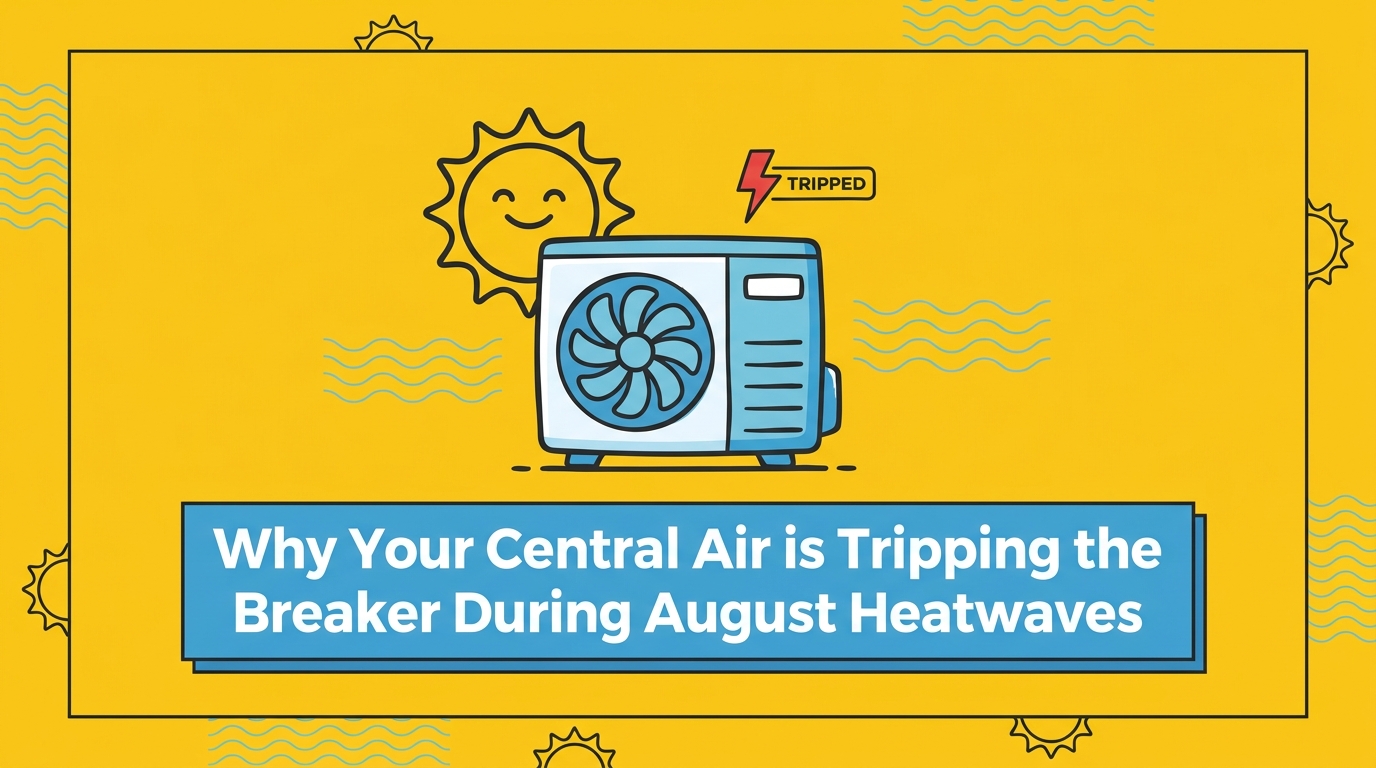
The Heatwave Dilemma: When the Cold Air Suddenly Stops
At Rep-Air Heating and Cooling, our team knows firsthand that summer in the Fraser Valley brings intense temperatures, and understanding exactly why your central air is tripping the breaker during August heatwaves is the key to preventing a catastrophic mid-summer breakdown. It is a highly stressful scenario: the house is sweltering, the vents have gone completely silent, and a quick check of your basement or garage electrical panel reveals the culprit, a tripped breaker switch. The immediate temptation is to simply flip that switch back to the "on" position to force the system to run and restore comfort to your home. However, that tripped breaker is not a nuisance, a glitch, or a minor inconvenience. It is a critical safety mechanism actively stepping in to prevent an electrical fire.
Addressing this sudden loss of cooling requires a comprehensive look at both your heavy-duty cooling equipment and your home's electrical infrastructure to ensure your property remains safe. If you are dealing with a sudden cooling failure, exploring professional air conditioning systems diagnostics and scheduling a professional electrical inspection are the safest next steps to take.
The Hidden Danger of the Breaker Reset Loop
When a circuit breaker trips, it is responding to a dangerous surge of electrical current that exceeds the safe capacity of your home's wiring. Repeatedly resetting a tripped AC breaker creates a highly dangerous cycle known as the "reset loop, " which puts both your mechanical equipment and your property at severe risk.
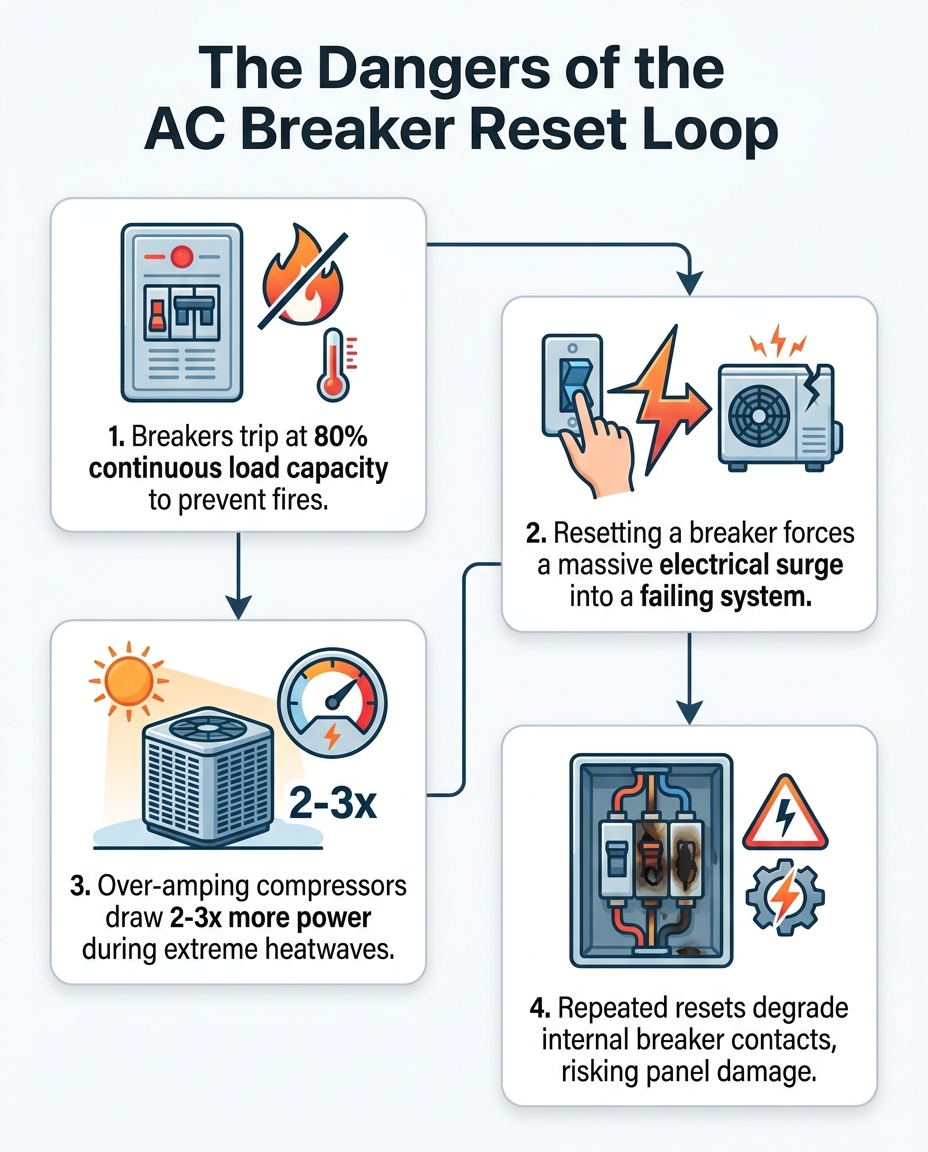
The 80% Rule Explained: The National Electrical Code (NEC) establishes a fundamental safety standard known as the 80% rule for continuous loads. A continuous load is any electrical demand that lasts for three hours or more, which perfectly describes an air conditioner running during August heatwaves. Under this rule, a circuit breaker is designed to trip if the continuous current exceeds 80% of the breaker's maximum rating. This buffer ensures that the wiring inside your walls never gets hot enough to melt its insulation or spark a fire.
Forcing a reset bypasses this essential safety buffer. When you flip a tripped breaker back on without resolving the underlying fault, you send a massive surge of electricity directly into a compromised system. This repeated action degrades the breaker's internal metallic contacts. Over time, a degraded breaker may fail to trip when it is supposed to, drastically increasing the risk of an electrical fire inside the panel itself.
When an AC system is not working correctly, the safest path is immediate professional evaluation. In one real-world instance our team responded to, a homeowner noticed their system struggling and shutting down; rather than forcing the unit to restart repeatedly, they requested an assessment. Our technician quickly assessed the problem and fixed it right away, avoiding severe electrical damage. The strict warning we give to any homeowner is clear: never reset a tripped AC breaker more than once without professional diagnostics to uncover what it means when your AC circuit breaker keeps tripping.
Why the Breaker is Your Home's First Line of Defense
• Thermal detection: Circuit breakers are specifically designed to detect when wiring is drawing too much current and getting dangerously hot.
• Successful intervention: A tripped breaker is a sign of a successful safety intervention, not a system error or a random glitch.
• Panel protection: Bypassing this safety feature by forcing the switch puts the entire electrical panel, and your home, at extreme risk.

Decoding Compressor Over-Amping in Plain English
To understand why the breaker is tripping, you have to look at the mechanical failure happening inside the outdoor condenser unit. The most common culprit behind a tripped AC breaker is a highly technical issue known as "compressor over-amping." While the term sounds complex, the underlying concept is straightforward when broken down.
Understanding Amperage: Think of electrical voltage as the water pressure in a pipe, and "amperage" (or amps) as the actual volume of water flowing through that pipe. Your air conditioner's compressor, the heavy-duty engine that pumps refrigerant through the system, requires a specific volume of electricity (amperage) to do its job. When the compressor struggles mechanically, it attempts to pull more power from the electrical panel to compensate for its struggle. This excessive draw of electrical volume is what professionals call over-amping.
One of the primary triggers for over-amping is a failing dual-run capacitor. The capacitor acts like a high-powered battery that provides the initial electrical jolt needed to get the heavy compressor motor spinning. If the capacitor is weak or dying, the compressor has to work significantly harder to start up, forcing it to draw dangerous amounts of electricity. This massive spike in amperage exceeds the safe limit of the circuit, causing the breaker to trip immediately.
Because over-amping involves high-voltage components and complex motor diagnostics, it is a severe mechanical fault requiring a licensed technician. In our years of serving Mission BC neighborhoods, we have seen firsthand how attempting a DIY fix on a system that is actively over-amping can lead to severe injury or further destruction of the cooling equipment.
• Normal Operation — Amperage Draw: Within manufacturer specifications (steady draw) — Result on Electrical Panel: Breaker remains engaged, system cools properly
• Failing Capacitor — Amperage Draw: Spikes heavily during startup only — Result on Electrical Panel: Breaker trips immediately upon system startup
• Mechanical Over-amping — Amperage Draw: Consistently high and climbing over time — Result on Electrical Panel: Breaker trips after 10-15 minutes of operation
• Grounded Compressor — Amperage Draw: Massive, instantaneous electrical short — Result on Electrical Panel: Breaker trips instantly, often with an audible pop
How Unrelenting Heat Multiplies Electrical Strain
The technical phenomenon of over-amping does not happen in a vacuum; it is heavily influenced by the specific seasonal climate context. When August heatwaves arrive, the ambient environment places an extraordinary burden on residential cooling systems. Air conditioners do not actually "create" cold air; instead, they absorb heat from inside your home and pump it outside. This process of heat rejection becomes exponentially more difficult when the outdoor air is already sweltering.
With summer temperature spikes pushing residential central air systems to run continuously at maximum capacity, the compressor is forced to work up to three times harder just to reject the captured heat. Our HVAC technicians frequently see how the Fraser Valley climate can push ambient temperatures high enough that the system's normal operational parameters are stretched to their absolute limits.
During milder weather, an air conditioner cycles on and off, providing the compressor and electrical components with crucial "cooling-off" periods. Extreme heatwaves eliminate these resting phases entirely. The lack of downtime accelerates mechanical wear on moving parts and increases the electrical draw exponentially as the motor runs hot for hours on end. Systems that are already on the brink of failure, perhaps due to a weakened capacitor or dirty condenser coils, will inevitably over-amp when pushed by severe weather.
This unrelenting strain means that a system might run perfectly fine in June, only to suffer a catastrophic breaker-tripping failure during the hottest weeks of August. The heat acts as a multiplier for any pre-existing electrical or mechanical weakness in the equipment.
Beyond the AC: When the Electrical Panel is at Risk
When an air conditioner continually over-amps, the emergency bridges the gap between a standard HVAC repair and critical electrical safety. Severe over-amping doesn't just damage the air conditioner outside; it directly threatens the electrical panel inside your home. The dual nature of this emergency is why a tripped breaker must be taken so seriously.
The bus bar inside your electrical panel is the metallic spine that distributes power to individual circuits. When a breaker overheats repeatedly due to a struggling AC compressor, that intense heat transfers directly to the bus bar. Over time, this can lead to melted wire insulation, scorched breaker contacts, and permanent damage to the panel itself. Fixing the air conditioner will not magically repair a breaker that has been thermally degraded by repeated resets.
This crossover between trades highlights the importance of having a professional who can evaluate both systems simultaneously. Properly addressing these complex issues sometimes requires careful coordination. During a recent system installation our Rep-Air Heating and Cooling team handled in Mission BC, a project was temporarily delayed due to an electrician being late to the site. Our HVAC technician waited patiently, completed the installation alongside the electrical work, and thoroughly explained the system with instructions, ensuring both the mechanical and electrical sides were handled safely.
Working with a company that offers dual expertise in HVAC and electrical systems ensures transparent diagnostics. A cross-trained professional will find the root cause of the over-amping rather than offering a dangerous band-aid fix. Homeowners should be wary of hiring technicians who only address the AC unit while completely ignoring the potential thermal damage inflicted on the electrical panel.
Proactive Defense: Stopping the Surge Before It Starts
Transitioning from emergency troubleshooting to proactive defense is the best way to protect your home from sudden cooling failures. Routine electrical and mechanical checks prevent over-amping scenarios entirely by catching weakened components before they fail under the stress of August heatwaves.
A structured maintenance approach keeps the system running safely during continuous loads. Before the peak season hits, one of our licensed technicians will perform a comprehensive evaluation of the system's electrical health. This involves using a specialized multimeter to measure the exact microfarad reading of the dual-run capacitor. If the capacitor is falling out of its acceptable range, it can be replaced proactively, preventing the compressor from ever experiencing a hard, over-amping start.
Furthermore, technicians will measure the active electrical draw of the compressor while it is running. By comparing the actual amperage against the manufacturer's data plate, they can determine if the motor is beginning to struggle mechanically. Cleaning the outdoor condenser coils, checking refrigerant pressures, and tightening electrical connections all work together to reduce the total workload on the compressor.
Proactive care protects the lifespan of both the cooling equipment and the electrical panel. By enrolling in a preventative maintenance plan, homeowners ensure their systems are verified safe for continuous operation, greatly reducing the risk of a tripped breaker when the worst of the summer heat arrives.
Frequently Asked Questions About Heatwaves and Tripped Breakers
Why does my AC trip the breaker on hot days?
Your AC trips the breaker on hot days because extreme temperatures force the compressor to work continuously without resting, leading to mechanical strain. This continuous operation causes the system to draw more electrical current (amperage) to keep up with the cooling demand. When that electrical draw exceeds 80% of the breaker's safe capacity, the breaker trips to prevent the wires from overheating and causing a fire.
Is it safe to reset a tripped AC breaker?
It is generally safe to reset a tripped AC breaker exactly one time, as power surges or minor electrical fluctuations can occasionally cause a nuisance trip. However, if the breaker trips a second time, it is absolutely not safe to reset it again. Repeatedly forcing the breaker on sends dangerous surges of electricity into a failing system and can melt the internal components of your electrical panel.
What does compressor over-amping mean?
Compressor over-amping means the air conditioner's main motor is pulling a higher volume of electricity than it is safely rated to handle. This usually happens when the compressor is struggling mechanically: often due to a failing capacitor, extreme heat, or a failing motor, and tries to compensate by drawing more power. This excessive electrical draw triggers the circuit breaker to shut off the power immediately.
How many times can you reset an AC breaker?
You should only ever reset an AC breaker one single time. If the breaker trips immediately after resetting, or trips again within a few hours, you must leave it in the "off" position. Continuing to reset the breaker degrades its internal safety mechanisms and significantly increases the risk of an electrical fire in your home.
Should I turn my AC off if the breaker trips?
Yes, you should turn your AC thermostat to the "off" position immediately if the breaker trips. If you reset the breaker while the thermostat is still calling for cooling, the system will try to start under a heavy load, which can cause further damage. Always turn the thermostat off, reset the breaker once, wait a few minutes, and then turn the thermostat back on to test the system safely.
Can a failing capacitor cause the breaker to trip?
Yes, a failing capacitor is one of the most common reasons an AC breaker trips. The capacitor acts as a powerful battery that gives the compressor the massive electrical boost it needs to start spinning. When the capacitor is weak or dead, the compressor struggles to start and pulls a dangerous amount of electricity from the panel, instantly tripping the breaker.
Secure Your Home's Cooling and Electrical Safety
A tripped breaker during the peak of summer is never a minor inconvenience; it is a critical warning sign of compressor over-amping and electrical strain. When the ambient heat pushes your central air system beyond its limits, the circuit breaker acts as the ultimate safeguard, intervening to protect your home from melted wiring and potential electrical fires. Ignoring this problem or attempting dangerous DIY resets will only accelerate mechanical failure and put your entire electrical panel at risk.
If you find yourself facing a sweltering home and a tripped breaker in Mission BC, leave the switch off and prioritize your safety. Reach out to our team at Rep-Air Heating and Cooling for professional, dual-certified diagnostics to evaluate both the cooling equipment and the electrical infrastructure. By addressing the root cause of the over-amping, we can help you restore safe, reliable cooling to your home and enjoy the rest of the summer with total confidence in your system's performance.
hear what our satisfied clients have to say
Neighbourhoods in the Fraser Valley