200 vs 400 Amp Residential Panels: When Your BC Home Actually Needs the Upgrade

The Myth of Unlimited Power: Why Modern Homes Outgrow Standard Panels
In our daily work at Rep-Air Heating and Cooling, we frequently hear homeowners assume their breaker box has infinite capacity. However, evaluating 200 vs 400 Amp Residential Panels: When Your BC Home Actually Needs the Upgrade is actually a matter of strict mathematical limits. A widespread myth we encounter in home improvement is that as long as there is physical space for another breaker switch in the box, you can keep adding new appliances. The reality of modern home electrification tells a very different story.
As we transition away from fossil fuels, our team sees homes taking on heavier electrical burdens than ever before. If you are planning to add a new heat pump, install a Level 2 electric vehicle (EV) charger, and perhaps put a hot tub in the backyard, you are rapidly approaching a critical tipping point. These high-draw additions can easily max out a standard 200-amp residential electrical panel, pushing it beyond its safe operating capacity.
This creates a significant decision point for homeowners. Do you proceed with a full service upgrade, or can you manage the load with smart technology? Making the right choice requires moving away from guesswork and looking at the hard numbers. By understanding how your home consumes power, you can evaluate contractor recommendations for residential electrical services with confidence and ensure your electrical system remains safe, reliable, and up to code.
The 80% Rule: Understanding Your True Continuous Load Limit
When our electricians perform home assessments, we always emphasize that to understand why a standard panel runs out of room so quickly, you have to look past the number printed on the main breaker. Just because a panel is rated for 200 amps does not mean you can safely draw 200 amps of power around the clock. The safety of your home's electrical system is governed by a strict mathematical threshold.
What Constitutes a Continuous Load?
In the electrical world, power draw is divided into two categories: non-continuous and continuous. Non-continuous loads are things that turn on and off quickly or run for short bursts. Think of your toaster, a microwave, or a hairdryer. They might draw a lot of power, but they only do so for a few minutes.
A continuous load is defined as any electrical draw that lasts for three hours or more. This is where modern home upgrades change the equation. Charging an electric vehicle overnight, heating a hot tub, and running a heat pump during a cold winter night all qualify as continuous loads because they run for extended, uninterrupted periods.
The 160-Amp Safety Threshold
The Canadian Electrical Code (CEC) mandates an 80% continuous load safety threshold for electrical panels. This rule states that a breaker—and the panel as a whole—should never carry a continuous load that exceeds 80% of its maximum rating.
When we apply this math to a standard 200-amp residential electrical panel, the true limit becomes clear. Eighty percent of 200 amps is exactly 160 amps. Therefore, your 200-amp panel is technically limited to a safe continuous draw of 160 amps. This 80% continuous load safety threshold (160 amps) is the magic number that dictates whether your home can support new appliances.
The Dangers of Pushing Past the Limit
The thermal risk: Why does this 80% rule exist? Heat. Electricity generates heat as it moves through wires and breakers. When a panel runs at full capacity for hours on end, the internal components get dangerously hot. The 20% buffer prevents the wire insulation from melting and the breaker terminals from degrading.
If you consistently exceed the 160-amp continuous limit, you will likely experience nuisance tripping, where the main breaker shuts off the entire house to prevent a fire. More concerningly, a pattern we see often is sustained overloading causing silent damage behind the panel cover, leading to significant safety hazards over time.
The Electrification Draw: Heat Pumps, EV Chargers, and Hot Tubs
In our experience designing systems for fully electrified homes, seeing how quickly a modern setup consumes that 160-amp allowance requires breaking down the specific requirements of today's most popular upgrades. These are not your average household appliances; they require dedicated, high-amperage circuits.
Level 2 EV Chargers
• Typical Continuous Draw: 32 to 40 amps.
• The Impact: Plugging your car in after work usually means it will charge for several hours into the night. Because this easily exceeds the three-hour mark, a standard 40-amp Level 2 charger eats up a full quarter of your panel's 160-amp continuous budget all by itself.
Electric Hot Tubs
• Typical Continuous Draw: 40 to 50 amps.
• The Impact: Hot tubs have powerful electric heaters and circulation pumps that work hard to maintain water temperature, especially during colder months. When the heater and jets are running simultaneously, a hot tub demands a massive chunk of your available power.
Modern HVAC Solutions
• Typical Continuous Draw: 20 to 40 amps.
• The Impact: Whether you are installing a central system or a mini split system, heating and cooling require significant sustained power. While inverter technology has made these units incredibly efficient, the compressor still runs continuously during extreme weather. If your system relies on auxiliary electric resistance heat strips during a deep freeze, that amperage draw spikes even higher.
The Cumulative Math Problem
Let's look at a standard 200-amp residential electrical panel under this load. If your EV charger draws 40 amps, your hot tub draws 40 amps, and your heat pump draws 30 amps, you are already at 110 amps of continuous load. That leaves only 50 amps of continuous capacity for the entire rest of your house—including your electric water heater, electric oven, clothes dryer, refrigerator, and all lighting. It becomes mathematically impossible to run everything at once without breaking the 80% continuous load safety threshold (160 amps).
Hitting the Tipping Point: 200 vs 400 Amp Residential Panels
We regularly walk clients through this exact math, and when the numbers no longer work in your favor, you have officially reached the tipping point. This is the moment where upgrading to a 400 amp panel for home use transitions from a luxury to a mathematical necessity.
Comparing the Continuous Limits
Just as a 200-amp panel is limited by the 80% rule, so is a 400-amp service. However, the scale is vastly different. A 400-amp panel provides a safe continuous load limit of 320 amps. This effectively doubles your home's capacity, providing massive headroom for simultaneous appliance operation.
• Standard 200 Amp — Maximum Rating: 200 Amps — Safe Continuous Limit (80% Rule): 160 Amps — Best Suited For: Homes with gas heating, basic appliances, and minimal high-draw upgrades.
• Upgraded 400 Amp — Maximum Rating: 400 Amps — Safe Continuous Limit (80% Rule): 320 Amps — Best Suited For: Fully electrified homes with an EV, hot tub, heat pump, and electric appliances.
A Real-World Electrification Scenario
Consider a typical evening routine. You arrive home at 6:00 PM and plug in your electric vehicle. You turn up the heat pump because the evening is getting chilly. You turn on the electric oven to cook dinner, and later, you decide to use the hot tub. On a 200-amp panel, this exact scenario is a recipe for a tripped main breaker. The combined draw of the oven, EV, hot tub, and HVAC far exceeds 160 amps.
With a 400-amp service, that same 320-amp continuous limit absorbs this evening routine effortlessly. Furthermore, it provides future-proofing. If you decide to add a second EV charger for a spouse's car or switch from a gas water heater to an electric heat pump water heater down the road, the capacity is already there waiting for you.


Load Management Devices vs. Full Panel Upgrades
If your calculations show that you are hovering right at the edge of that 160-amp limit, a full 400-amp upgrade is not your only option. Our team often recommends load management devices as an alternative for homeowners who want to electrify without replacing their entire service infrastructure.
How Smart Load Management Works
A smart load management device is an intelligent energy controller installed near your breaker box. It uses current transformers to constantly monitor how much power your home is drawing in real-time. If the device detects that your home is approaching the 80% continuous load safety threshold (160 amps), it automatically intervenes.
Usually, these devices are wired to temporarily pause a non-essential heavy load—most commonly the EV charger. If the hot tub heater kicks on while the heat pump is running, the management device will pause the car's charging session. Once the hot tub turns off and capacity frees up, the device resumes charging the vehicle.
Weighing the Pros and Cons
Pros of Load Management:
• Allows you to keep your standard 200-amp residential electrical panel.
• Prevents the main breaker from tripping during peak usage.
• Requires less invasive electrical work than a total service overhaul.
Cons of Load Management:
• Requires operational compromises (your car might not charge as fast if other appliances are running).
• Adds mechanical complexity to your electrical system.
• Does not actually increase your home's total power capacity, leaving no room for future additions.
A note on incentives: Various energy rebates or tax credits may apply to electrical panel upgrades and smart load management installations as part of broader electrification initiatives. Because these programs change frequently, homeowners should always verify current generic rebate eligibility with their local utility providers or tax professionals before making a final decision.
Why Regional Climate Dictates Your Electrical Load
When calculating electrical capacity, you cannot ignore the weather outside. Regional weather patterns heavily influence how hard and how long your appliances must run continuously, which directly impacts your panel's load.
The Year-Round Demand of Mission, BC
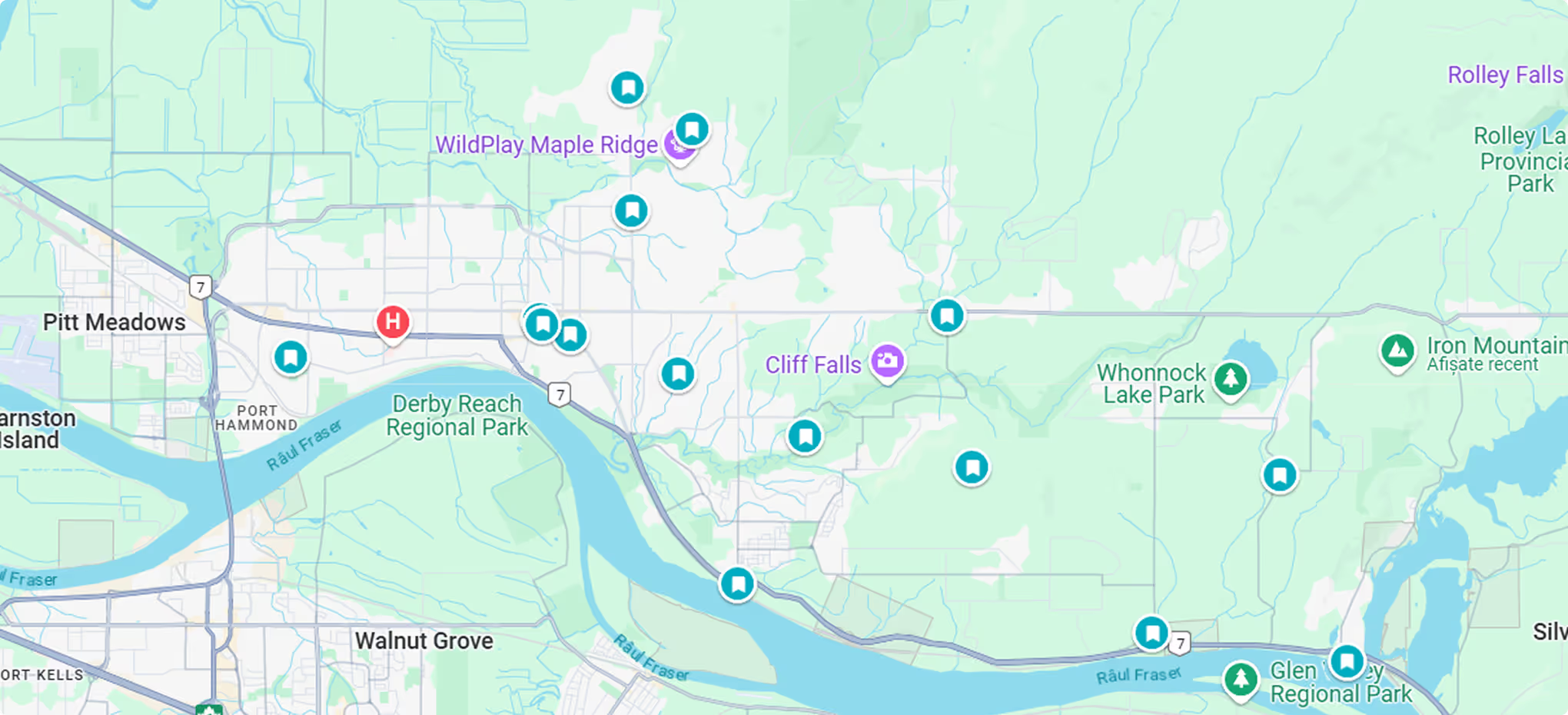
Because our technicians operate right here in the Fraser Valley, we know firsthand that unlike milder coastal regions where heating and cooling demands are brief, the climate in Mission, BC, demands a lot from a home's infrastructure. We experience cold, damp winters that require robust heating, and increasingly warm summers that make air conditioning a necessity. This means a heat pump installation here isn't just for occasional use—it is a primary, year-round utility.
During a winter cold snap in Mission, BC, your heat pump will run continuously for days to maintain indoor comfort. If it has to rely on auxiliary electric heat, the amperage draw is maximized. At the exact same time, your hot tub is working overtime to prevent freezing, and your EV battery requires more energy to charge in the cold. This regional climate reality creates significant continuous electrical loads that homes in milder climates simply do not face, aligning with BC Hydro's broader push for residential electrification and emphasizing the need for adequate panel capacity.
The Value of Comprehensive Professional Assessment
Because your HVAC system and your electrical panel are so deeply intertwined, assessing them separately often leads to miscalculations. Having a single expert evaluate both requirements simultaneously is the most reliable way to protect your home.
The Risks of Fragmented Planning
A common pitfall we encounter is when a homeowner hires an electrician who guesses at the HVAC load, or an HVAC tech who assumes the electrical panel can handle a new system. When contractors work in silos, the mathematical precision required by the 80% continuous load safety threshold (160 amps) is often lost. This can lead to mid-project delays, blown budgets, or unsafe installations.
Why Dual Expertise Matters
As a comprehensive home comfort provider handling both HVAC and electrical systems, our team at Rep-Air Heating and Cooling can assess your heat pump needs and electrical capacity simultaneously without relying on subcontractors. This unified approach means the load calculations are precise, the equipment matching is accurate, and the final execution is seamless.
We see the value of this approach constantly. For example, when a customer in our area was comparing quotes for professional electrical services, they found that having a unified team made a significant difference. Technicians Justin, Sanjay, and Colin were able to provide a thorough, professional assessment from start to finish, adhering strictly to the quoted expectations without any unexpected capacity surprises. Working with a professional HVAC installer who also holds electrical expertise ensures your home is evaluated holistically.
A strict warning: All load calculations, panel upgrades, and heavy-appliance wiring must be performed by licensed professionals. Never attempt DIY electrical work or panel modifications, as the risks of fire, electrocution, and code violations are severe.
Frequently Asked Questions About Home Electrical Capacity
How many amps does a heat pump and EV charger use?
Combined, a heat pump and a Level 2 EV charger typically draw between 52 and 80 amps of continuous load. An EV charger usually requires 32 to 40 amps, while a heat pump draws 20 to 40 amps depending on its size and whether auxiliary heating is active. Because both run for extended periods, they consume a massive portion of a standard panel's capacity.
What is the maximum continuous load on a 200 amp panel?
The maximum safe continuous load on a 200-amp panel is 160 amps. This is dictated by the 80% safety rule, which prevents continuous draws (loads lasting more than three hours) from overheating the breakers and wiring. Exceeding this 160-amp limit can cause tripped breakers and serious safety hazards.
Do I need a 400 amp service for a hot tub and EV?
It heavily depends on your home's baseline electrical load, but adding a hot tub and an EV charger often pushes a standard panel past its safe limit. Together, these two items can add 80 to 90 amps of continuous load. If your home also relies on electric heating, an electric oven, and an electric dryer, our electricians usually find that a 400-amp service upgrade is mathematically necessary to run everything simultaneously.
What is the 80% rule for electrical panels?
The 80% rule is a Canadian Electrical Code guideline stating that a breaker should only be loaded to 80% of its maximum rating for continuous loads. This safety buffer prevents the electrical components from overheating when power is drawn steadily for three hours or more, protecting the home from electrical fires and equipment degradation.
Can a smart load management device prevent a panel upgrade?
Yes, a smart load management device can often prevent the need for a full panel upgrade by automatically pausing certain heavy loads. For example, it might temporarily stop your EV from charging while the hot tub heater is running to keep total consumption under the 160-amp limit. However, this requires compromising on simultaneous appliance usage.
Make Informed Decisions About Your Home's Electrical Future
Understanding the math behind heavy-draw appliances empowers you to evaluate contractor recommendations confidently. You no longer have to guess whether your standard 200-amp residential electrical panel can handle the strain of modern living; the numbers speak for themselves.
Whether your home's layout makes smart load management the right choice, or your electrification plans demand a full 400-amp service upgrade, clear and precise answers are available. Schedule a comprehensive professional assessment with our team today to get exact load calculations for your specific home, ensuring your electrical system remains safe, capable, and ready for the future.
hear what our satisfied clients have to say
Neighbourhoods in the Fraser Valley