The Real Reason Your Furnace Smells Like Burning Dust in September
That First Fall Chill: Why Your Vents Suddenly Smell Like Smoke
September is just around the corner, and the overnight temperatures are finally beginning to drop. You walk over to the thermostat, switch it from cooling to heating for the first time this season, and wait for the warmth. But within minutes, a harsh, alarming scent fills the hallway. The real reason your furnace smells like burning dust in September usually comes down to one simple, seasonal event: the first fall furnace cycle. When that earthy, dry odor suddenly pours out of your vents, your immediate reaction is often panic. You are suddenly faced with a stressful decision: do you immediately shut off the system and call for emergency service, or is it safe to wait and see if the smell goes away?
Here is the short answer from our team at Rep-Air Heating and Cooling: in the vast majority of cases, this initial smell is a completely normal, harmless seasonal phenomenon. Your heating system has been sitting completely dormant for months. When it finally fires up, it goes through a brief period of burning off the microscopic debris that has settled inside the unit over the summer. Understanding how home heating systems operate during this transition period is the key to knowing when to relax and when to actually pick up the phone.
The immediate reaction: It is entirely natural to feel alarmed when your home smells like smoke. Our instinct is to protect our property and our families. However, before you rush to flip the breaker, it helps to understand the physical mechanics of what is happening inside your ductwork. The scent is strong because the blower motor is highly efficient at distributing air—and any odors caught in that air—throughout every room in your house simultaneously. By taking a breath and evaluating the specific type of smell, you can quickly determine if you are experiencing a standard seasonal burn-off or a true mechanical emergency.
The Science of the Scent: What Exactly Is Burning?
To understand why your vents smell like a dusty attic on a hot day, you have to look closely at the internal components of your heating system. The primary culprit behind this odor is the heat exchanger. This critical metal component is responsible for transferring the heat generated by the burners into the air that circulates through your home. All summer long, while you rely on your air conditioning, the heat exchanger sits idle in the dark, quietly collecting airborne particulates.
When you finally adjust your thermostat to call for heat, a highly specific chain of events begins. Understanding what happens when your furnace turns on helps demystify the sudden odor. Here is the step-by-step process that creates the burning dust smell:
1. The Call for Heat: Your thermostat detects that the indoor temperature has dropped below your set point and sends an electrical signal to the furnace control board.
2. The Draft Inducer Starts: A small motor kicks on to clear any residual gases out of the heat exchanger and ensure proper venting.
3. Ignition and Heating: The gas valve opens, and the burners ignite. The flames shoot directly into the heat exchanger, causing the metal to rapidly heat up to extreme temperatures.
4. The Incineration Phase: As the metal expands and heats, any dust, pet dander, or microscopic debris resting on the surface is instantly incinerated. This creates a small amount of smoke and a very distinct, dry odor.
5. Distribution: Finally, the main blower motor activates, pushing cold return air over the now-hot heat exchanger. The air absorbs the heat—and the temporary smell of the incinerated dust—and pushes it through your ductwork into your living spaces.
The Summer Dust Buildup
You might wonder why dust accumulates inside the furnace even if you keep a spotless home. In our years of inspecting ductwork and furnaces across Mission, our technicians have seen firsthand how idle HVAC components act as a powerful magnet for pet dander, dead skin cells, textile fibers, and ordinary household dust. Even if you run your air conditioning constantly throughout July and August, standard summer air conditioning does not prevent dust from settling on the heating components. The cooling coils (evaporator coil) are located in a different part of the air stream than the heat exchanger.
Furthermore, standard fiberglass air filters are designed to catch large particles, like pet hair and heavy debris, to protect the blower motor. They do not catch every microscopic speck of dust. Over the course of three to four months of inactivity, a fine layer of silt inevitably coats the heat exchanger. When subjected to sudden, intense flames during that September first fall furnace cycle, this microscopic blanket of dust flash-burns all at once, generating the strong smell you notice in your living room.
The 15-to-45 Minute Rule: How Long Is Normal?
Knowing that the smell is just burning dust provides some relief, but the next logical question is: how long should you have to tolerate it? Our technicians at Rep-Air Heating and Cooling rely on a standard timeframe to determine if a system is operating safely during its first seasonal start-up. A normal dust burn-off should dissipate within 15 to 45 minutes of continuous operation.
Here is a detailed breakdown of what you should expect during that critical first hour of heating:
• Minutes 1 to 5: The Initial Burn. This is when the smell will be the most intense. The heat exchanger reaches its peak operating temperature, and the bulk of the settled dust is incinerated simultaneously. You may notice the smell is strongest near the vents closest to the furnace.
• Minutes 5 to 15: The Peak Odor. The blower motor has fully pressurized your ductwork, spreading the scent evenly throughout the house. The smell will be highly noticeable, but you should not see any visible smoke in your living areas.
• Minutes 15 to 45: The Dissipation. The heat exchanger is now clean. The smell should begin to fade noticeably as your system cycles fresh air through the return vents and the remaining odor is diluted. Opening a few windows temporarily can help clear the lingering odor much faster.
• Beyond 60 Minutes: The Warning Zone. If the furnace has been running for over an hour and the smell persists unchanged—or grows stronger—it may no longer be a simple dust issue. At this point, the normal burn-off period has passed, and you should investigate further.
It is also completely normal for the smell to return faintly on the second or third heating cycle of the season. Sometimes, dust settles in hard-to-reach crevices of the heat exchanger and burns off more slowly. However, the scent should be noticeably weaker each time the system kicks on. If the odor remains sharp and overpowering after a full day of use, it is time to turn the system off and seek professional guidance.
Burning Dust vs. True Danger: Decoding Furnace Odors
While the smell of burning dust is harmless, your furnace is a powerful appliance that utilizes high-voltage electricity, natural gas, and rapidly moving mechanical parts. It is absolutely critical to clearly differentiate between the normal scent of a seasonal burn-off and the dangerous smells of electrical or mechanical failure.
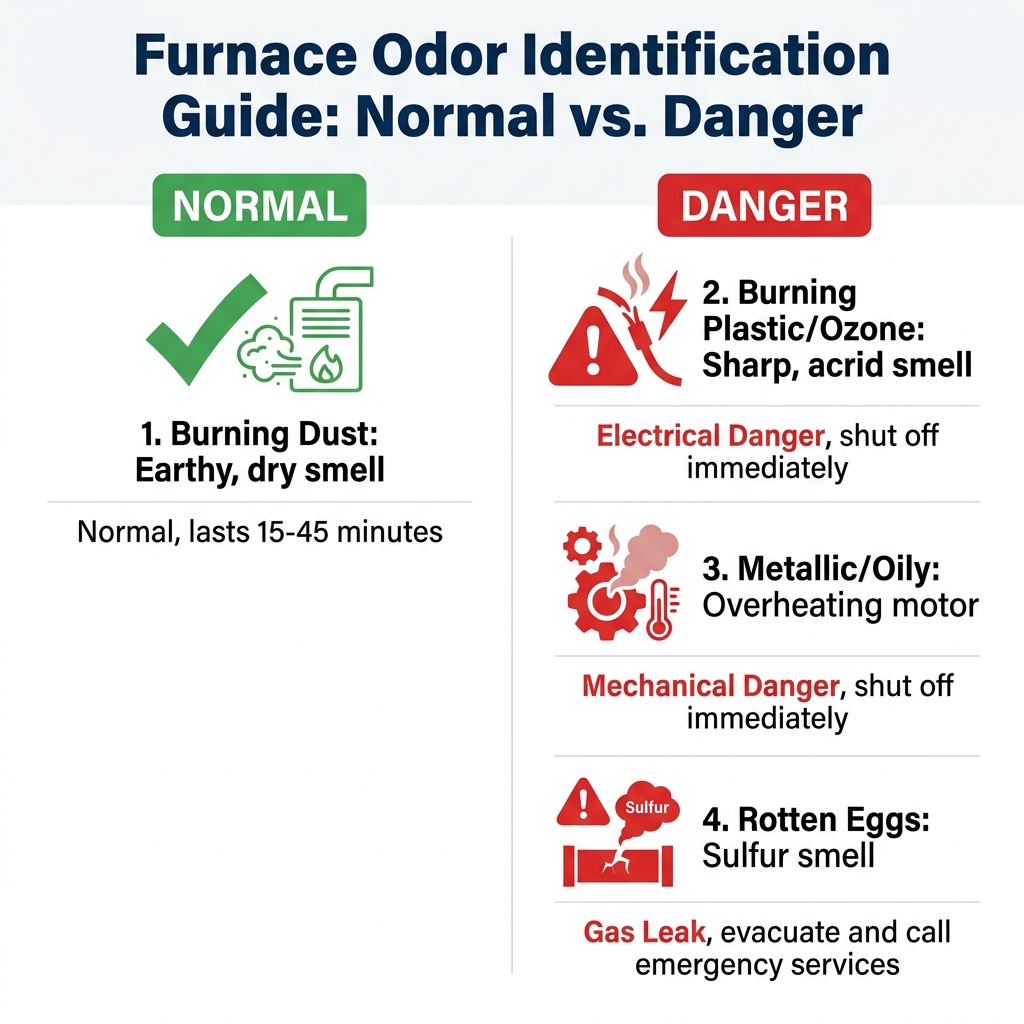
The exact scent profile of burning dust is earthy, dry, and somewhat similar to the smell of a hot hair dryer that has been left on too long. It is unpleasant, but it does not sting your eyes or catch in the back of your throat. Contrast this with the sharp, acrid smells associated with actual component failures.
• Earthy, dry, "hot hair dryer" smell — Likely Cause: Dust burning off the heat exchanger — Danger Level: Low (Normal) — Required Action: Wait 15-45 minutes for it to dissipate.
• Sharp, acrid, melting plastic or ozone — Likely Cause: Electrical short, melting wire insulation — Danger Level: High (Fire Hazard) — Required Action: Shut off power at the breaker immediately.
• Metallic, oily, or hot rubber smell — Likely Cause: Overheating blower motor or slipping belt — Danger Level: High (Mechanical Failure) — Required Action: Turn off system at the thermostat.
• Rotten eggs or sulfur — Likely Cause: Natural gas leak (mercaptan additive) — Danger Level: Extreme (Explosion Hazard) — Required Action: Evacuate home, leave doors open, call emergency services.
One local homeowner reached out to us at Rep-Air Heating and Cooling during a winter freeze when their furnace stopped working correctly and began emitting an unfamiliar, harsh odor. Our technician, Colin, arrived quickly to assess the situation. He diagnosed the malfunction—which turned out to be a failing mechanical component, not just dust—and took the time to explain exactly what was wrong. He showed the customer why the system wasn't working, how he would fix it, and how to maintain it moving forward. Because the homeowner recognized that the smell was abnormal and acted quickly, a minor repair was completed before it could cause catastrophic damage to the system.
When to Hit the Shut-Off Switch
You should never hesitate to prioritize safety if you feel uncertain about an odor in your home. There are specific warning signs that indicate you should immediately shut off the system at the thermostat or the main electrical breaker. If you ever see visible smoke coming directly out of your supply vents, shut the system down instantly. A normal dust burn-off will create an odor, but it should never produce thick, visible smoke in your living space.
Additionally, if the burning smell is accompanied by loud banging, screeching, or metal-on-metal grinding noises, turn the power off. These sounds point to a failing blower motor or a broken internal component that is overheating due to friction. Finally, if you ever detect the distinct scent of rotten eggs (mercaptan), do not touch any electrical switches. This indicates a natural gas leak. Evacuate the house immediately and call your local gas utility provider from a safe distance.

How Mission's September Weather Impacts Your HVAC System
The sudden appearance of the burning dust smell is heavily influenced by regional climate patterns. Having serviced HVAC systems throughout the Fraser Valley for years, our team knows firsthand that the transition from summer to fall is often abrupt. We move quickly from the dry, lingering heat of August into the damp, chilly rains that define September in Mission BC. This sharp increase in precipitation and humidity changes how your home feels, often making the indoor air feel clammy and uncomfortably cold long before the deep winter freezes arrive.
Because of this specific weather pattern, homeowners often turn on their furnaces not just for pure warmth, but to dry out the damp indoor air. The heat from the furnace helps lower the relative humidity inside the house, making the living space feel much more comfortable. However, this high indoor humidity prior to turning on the heat can actually cause dust to cling more stubbornly to your HVAC components. Moisture in the air acts as a binding agent, creating a slightly sticky layer of dust on the heat exchanger that produces a more pronounced smell when it finally burns off.
This seasonal shift also connects to broader indoor air quality concerns. As the September rains begin, we start closing our windows and sealing up our homes for the fall. This traps the incinerated dust particles, pet dander, and other allergens inside. If you notice that your home consistently smells dusty or stale even after the initial 45-minute burn-off period, it may be time to look into comprehensive indoor air quality solutions. Upgrading your filtration system or adding an air purifier can drastically reduce the amount of airborne debris that settles on your furnace during the summer, minimizing the burning smell next season.
Beyond the Smell: Why Homeowner Education Matters
Dealing with a sudden burning smell in your home can be incredibly stressful, which is why understanding how your heating system works is your best defense against seasonal panic. A trustworthy HVAC provider doesn't just fix broken parts; they ensure you understand the mechanics of your own home. At Rep-Air Heating and Cooling, we firmly believe that a transparent, professional safety check involves walking the homeowner through the system's functions, explaining the sequence of operations, and empowering you to recognize the difference between normal operation and a true emergency.
During a routine winter repair call, one of our technicians, Colin, noticed a homeowner was anxious about their system's safety and performance. Instead of simply swapping out a part in silence, Colin explained exactly what he was working on and how it needed to be repaired. He broke down the internal mechanics so the homeowner could visualize the process. By the time the service visit was over, the customer fully understood their furnace, felt confident in its operation, and knew exactly what maintenance steps to take in the future.
This level of education is why we prioritize taking the time to explain your furnace's sequence of operations during every visit. Knowing the "why" behind a repair or a maintenance step takes the fear out of homeownership. As we move deeper into the fall, this proactive approach becomes even more critical. Scheduling an annual heating maintenance plan before the heavy winter usage begins ensures that a professional can safely clean off the summer dust, inspect the heat exchanger for cracks, and verify that all electrical components are secure before you ever have to experience that initial burning smell.
Breathe Easy and Stay Warm This Fall
That first fall chill should be a time to get cozy, not a time to stress over strange odors coming from your vents. Remember that a brief burning dust smell is a completely normal rite of passage for the start of the heating season in Mission BC. As long as the earthy, dry scent follows the 15-to-45 minute dissipation rule and is not accompanied by smoke, grinding noises, or the smell of melting plastic, your system is simply doing its job and clearing out the summer cobwebs.
If the smell persists, or if you want the ultimate peace of mind before the deep winter cold sets in, proactive care is the best step forward. A thorough, professional cleaning and inspection will ensure your heat exchanger is safe, your burners are aligned, and your home is ready for the colder months ahead. Stay warm, breathe easy, and enjoy the changing seasons with confidence.
Frequently Asked Questions
How long should a furnace smell like burning dust?
A normal dust burn-off should last between 15 to 45 minutes after you turn on the heat for the first time. The smell will be strongest in the first few minutes and gradually fade as the system circulates fresh air. If the smell persists for more than an hour without decreasing in intensity, you should turn off the system and investigate further.
Is it dangerous if my heater smells like burning?
It is usually not dangerous if the smell is strictly the earthy, dry scent of burning dust during the first use of the season. However, it becomes highly dangerous if the smell resembles melting plastic, electrical ozone, or hot metal. Always trust your instincts; if the smell is sharp, acrid, or accompanied by smoke, shut the system down immediately.
Why does my furnace smell like burning plastic?
A burning plastic smell typically indicates an electrical failure, such as melting wire insulation, a failing capacitor, or an overheating control board. This is a serious fire hazard and is never a normal part of the furnace's operation. You should turn off the power to the furnace at the main breaker panel immediately and call a licensed professional.
Should I turn off my furnace if it smells like burning?
You should turn off your furnace if the burning smell lasts longer than 45 minutes, if it smells like electrical components or rubber, or if you see visible smoke. If you only smell a dry, dusty odor during the very first cycle of the fall, it is generally safe to let it run for half an hour to clear the dust. When in doubt, turning it off is always the safest choice.
Can changing my air filter stop the burning dust smell?
Changing your air filter is a great maintenance step, but it will not stop the initial burning dust smell once it has started. The dust causing the odor is already resting directly on the heat exchanger deep inside the furnace. However, using a high-quality filter year-round can reduce the amount of dust that settles on the internal components in the future.
What does an electrical furnace fire smell like?
An electrical fire in a furnace produces a sharp, highly toxic smell that resembles melting plastic, burning rubber, or ozone (similar to the smell of a lightning strike). It is harsh on the nose and throat, unlike the mild, earthy smell of burning dust. If you detect this acrid scent, cut the power to the unit instantly to prevent further damage or a house fire.
hear what our satisfied clients have to say
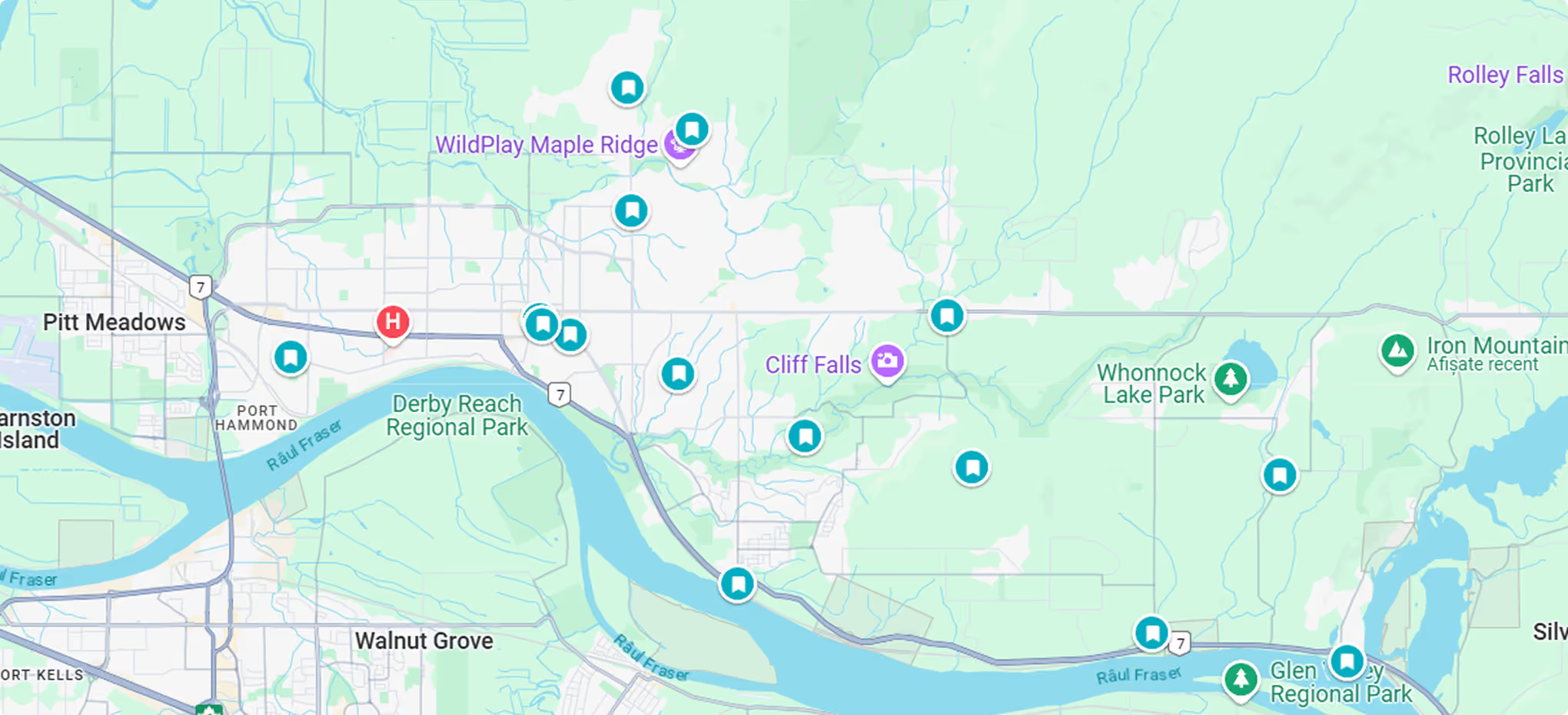
Neighbourhoods in the Fraser Valley