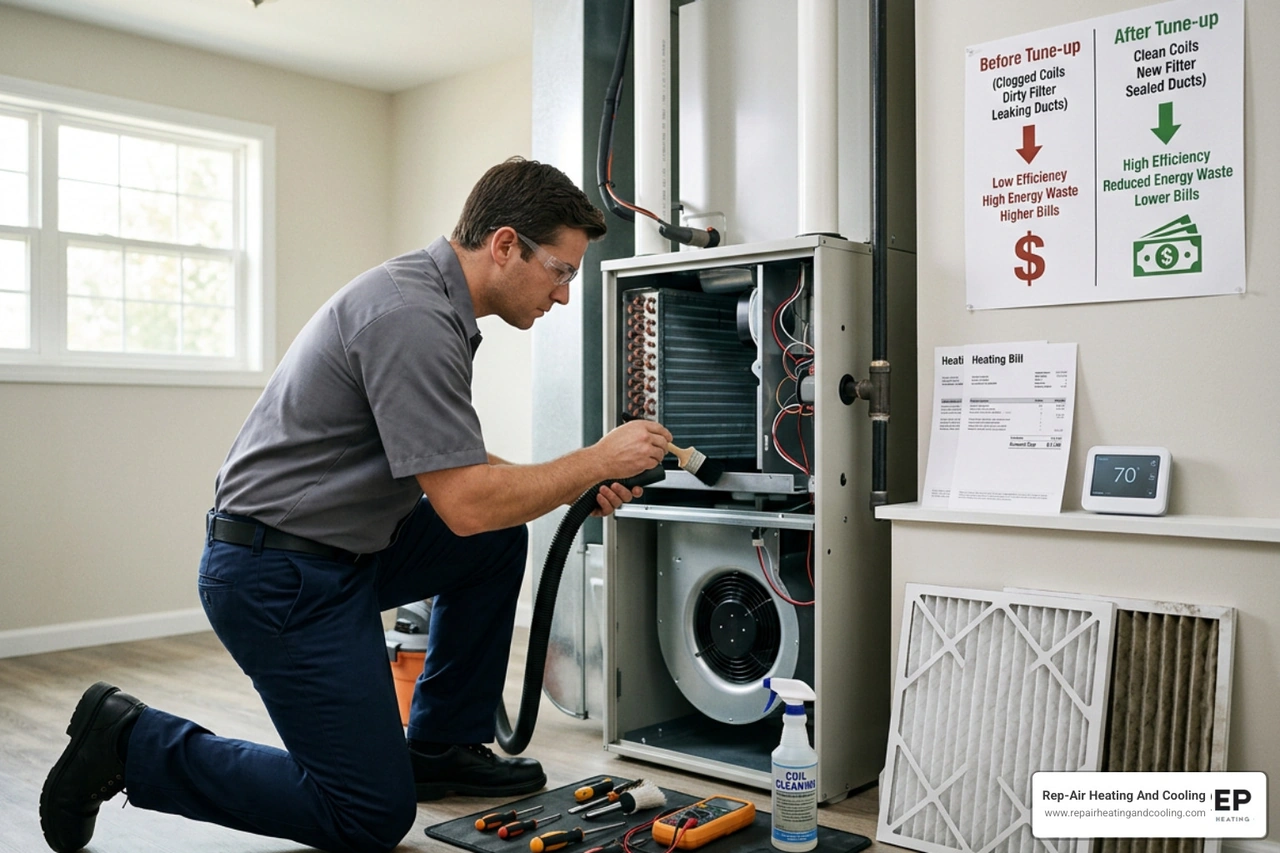
How a Tune Up Improves Efficiency and Lowers Bills
Why How a Tune Up Improves Efficiency and Lowers Bills Matters for Lower Mainland, BC Homeowners
Understanding how a tune up improves efficiency and lowers bills is one of the most practical things you can do as a homeowner in British Columbia, BC. Your HVAC system quietly accounts for nearly half of your monthly energy costs — and when it hasn't been serviced, it works harder than it needs to, burning through more electricity or gas to deliver the same level of comfort.
The result? Bills that creep up month after month, often with no obvious cause.
Here's a quick look at what a professional tune-up actually does for your energy costs:
• Cleans dirty coils and filters — restoring heat transfer and reducing compressor runtime by up to 15%
• Corrects refrigerant levels — improper charge can increase energy use by 5% to 15%
• Calibrates the thermostat — a reading that's off by just 2 degrees can add 30 to 45 minutes of unnecessary runtime every day
• Lubricates moving parts — reducing friction so motors draw less power
• Clears blocked airflow — so the system reaches your set temperature faster and shuts off sooner
On average, homeowners see a 5% to 15% reduction in monthly energy costs after a professional tune-up. For systems that have been neglected for several years, that savings can reach up to 30%.
For homeowners across Surrey, BC, Abbotsford, BC, Burnaby, BC, and the rest of the Lower Mainland, BC, where heating and cooling systems work year-round through wet winters and warm summers, staying on top of maintenance isn't just smart — it's essential.
What is an HVAC Tune-Up and What Does It Include?
When we talk about a professional HVAC tune-up, we are not talking about a quick, five-minute visual inspection. A true, professional tune-up is a comprehensive, multi-point physical exam for your home's heating and cooling systems. Think of it as a restorer of factory-fresh performance. Over months of continuous running, dust settles, electrical connections loosen, and moving parts slowly lose their lubrication.
A professional tune-up systematically addresses this wear and tear through a detailed process of inspection, deep cleaning, calibration, and safety testing. During a standard visit, our experienced technicians perform several vital tasks:
• Deep Cleaning the Coils: We scrub away the dirt, dust, and outdoor grime that coats your air conditioner's condenser coils and indoor evaporator coils.
• Airflow Inspection: We check the blower motor, fan blades, and duct connections to make sure nothing is blocking the free movement of conditioned air.
• Electrical Diagnostics: We inspect, tighten, and test all electrical connections. Over time, the heat of operation causes wires to expand and contract, which naturally loosens connections.
• Thermostat Calibration: We verify that your thermostat is reading the actual indoor temperature accurately so your system doesn't run longer than necessary.
• Safety Control Testing: We check all safety limits and controls, ensuring your system shuts down safely if an issue arises.
Understanding What Does an AC Maintenance Plan Typically Include can help you see why these detailed steps are crucial. By having a professional service these hidden parts, you prevent small performance issues from snowballing into expensive mechanical breakdowns.
How a Tune Up Improves Efficiency and Lowers Bills by Restoring Components
To understand how a tune up improves efficiency and lowers bills, it helps to look at the physics of how your system operates. Your air conditioner does not actually "create" cold air; instead, it absorbs heat from inside your home and dumps it outside. This heat exchange relies entirely on clean metal surfaces.
When your outdoor condenser coils are coated in dirt, pollen, and lawn debris, they act like an insulating blanket. The heat becomes trapped, forcing your compressor to run hotter and run up to 15% longer just to release the same amount of heat.
Similarly, inside your home, a dirty blower motor or a clogged filter creates restricted airflow. Imagine trying to run a marathon while breathing through a cocktail straw. That is exactly what your blower motor goes through when dust builds up on its blades. This static pressure forces the motor to draw far more electricity to push air through your vents.
During a tune-up, we also check and correct refrigerant levels. If your system is even slightly undercharged or overcharged, its cooling capacity drops, which can increase your energy consumption by 5% to 15%. For homes that rely on gas furnaces during our chilly Lower Mainland, BC winters, checking burner alignment and flame sensors is just as critical.
If you want to ensure your heating system is fully prepared for the winter months, checking out our Furnace Maintenance Plans Complete Guide is a great place to start.
How a Tune Up Improves Efficiency and Lowers Bills
At its core, the relationship between a professional tune-up and lower utility bills comes down to minimizing runtime and reducing mechanical friction. When your system has to work twice as hard to do its job, it consumes significantly more energy.
A clean, well-calibrated system reaches your desired thermostat setpoint quickly and shuts off. A neglected system, on the other hand, will experience "short-cycling" (turning on and off rapidly) or will run continuously without ever truly making the home feel comfortable. Because the startup phase of an HVAC motor consumes the highest amount of electrical current, frequent short-cycling is incredibly expensive.
Let's look at how a maintained system stacks up against a neglected one over time:
• Operating Efficiency — Well-Maintained HVAC System: 95% to 100% of original SEER/AFUE rating — Neglected HVAC System (3+ Years): 70% to 85% of original rated efficiency
• Average Monthly Energy Draw — Well-Maintained HVAC System: Baseline / Optimized — Neglected HVAC System (3+ Years): 10% to 25% higher electricity/gas usage
• Compressor & Motor Runtime — Well-Maintained HVAC System: Optimized, shorter cycles — Neglected HVAC System (3+ Years): Extended runtimes (up to 15% longer)
• Risk of Unexpected Breakdown — Well-Maintained HVAC System: Less than 5% annually — Neglected HVAC System (3+ Years): Up to 95% of major failures are preventable
• Expected Equipment Lifespan — Well-Maintained HVAC System: 15 to 20 years — Neglected HVAC System (3+ Years): 8 to 12 years
By restoring airflow, reducing mechanical friction through proper lubrication, and ensuring correct refrigerant pressures, a tune-up acts as a "factory reset" for your heating and cooling equipment.
If you have been wondering whether enrolling in a structured maintenance program is the right move for your household, reading through our guide on Is an AC Maintenance Plan Worth It can help clarify the long-term return on investment.
Realizing Monthly Energy Savings in British Columbia, BC
Here in the Lower Mainland, BC, our unique Pacific Northwest climate means we experience highly variable weather. From humid, warm summer days in Abbotsford, BC to damp, freezing winter nights in Surrey, BC, our comfort systems are rarely given a rest. Because our heating and cooling systems run for a large portion of the year, even a minor drop in efficiency can add up to hundreds of dollars in wasted energy annually.
When you invest in a professional tune-up, the efficiency gains translate directly into cold, hard cash. On average, local homeowners enjoy a 5% to 15% reduction in their monthly energy costs immediately following a professional service.
If your system has been neglected for several seasons, the drop in energy consumption can be as high as 30%. In many cases, the money you save on your monthly gas and hydro bills over a single season is more than enough to cover the cost of the tune-up itself.
To see how structured maintenance plans compare to simply scheduling one-off service visits when something goes wrong, take a look at our Maintenance Plan vs Paying Per Visit Cost Comparison.
Long-Term Financial, Lifespan, and Warranty Benefits
While the immediate reduction in your monthly energy bills is incredibly satisfying, the long-term financial benefits of regular maintenance are even more substantial. An HVAC system is one of the most expensive investments you will make in your home. Protecting that investment requires a proactive approach rather than a reactive one.
When a system is forced to run with dirty coils, loose electrical connections, and unlubricated bearings, it experiences extreme mechanical stress. This constant strain accelerates wear and tear, leading to premature component failures.
A simple, worn-out capacitor that costs very little to replace during a routine tune-up can easily cause your compressor to overheat and fail if left unaddressed. Replacing a compressor is a major, expensive repair that can often be avoided entirely with basic preventative care.
Enrolling in a structured maintenance plan is the easiest way to automate this protection. If you are curious about the additional perks of these programs, you can read our article on the Reasons to Purchase a HVAC Maintenance Plan.
Protecting Your Investment and Warranty Compliance
Did you know that skipping your annual maintenance could actually void your manufacturer's warranty? It's true. Nearly every major heating and cooling manufacturer requires documented proof of annual professional maintenance to honor their warranty terms. If your system experiences a major part failure in year five, but you cannot provide service records proving the system was maintained annually, the manufacturer may deny your claim.
Furthermore, regular maintenance directly impacts how long your system will keep your home comfortable:
• Well-Maintained Systems: Typically last 15 to 20 years while maintaining high efficiency.
• Neglected Systems: Often experience catastrophic failures and require complete replacement in just 8 to 12 years.
By keeping detailed service records, you protect your warranty coverage and ensure your system lives out its full, natural lifespan. To learn more about how to set up a consistent schedule for your home, explore our HVAC Maintenance Plans Complete Guide.
Safety, Comfort, and Indoor Air Quality Enhancements
While saving money on utility bills is a major motivator, your family's safety and comfort are always the top priorities. During a heating tune-up, safety checks are the most critical steps we perform. For homes with natural gas furnaces, our technicians thoroughly inspect the heat exchanger for any microscopic cracks or signs of corrosion.
A cracked heat exchanger is incredibly dangerous because it can allow carbon monoxide—a colorless, odorless, and highly toxic gas—to leak directly into your home's breathing air. We also test your system's venting pipes and safety limit switches to make sure combustion gases are being safely exhausted outside.
In addition to safety, a professional tune-up dramatically improves your indoor air quality and daily comfort. As air circulates through your system, dust, pet dander, pollen, and other allergens accumulate on the internal components. During a tune-up, we clean these areas and ensure your filtration system is working efficiently. This significantly reduces the volume of airborne irritants circulating through your living spaces.
For a deeper look into how professional heating maintenance keeps your home safe and healthy, check out our article on Furnace Maintenance Plans Top 5 Smart Benefits.
When to Schedule Your Tune-Up and Signs You Are Overdue
Timing is everything when it comes to scheduling your HVAC maintenance. The absolute best time to schedule service is during the "shoulder seasons"—specifically spring (March through May) for your air conditioning system, and early fall (September through November) for your heating system.
Scheduling during these periods ensures your system is fully prepared before extreme weather hits. It also means you can secure a convenient appointment slot before our technicians get incredibly busy responding to emergency no-heat or no-cool calls during peak winter and summer.
If you want to know what signs to watch out for between scheduled visits, read our guide on the Signs Your HVAC System Needs Maintenance. Staying proactive is the best way to keep your home comfortable year-round.
Additionally, learning How a Pre-Season Tune-Up Prevents Mid-Summer Failures will help you understand why preparing your system early is so beneficial.
Recognizing When Your System Needs a Tune Up to Improve Efficiency and Lower Bills
Sometimes, your system will send out clear warning signs that it is struggling and overdue for a professional visit. If you notice any of the following issues, it is time to call in the professionals:
• Weak Airflow: If the air coming out of your registers feels weak or barely moving, your blower motor or filter is likely choked with dust.
• Frequent Cycling: If your system turns on, runs for two minutes, shuts off, and then repeats the cycle, it is short-cycling and wasting massive amounts of energy.
• Inconsistent Temperatures: If your kitchen is freezing while your upstairs bedroom feels like a sauna, your system is struggling to distribute air evenly.
• Unusual Noises: Squealing, grinding, banging, or rattling noises indicate mechanical friction, worn bearings, or loose components that need immediate attention.
• Rising Utility Bills: If your monthly energy bills are noticeably higher than they were during the same month last year—without a major change in the weather—your system's efficiency is dropping.
If you want to avoid long wait times during peak seasons and get front-of-the-line service when you need it most, find out How a Plan Gives You Priority Scheduling During Peak Season.
Frequently Asked Questions about HVAC Efficiency
How often should I schedule an HVAC tune-up in the Lower Mainland, BC?
For the vast majority of homes, we recommend scheduling professional service twice a year: once in the spring for your air conditioner and once in the fall for your heating system.
If you have a heat pump that handles both heating and cooling, we still highly recommend two checks per year. Because a heat pump works year-round without a seasonal break, it accumulates wear and tear twice as fast as single-season equipment.
Can a homeowner perform a full HVAC tune-up themselves?
While we always encourage homeowners to handle basic tasks like replacing air filters every 30 to 90 days, keeping outdoor condenser units clear of leaves and weeds, and ensuring indoor vents are unblocked, a full tune-up must be left to a professional.
Working with electrical control boards, checking refrigerant pressures, and inspecting gas burners require specialized diagnostic tools, advanced training, and EPA certifications. Attempting to perform these technical tasks yourself can result in serious safety hazards, system damage, and will likely void your equipment's warranty.
Will a professional tune-up really lower my monthly utility bills?
Yes, absolutely. On average, a professional tune-up reduces monthly energy costs by 5% to 15%. If your system has gone several years without professional care, you could see savings of up to 30%.
By restoring proper airflow, cleaning the coils to optimize heat transfer, and calibrating your system back to its original factory specifications, we significantly reduce its daily runtime. Less runtime means less energy consumed, which translates directly to lower monthly bills.
Conclusion
At the end of the day, understanding how a tune up improves efficiency and lowers bills is all about taking control of your home's comfort and your monthly budget. A clean, well-adjusted heating and cooling system doesn't have to work nearly as hard to keep your family comfortable—and when your system does less work, you pay less on your utility bills.
At Rep-Air Heating And Cooling, we pride ourselves on treating our customers like family. We serve homeowners across the Lower Mainland, BC, with unmatched customer service and comprehensive maintenance options designed to take the stress out of home maintenance.
Don't wait for your utility bills to climb or for your system to struggle during a seasonal transition. Schedule your professional AC maintenance with Rep-Air Heating And Cooling today and start enjoying a more efficient, comfortable, and affordable home.
hear what our satisfied clients have to say
Neighbourhoods in the Fraser Valley