How to Prevent Summer Equipment Failures with a Pre Season Tune Up

How a Pre Season Tune Up Prevents Mid Summer Failures in Langley, BC
How a pre season tune up prevents mid summer failures comes down to one simple idea: catching small problems before summer heat turns them into full breakdowns. Here is a quick summary:
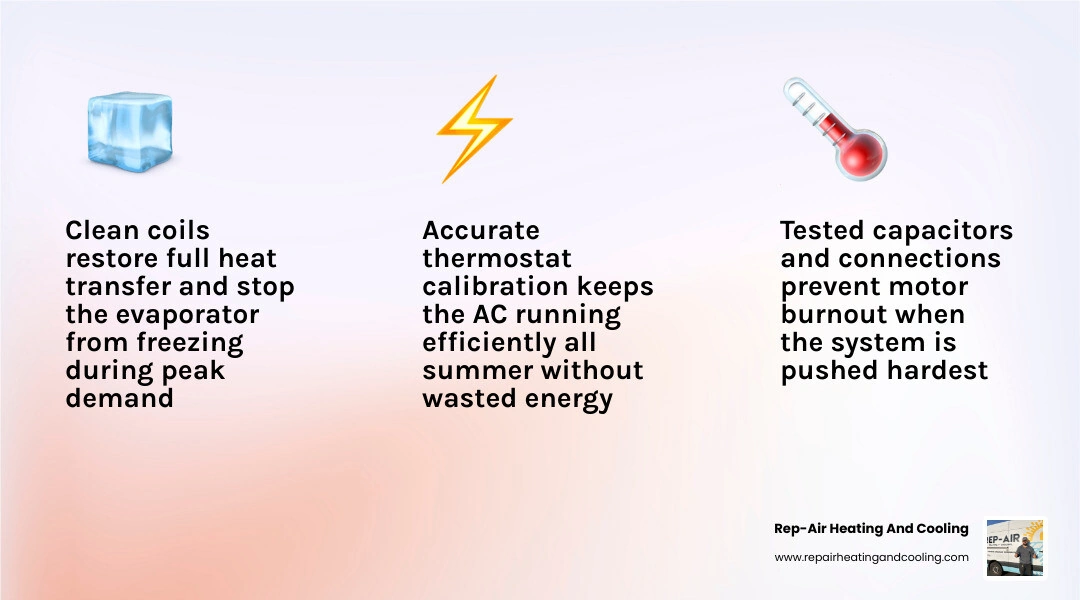
• Cleans condenser and evaporator coils — How It Prevents Mid-Summer Failure: Restores heat transfer and prevents freezing
• Checks refrigerant levels — How It Prevents Mid-Summer Failure: Protects the compressor from strain and damage
• Tests capacitors and electrical connections — How It Prevents Mid-Summer Failure: Prevents motor failures during peak demand
• Clears condensate drain lines — How It Prevents Mid-Summer Failure: Stops water backups and indoor leaks
• Replaces or inspects air filters — How It Prevents Mid-Summer Failure: Maintains airflow and prevents system overload
• Calibrates the thermostat — How It Prevents Mid-Summer Failure: Ensures accurate temperature control all summer
When an AC system sits dormant through a Langley, BC winter and then gets pushed hard on the first hot week of summer, any hidden wear from the previous season gets exposed fast. According to industry data, 87% of emergency AC calls could have been prevented with a routine spring tune-up, and systems that skip annual maintenance run 15 to 25% less efficiently. That means higher utility bills, more strain on components, and a much greater chance of a breakdown on the hottest day of the year, when HVAC technicians are fully booked.
For homeowners in Langley, BC, the gap between a comfortable summer and a sweaty, stressful one often comes down to one scheduled visit in the spring.
Simple how a pre season tune up prevents mid summer failures glossary:
• best time of year to schedule your ac tune up
• how early scheduling saves you money on ac tune ups
Why Mid-Summer AC Breakdowns Happen More Often Than Spring Failures
It is a classic July scenario in Langley, BC: the temperature spikes past 30°C, the air gets thick with humidity, and suddenly, your air conditioning system completely gives up. But why do these failures almost always happen in the dead of summer rather than during the mild spring days of May?
The answer lies in the concepts of peak demand, thermal margin, and cumulative wear. During the spring, your cooling system operates with a high "thermal margin." Because the outdoor temperatures are mild, the system does not have to work very hard to reject heat from inside your home. It runs short, easy cycles. Even if a component like a capacitor is weakened or your coils are covered in a thin layer of dust, the system can still cope because the overall demand is low.
As we move into July and August, that thermal margin completely disappears. The system is forced to run continuously for hours on end to maintain your indoor comfort. This continuous operation causes heat to build up rapidly within the mechanical and electrical components of your air conditioner. Any minor, hidden issue that existed in May: such as a tiny refrigerant leak, a slightly worn motor bearing, or a degrading electrical connection, is subjected to extreme, relentless stress.
Without a spring check-up, these small issues undergo a process of cumulative wear. The system does not fail because of a single, sudden event; instead, it fails because it has been running at maximum capacity with compromised parts for weeks. To understand how to protect your home from these high-stress periods, it helps to understand Why Preventative AC Service is Essential for Comfort before the peak summer heat arrives.
The Science of Heat Stress on Cooling Systems
To truly appreciate the stress your air conditioner faces, we have to look at the science of cooling. An air conditioner does not actually "create" cold air; instead, it removes heat and moisture from your indoor air and transfers it outside. This process involves two distinct types of cooling:
• Sensible Cooling: This is the actual lowering of the indoor air temperature that you see on your thermostat.
• Latent Cooling: This is the removal of moisture (humidity) from the air.
In the Lower Mainland, particularly in valley communities like Langley, BC, and Abbotsford, BC, our geography traps humidity. When humid summer air hits your indoor evaporator coil, the system has to perform heavy latent cooling alongside sensible cooling. This means your air conditioner must run longer and work significantly harder to make the air feel comfortable.
When humidity is high, the compressor and blower motor must operate under elevated pressures. If your system's components are already dirty or worn, this extra thermodynamic workload causes temperatures inside the compressor to soar, rapidly accelerating component degradation.
How a Pre Season Tune Up Prevents Mid Summer Failures by Building System Resilience
A professional pre-season tune-up is designed to build "thermal margin" back into your cooling system before the hot weather hits. By cleaning, calibrating, and testing every critical component in the spring, we ensure that your air conditioner is operating at its absolute peak physical capability.
When your system is clean and fully calibrated, it transfers heat much more efficiently. This means it can achieve your desired indoor temperature in shorter cycles, reducing the total runtime and protecting the system from cumulative wear. Investing in early preventative care directly translates to long-term system reliability and peace of mind when the summer heat is at its worst. To learn more about how this process protects your system, check out our guide on AC Maintenance Benefits.
Critical Components Most Vulnerable to Peak Summer Heat
When your air conditioner runs continuously during a summer heatwave, certain components bear the brunt of the physical and thermodynamic stress. If any of these critical parts are neglected, they become prime candidates for a mid-summer failure.
Electrical Strain and Failing Capacitors
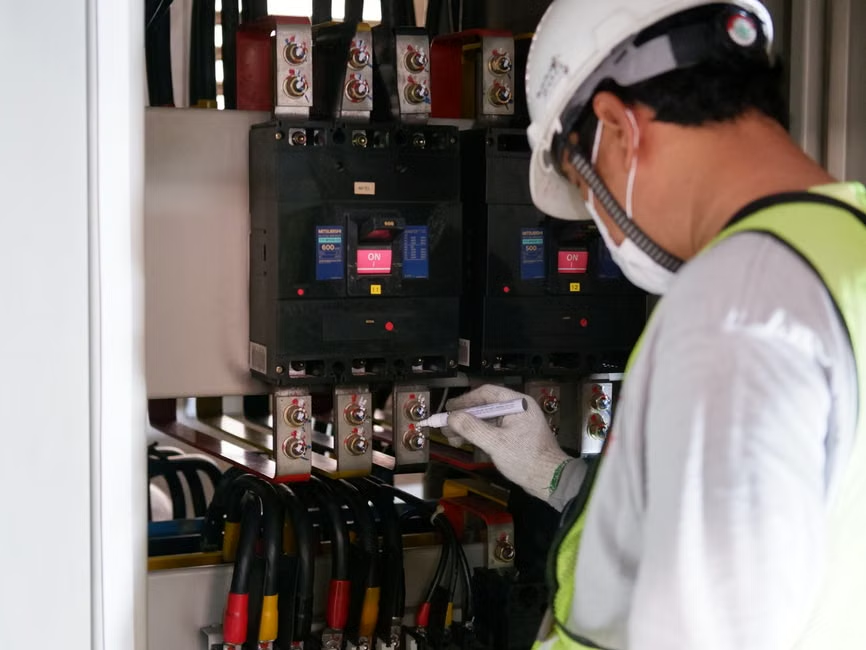
If the compressor is the "heart" of your air conditioner, the capacitors are the electrical spark plugs. Capacitors store up electrical energy and release it in a quick burst to help your compressor and fan motors start up and run.
Unfortunately, capacitors are highly sensitive to heat and age. During a hot summer afternoon, the electrical control box inside your outdoor unit can reach incredibly high temperatures. This ambient heat, combined with continuous voltage loads, causes the internal chemistry of the capacitor to degrade.
During a pre-season tune-up, a technician uses a multimeter to measure the capacitor's "microfarad" readings. If the reading is even slightly below the manufacturer's recommended range, it is a clear warning sign that the capacitor is failing. If a weakened capacitor is left in the system, it will eventually fail entirely on a hot day, preventing your compressor or fan motor from starting. This can lead to motor overheating, tripped circuit breakers, or even a completely burned-out compressor.
Airflow Restrictions and Frozen Evaporator Coils
Another common cause of sudden mid-summer failures is restricted airflow, which frequently leads to a frozen evaporator coil. Your indoor evaporator coil relies on a steady, unrestricted stream of warm indoor air passing over its fins to transfer heat to the refrigerant inside.
If this airflow is restricted by a dirty air filter, blocked return vents, or a buildup of household dust, the temperature of the evaporator coil will drop below freezing. The moisture that the system pulls from the air will instantly freeze onto the coil, forming a block of ice. Once the coil freezes, it can no longer absorb heat, and your system will blow warm air or shut down entirely.
In areas like Langley, BC, and Maple Ridge, BC, seasonal outdoor factors can also block your outdoor condenser coil. Late spring brings a heavy release of cottonwood seeds and pollen, which can quickly coat the delicate aluminum fins of your outdoor unit like a thick blanket. This buildup restricts the outdoor unit's ability to release heat, forcing the compressor to run hotter and use significantly more electricity to cool your home.
How a Pre Season Tune Up Prevents Mid Summer Failures
A comprehensive pre-season tune-up is a multi-point inspection and cleaning process designed to address every chemical, mechanical, and electrical aspect of your cooling system. By scheduling this service in the spring, you ensure that your system is fully prepared for the upcoming seasonal demands. For a deeper look into the timing of this service, explore the Best Time of Year to Schedule Your AC Tune-Up.
During a typical professional tune-up, our technicians perform several critical steps that directly target and prevent mid-summer failures:
1. Refrigerant Charge Verification: We measure the system's refrigerant levels using digital manifold gauges. Running an AC with even a slightly low refrigerant charge forces the compressor to work harder, run longer, and run hotter, which can eventually cause the compressor to seize.
2. Coil Cleaning: We thoroughly clean both the indoor evaporator coil and the outdoor condenser coil. Removing dust, pollen, and cottonwood seeds restores optimal heat transfer, allowing your system to cool your home faster and with less energy.
3. Electrical Diagnostics: We inspect all electrical wiring, tighten loose connections (which can loosen over time due to seasonal temperature swings), and test capacitors and contactors for proper performance.
4. Condensate Drain Flushing: We clear the condensate drain line of any algae, dust, or debris buildup. This prevents water backups that can cause ceiling water damage or trigger safety switches that shut down your system.
5. Thermostat Calibration: We verify that your thermostat is communicating accurately with your cooling system, ensuring that your AC runs only when necessary and doesn't short-cycle.
Catching Minor Issues Before They Cause Chain-Reaction Damage
One of the greatest values of a pre-season tune-up is the ability to catch minor issues before they trigger a catastrophic chain-reaction failure. In an air conditioner, components do not operate in isolation; the failure of one small part can quickly ruin a much larger, more expensive component.
For example, a slightly dirty condenser coil restricts heat rejection, which increases the operating pressure and temperature inside the compressor. This extra heat degrades the compressor's lubricating oil and puts extra strain on the run capacitor. Eventually, the capacitor fails, which causes the compressor motor to stall while drawing high electrical current, ultimately burning out the compressor motor entirely.
By identifying and correcting the dirty coil or the weakening capacitor in May, we prevent a cascade of failures that could require a complete system replacement in July. Discover more about how early diagnostics can protect your budget by reading How Early Scheduling Saves You Money on AC Tune-Ups.
Restoring Energy Efficiency to Lower Summer Utility Bills
When your air conditioner is dirty or poorly calibrated, it has to run much longer to keep your home cool. This extra runtime directly translates to higher energy bills. In fact, systems that skip annual maintenance run 15 to 25% less efficiently than well-maintained units.
During a tune-up, we restore your system's efficiency by reducing mechanical friction, optimizing airflow, and ensuring the refrigerant charge is exact. A well-maintained system uses measurably less electricity to maintain the same level of indoor comfort, keeping your summer utility bills manageable even during prolonged heatwaves. To understand how regular maintenance can protect your system's efficiency over its entire lifespan, read about how to Extend the Life of Your AC with Maintenance.
Homeowner Maintenance Steps to Support Your Pre-Season Service
While a professional tune-up is essential for deep technical calibration and cleaning, there are several simple maintenance tasks that homeowners in Langley, BC, can perform to support their system throughout the summer.
Understanding how a pre season tune up prevents mid summer failures through regular filter changes
The single most important task a homeowner can perform is regularly replacing or cleaning the air filter. During peak summer cooling, your AC runs frequently, pulling indoor air through the filter to catch dust, pet dander, and allergens.
We recommend checking your filter once a month during the summer and replacing it every 30 to 90 days, depending on your household needs (homes with pets or allergy sufferers may need more frequent changes). Keeping the filter clean is the easiest way to optimize airflow, reduce wear on your blower motor, and keep your indoor air clean.
In addition to filter changes, homeowners should perform the following quick checks:
• Clear Outdoor Debris: Ensure there is at least a two-foot (60 cm) clearance around your outdoor condenser unit. Trim back any bushes, weeds, or overhanging branches, and gently sweep away any loose leaves or cottonwood seeds.
• Keep Vents Unblocked: Make sure that furniture, rugs, or drapes are not blocking your indoor supply or return vents. Blocked vents disrupt the system's pressure balance and restrict airflow.
• Monitor the Condensate Drain: Keep an eye on the outdoor drain line to ensure water is dripping steadily while the system is running, which indicates that the drain is clear and functioning.
Frequently Asked Questions About Preventing AC Failures
When is the best time to schedule a pre-season AC tune-up in Langley, BC?
The ideal time to schedule your pre-season tune-up is in the early spring, typically between April and May. Scheduling during this window ensures your system is ready before the first major heatwave of summer arrives. Additionally, performing the tune-up when outdoor temperatures are at least 15°C (60°F) allows our technicians to accurately test and measure refrigerant pressures under realistic operating conditions.
What are the warning signs that my AC needs immediate attention before summer?
You should schedule a professional inspection if you notice any of the following warning signs:
• Weak or Warm Airflow: If the air coming from your vents feels weak or warm, your system may have an airflow restriction or a refrigerant issue.
• Strange Noises: Squealing, grinding, rattling, or clicking sounds indicate mechanical wear or electrical component degradation.
• Frequent Cycling: If your AC turns on and off every few minutes (short-cycling), it is putting extra strain on the compressor.
• Unexplained Energy Spikes: A sudden jump in your utility bills is a clear sign that your system is working harder than it should to cool your home.
Can a neglected AC system recover its efficiency with a tune-up?
Yes! While years of complete neglect can cause permanent wear, a thorough professional tune-up can help restore up to 95% of an AC unit's original operating efficiency. Cleaning the coils, replacing the filters, correcting the refrigerant charge, and lubricating moving parts will immediately reduce the system's power consumption and improve its overall cooling performance.
Conclusion
Your air conditioner is one of the most important investments in your home's comfort. When summer temperatures climb in Langley, BC, you rely on your AC to keep your family cool, healthy, and safe from oppressive humidity. Don't wait for the first major heatwave of July to find out if your system can handle the strain.
At Rep-Air Heating And Cooling, we pride ourselves on treating our customers like family. Our experienced technicians are dedicated to providing customer service and thorough, high-quality maintenance that keeps your home comfortable all year long.
Schedule your professional AC tune-up with Rep-Air Heating And Cooling today to ensure your system is fully prepared to handle the summer heat with ease!
hear what our satisfied clients have to say
Neighbourhoods in the Fraser Valley