How to Load Calculations for AC Installation

Why Load Calculations Are the Foundation of Every AC Installation
How load calculations determine your AC installation specs is one of the most important things to understand before investing in a new cooling system for your home in Langley, BC. In short, a load calculation tells your HVAC technician exactly how much cooling power your home needs — no more, no less.
Here's a quick breakdown of how the process works:
• Home data is collected — square footage, ceiling height, insulation levels, window types, and orientation
• Heat gain and loss are calculated — how much heat enters and escapes your home under peak conditions
• BTU requirements are determined — the total cooling capacity your home actually needs
• Tonnage is selected — the right AC unit size is matched to your calculated load
• Equipment is confirmed — using standards like ACCA Manual S to ensure the chosen system performs correctly at real operating conditions
Without this process, contractors are guessing — and guessing wrong often means a system that's too big, too small, or simply wrong for your home.
Cooling and heating account for nearly half of a home's energy use, so getting the size right matters far more than most homeowners realize. An oversized system can increase energy consumption by up to 30% due to short-cycling, while an undersized one runs nonstop and wears out fast. Neither outcome is acceptable when you're making a long-term investment in home comfort.
At Rep-Air Heating And Cooling, we serve homeowners across Langley, BC and the surrounding Lower Mainland with professional, calculation-backed AC installations — so your new system is sized exactly right from day one.

Easy how load calculations determine your ac installation specs word list:
• ac installation process explained step by step
• how ductwork evaluation affects your ac installation
I'm planning a new AC installation in Langley, BC: How do load calculations determine my system specs?
When we sit down with families in Langley, BC, to discuss a new air conditioner, the first thing we explain is that your home is a unique thermal environment. No two houses are identical, even if they share the same floor plan. This is where the Manual J load calculation comes into play. Developed by the Air Conditioning Contractors of America (ACCA), Manual J is the industry gold standard for determining the precise BTU (British Thermal Unit) requirements of a building.
In British Columbia, BC, our weather patterns are changing. We are seeing hotter summers and higher humidity levels than we did a decade ago. A professional load calculation ensures that your system specs are tailored to these local climate zones. It's not just about surviving the heat; it's about ensuring your system operates within its design parameters during the hottest 1% of the year. Knowing signs it's time to schedule HVAC installation is the first step, but the load calculation is the roadmap that gets us to the finish line.
How load calculations determine your ac installation specs
At its core, how load calculations determine your ac installation specs is a matter of physics. We are looking at three primary ways heat moves through your home:
1. Conduction: Heat traveling through solid objects like your walls, roof, and windows.
2. Convection: Heat moving through air currents, often caused by air leaks or drafts.
3. Radiance: Solar heat from the sun shining through glass or onto your roof.
When we perform an AC installation in Abbotsford, BC or Langley, BC, we analyze your "thermal envelope"—the barrier between your indoor air and the outside world. We look at the R-value of your insulation and the specific building materials used in your construction. A brick house in Murrayville, BC will hold and release heat differently than a wood-sided home in Willoughby, BC. By quantifying these variables, we can determine the exact cooling capacity required to keep you comfortable.
Key factors in how load calculations determine your ac installation specs
While square footage is a starting point, it is only one ingredient in the recipe. To get truly accurate specs, we must dig deeper into the details of your home.
• Ceiling Height: A room with 12-foot vaulted ceilings has 50% more air volume to cool than a room with 8-foot ceilings, even if the floor area is the same.
• Window Orientation and Sun Exposure: A large south-facing window can demand more cooling BTUs than an entire insulated wall. We map out which rooms get blasted by the afternoon sun.
• Insulation Levels: We check the attic and walls. Modern R-40 insulation requires far less cooling capacity than the R-12 found in older Langley, BC homes.
• Air Infiltration: How "tight" is your home? We look for air leaks around doors and windows that let cool air out and humid air in.
• Occupancy Patterns and Appliances: Every person in the home radiates about 400 BTUs of heat per hour. High-end gaming PCs or large kitchen appliances also add to the internal heat gain.
Knowing how to prepare for HVAC installation involves gathering any information you have about these upgrades, as they directly impact the final math.
How load calculations determine your ac installation specs for humidity control
In the Lower Mainland, we don't just deal with heat; we deal with moisture. This brings us to the difference between sensible heat (the temperature you see on the thermometer) and latent heat (the moisture in the air).
If a system is sized based on a guess, it often ends up being oversized. An oversized AC unit will cool the house down very quickly and then shut off—a process called short-cycling. The problem is that the air conditioner needs to run for at least 15 to 20 minutes continuously to effectively remove humidity. If it only runs for 8 minutes, you end up with a "cold and clammy" house, which can lead to mold growth and poor indoor air quality.
When we look for the best heat pump installation in Abbotsford, BC, we use Manual S to match the indoor evaporator coil perfectly to the outdoor unit. This ensures the system has the right Sensible Heat Ratio (SHR) to pull exactly enough moisture out of the air for our specific BC climate.
The Dangers of "Rule-of-Thumb" Sizing for Langley, BC Homeowners
For decades, some contractors used a "rule-of-thumb" like "one ton of cooling for every 500 square feet." In May 2026, this approach is considered engineering malpractice. Modern homes are built much tighter and better insulated than homes from thirty years ago. Using an old rule-of-thumb almost always results in a system that is 20-40% larger than necessary.
• Accuracy — Manual J Calculation: High (Site-Specific) — Rule-of-Thumb (Sq. Ft.): Low (Generic Guess)
• Energy Use — Manual J Calculation: Optimized — Rule-of-Thumb (Sq. Ft.): Up to 30% Higher
• Humidity Control — Manual J Calculation: Excellent — Rule-of-Thumb (Sq. Ft.): Poor (Short-Cycling)
• Equipment Lifespan — Manual J Calculation: Maximized — Rule-of-Thumb (Sq. Ft.): Reduced due to wear
• Comfort — Manual J Calculation: Even Temperatures — Rule-of-Thumb (Sq. Ft.): Hot/Cold Spots
Oversizing isn't a "safety margin"—it's a liability. It leads to higher energy bills, louder operation, and premature component failure because the compressor is starting and stopping far more often than it was designed to.
Why You Shouldn't Reuse Your Old AC Unit Size
One of the most common questions we hear in Langley, BC is: "My old unit was a 3-ton, can't we just put another 3-ton in?" The answer is usually no.
Think about everything that has changed in the 15 to 20 years since your old unit was installed. Have you replaced your windows with high-efficiency double-pane glass? Did you add more insulation to the attic? Have the trees in your backyard grown large enough to shade the western side of your house?
All of these factors reduce the cooling load. If we simply "box-swap" the old size, we are likely installing a system that is now far too large for your improved home. Furthermore, the previous installer might have used a rule-of-thumb and oversized it from the start. We often recommend a heat pump installation in Townline Hill, BC that is smaller in capacity but higher in efficiency than the unit it replaces, providing much better comfort at a lower operating cost.
The Professional Manual J Process: What to Expect During a Home Survey
When we perform a professional survey for a homeowner in Langley, BC, we don't just glance at the thermostat. We perform a room-by-room analysis. Here is what that looks like:
1. Measuring the Envelope: We measure every room, including ceiling heights and the square footage of all exterior walls.
2. Fenestration Data: We catalog every window and door, noting its size, the type of glass (U-factor), and which direction it faces.
3. Insulation Check: We physically verify the insulation in your attic and crawlspace to ensure our software has accurate R-values.
4. Infiltration Assessment: We look for signs of air leakage. In some cases, we may suggest blower door testing to get a precise measurement of air changes per hour.
5. Ductwork Inspection: We evaluate your existing ducts to ensure they can handle the airflow (CFM) required by the new system. This is a critical part of any residential furnace installation guide in Abbotsford, BC as well.
6. Software Modeling: All this data is fed into ACCA-approved software that uses ASHRAE design temperatures for the Lower Mainland to produce a detailed report.
Frequently Asked Questions About AC Load Calculations
What is the difference between a BTU and a Ton?
A BTU (British Thermal Unit) is the amount of heat energy required to raise the temperature of one pound of water by one degree Fahrenheit. In the HVAC world, we measure how many BTUs an AC can remove per hour. One "ton" of cooling is equal to 12,000 BTUs per hour. The term comes from the 19th century, referring to the cooling power provided by a one-ton block of ice melting over 24 hours. Most residential systems range from 1.5 to 5 tons.
How long does a professional load calculation take?
A thorough home survey and data collection usually takes between 20 and 60 minutes, depending on the size and complexity of your home. After the field data is collected, the software entry and analysis may take another hour or two back at the office to ensure every spec is perfect before we present you with a quote.
Is a load calculation required for a building permit in BC?
In many jurisdictions across the Lower Mainland and British Columbia, BC, a Manual J load calculation (or equivalent) is increasingly required for building permits, especially for new construction or major renovations. Even where it isn't strictly mandated by the city, it is required by equipment manufacturers to honor warranties and by utility providers for energy efficiency rebates. It is the only way to prove the system meets modern energy codes.
Conclusion
Investing in a new air conditioner is a big decision for any Langley, BC homeowner. By understanding how load calculations determine your ac installation specs, you can move forward with confidence, knowing that your system isn't just a "best guess." At Rep-Air Heating And Cooling, our expert technicians pride themselves on treating your home like our own. We don't believe in shortcuts; we believe in the science of comfort.
Whether you are in Willoughby, BC, Walnut Grove, BC, or Brookswood, BC, we are here to provide the personalized, energy-efficient cooling solutions you deserve. If you're ready to experience the difference that a properly sized system makes, schedule your professional AC installation in Silver Valley, BC or contact our Langley, BC team today. Let's get your home's climate "just right" for the summer of 2026 and beyond.
hear what our satisfied clients have to say
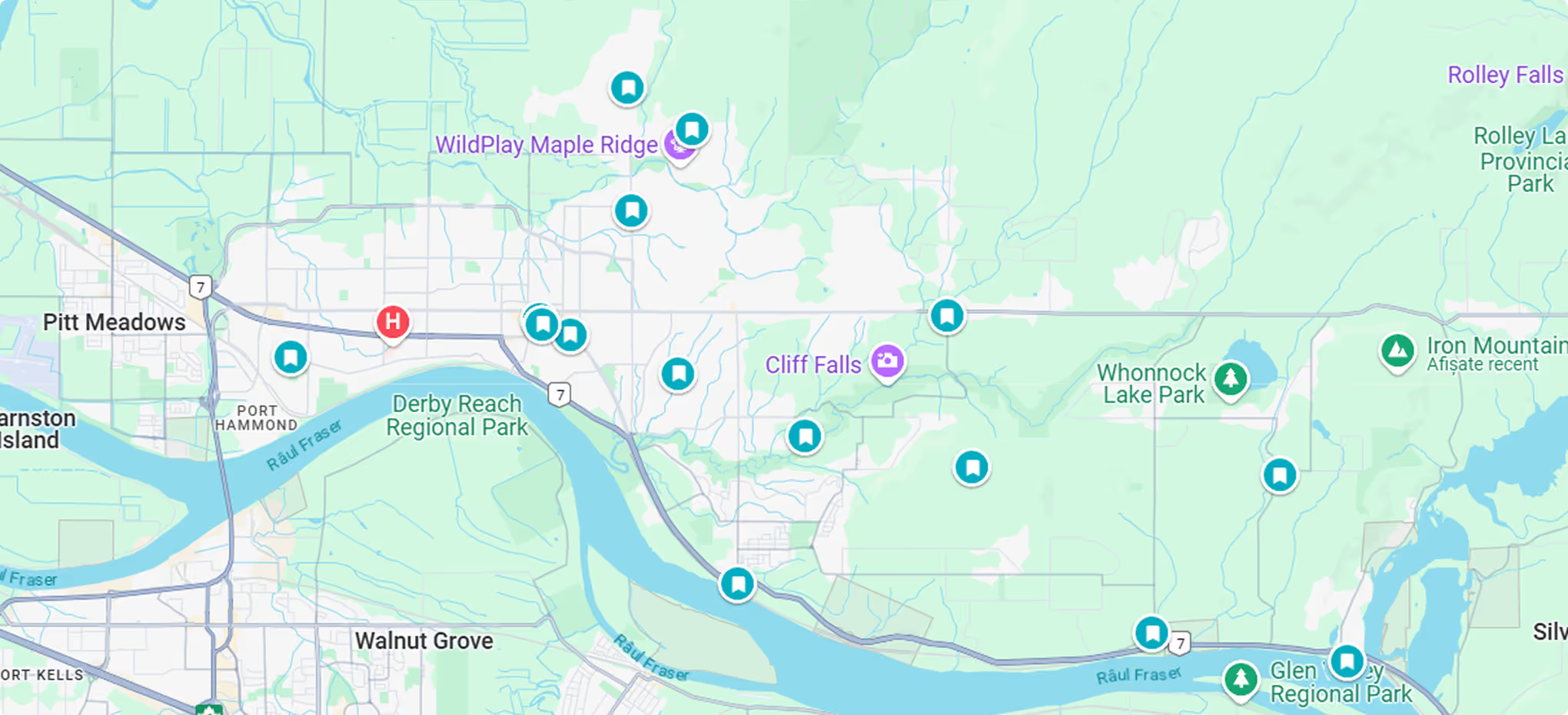
Neighbourhoods in the Fraser Valley