Did You Skip Your Tune-Ups? How Maintenance History Dictates AC Lifespan
Why Your AC's Replacement Clock Starts the Day You Skip Your First Tune-Up
How your AC replacement timeline depends on maintenance history more than almost any other factor — including the unit's age. Two identical AC systems installed on the same street in Abbotsford, BC can have completely different lifespans depending on whether they received regular tune-ups, clean filters, and professional inspections.
Here is a quick summary of how maintenance history shapes your AC replacement window:
• Consistent annual tune-ups — Typical AC Lifespan: 15–20 years — Replacement Risk: Low
• Occasional or irregular service — Typical AC Lifespan: 12–15 years — Replacement Risk: Moderate
• Neglected or no maintenance — Typical AC Lifespan: 8–12 years (or less) — Replacement Risk: High
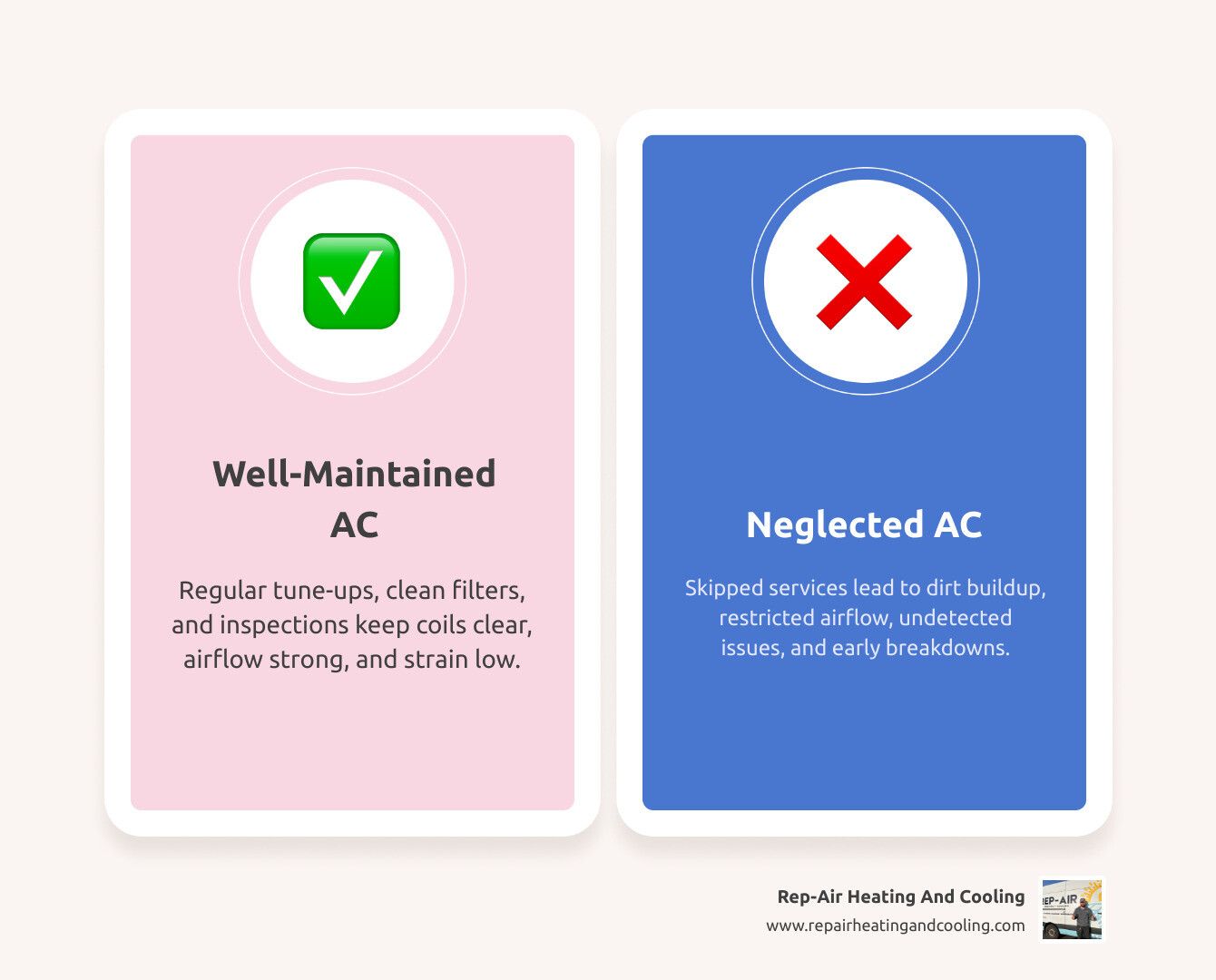
The difference between a system that lasts 20 years and one that fails at 10 often comes down to a handful of skipped appointments and ignored filter changes. Dirt builds up on coils, airflow gets restricted, small problems go undetected, and the whole system works harder than it should — year after year.
For homeowners in Abbotsford, BC, this matters. The combination of warm summers, coastal moisture, and year-round dust and pollen puts steady demand on your AC. Without regular care, that wear adds up fast.
This guide walks you through exactly how your maintenance record affects when you will need to replace your system — and what you can do right now to extend that timeline.
How Your AC Replacement Timeline Depends on Maintenance History
Your AC's age matters, but its history matters more. We often see systems with the same manufacture date behaving very differently. One still cools reliably with strong airflow and stable humidity control. The other struggles, runs longer, and keeps needing repairs.
That is why how your AC replacement timeline depends on maintenance history is such an important question for Abbotsford homeowners. Maintenance records tell us whether the system has been protected from avoidable wear or pushed through years of extra strain.
A system's replacement timeline is usually shaped by:
• how often filters were changed
• whether seasonal tune-ups were done
• coil and condenser cleanliness
• refrigerant and airflow condition
• repair frequency over the last few years
• whether performance has gradually declined
Why two AC units of the same age can have very different replacement timelines
Two 12-year-old AC units are not automatically in the same condition.
One may have had annual service, clean coils, proper airflow, and only minor repairs. The other may have gone years without inspection, run with dirty filters, and developed hidden issues like low airflow, frozen coils, or electrical wear.
Even if both still turn on, their remaining life can be miles apart.
Why? Because AC wear is cumulative. Restricted airflow and dirt buildup make the system run hotter, longer, and harder. Low refrigerant charge can stress the compressor. Skipped tune-ups allow small issues to keep grinding away in the background like a pebble in a shoe, except much more expensive.
Installation quality and runtime hours also matter. A properly sized system that cycles normally will usually age better than one that short-cycles or runs constantly trying to catch up.
Typical AC lifespan with regular maintenance vs neglected care
Research across HVAC sources is consistent on one big point: maintenance is one of the strongest predictors of lifespan.
For central AC and heat pump systems, typical lifespan ranges often look like this:
• Well-maintained — Common Lifespan Range: 15-20 years — What Usually Happens: Better efficiency, fewer breakdowns, slower wear
• Some missed service — Common Lifespan Range: 12-15 years — What Usually Happens: More repair needs, gradual efficiency loss
• Neglected — Common Lifespan Range: 8-12 years — What Usually Happens: Premature failures, airflow issues, dirt-related damage
Some sources put average AC lifespan around 10-12 years, while others place well-maintained systems closer to 15-20 years. Those numbers are not really contradictory. They reflect different levels of care, climate, usage, and installation quality.
Neglected systems usually fail early because the same few issues compound over time:
• dirty evaporator or condenser coils
• clogged filters
• blocked condensate drains
• poor airflow across the system
• electrical components wearing out under higher load
How climate and usage in Abbotsford, BC affect the timeline
Abbotsford's climate is more moderate than very hot regions, which can help AC systems last longer. But "moderate" does not mean "easy."
In our area, ACs still face:
• warm summer demand
• shoulder-season use in spring and early fall
• moisture that can contribute to corrosion and biological growth
• pollen, dust, and outdoor debris that affect filters and coils
• indoor humidity that increases cooling load
Homes with pets, renovations, dusty surroundings, or rooms that heat up quickly will put even more strain on the system. A lightly used, well-maintained AC may age gracefully. A heavily used system with poor upkeep can age fast, even in a milder climate.
The Maintenance Tasks That Most Affect AC Longevity
Not all maintenance tasks have the same impact. Some are nice to do. Others are lifespan savers.
If you want to delay replacement as long as reasonably possible, the biggest priorities are airflow, cleanliness, drainage, and early problem detection. Our guide on how a complete AC service improves your system performance goes deeper into what a full service visit should cover.
The neglected basics that quietly shorten lifespan
The most damaging maintenance misses are usually the boring ones.
• Dirty filters: The U.S. Department of Energy advises checking and replacing or cleaning filters regularly, often every 1-2 months during cooling season in heavier-use conditions. Many HVAC guides also recommend a practical range of every 1-3 months, with more frequent changes in homes with pets or dust.
• Blocked vents and returns: Closed or obstructed vents reduce airflow and raise strain.
• Outdoor debris: Leaves, cottonwood fluff, grass clippings, and overgrown plants restrict condenser airflow.
• Bent coil fins: Damaged fins reduce heat transfer and airflow.
• Poor thermostat habits: Cranking the thermostat down dramatically can increase runtime and system stress.
• Ignored frozen coils: A frozen coil is not just an inconvenience. It is a warning sign of airflow or refrigerant trouble.
These issues often look small in the moment. But over several summers, they can shave years off a system's life.
Professional tune-up tasks that help delay replacement
A proper spring tune-up is where replacement timelines often get extended.
Professional maintenance can include:
• checking temperature split and airflow
• measuring amp draw on motors
• inspecting capacitor and contactor condition
• cleaning condenser and inspecting evaporator coil condition
• clearing condensate drains
• checking refrigerant charge and signs of leaks
• tightening electrical connections
• spotting early wear before it becomes a breakdown
This is why regular inspections matter so much. They catch minor issues before they turn into compressor stress, fan motor damage, or chronic performance decline. If you want a structured checkup, our AC system check page explains what homeowners should expect.
Supporting maintenance that reduces strain on the whole system
Sometimes the AC itself is not the whole problem. The system may be working overtime because the house is making it work too hard.
Supporting maintenance includes:
• checking duct condition and airflow balance
• making sure return airflow is not restricted
• keeping the air path cleaner
• improving home insulation and reducing heat gain
• making sure the thermostat is operating sensibly
• addressing dust buildup around vents and registers
For seasonal homeowner tasks, see our tips on spring cleaning for your HVAC units in Mission, BC. Even though every home is different, the principle is the same: reduce system strain, and you slow down wear.
How to Assess Your AC's Maintenance History and Predict Remaining Life
If you are trying to guess how much life your AC has left, start by acting like a detective.
Look at the paper trail, the repair pattern, and the current symptoms together. One by itself can mislead you. Together, they tell a much clearer story.
How your AC replacement timeline depends on maintenance history in real life
In real homes, maintenance history usually falls into one of these buckets:
• Consistent annual visits: Usually the best-case scenario. These systems often have cleaner coils, fewer surprise breakdowns, and a longer replacement horizon.
• Missed years with occasional service: The middle ground. The unit may still be serviceable, but hidden wear is more likely.
• Mostly emergency calls only: This usually means maintenance was reactive, not preventive. Replacement often comes sooner because issues were addressed only after damage or severe wear had already started.
A system with annual tune-ups and only minor repairs may have meaningful life left even at an older age. A newer unit with multiple emergency calls, recurring airflow issues, or repeated shutdowns may be much closer to replacement than its age suggests.
A simple homeowner checklist to estimate remaining AC life
Use this checklist to estimate whether your AC is aging normally or wearing out early:
• Check the age from the serial plate or installation records.
• Gather service invoices from the last 3-5 years.
• Note whether tune-ups happened annually, occasionally, or rarely.
• Write down how often you changed filters.
• Count repair visits, especially repeat issues.
• Watch for uneven cooling from room to room.
• Notice if airflow feels weaker than it used to.
• Track humidity problems indoors.
• Listen for new startup noises, buzzing, or rattling.
• Look for water leaks, drain clogs, or musty smells.
• Review summer electricity bills for gradual increases.
• Check whether the system still starts reliably and reaches set temperature.
The more missing maintenance and repeat symptoms you find, the shorter the likely remaining lifespan.
Signs of accelerated wear caused by poor maintenance
Poor maintenance usually leaves fingerprints.
Common warning signs include:
• musty odours from moisture or dirt buildup
• ice on refrigerant lines or the indoor coil
• weak airflow
• constant or unusually long runtime
• loud startup or hard-start behaviour
• water leaks from blocked drains
• repeated tripping, shutdowns, or erratic operation
• visible dirt on coils or around blower components
These do not always mean immediate replacement, but they do mean the system has likely been under extra stress. If you are seeing these signs, scheduling service early is much smarter than hoping the problem becomes more polite on its own. For related issues on the outdoor side, our page on AC condenser unit repair may help.
When Maintenance History Changes the Repair-or-Replace Decision
Repair-or-replace decisions should not be based on age alone. A 14-year-old system with a clean record is different from a 14-year-old system with years of deferred maintenance and recurring issues.
Maintenance history helps answer the real question: if we repair this today, how confident should we be in the rest of the system tomorrow?
How your AC replacement timeline depends on maintenance history when repairs start stacking up
One isolated repair on an otherwise reliable system is very different from a pattern.
Repair may still make sense when:
• the system is relatively young
• service history is strong
• the issue is isolated
• comfort and airflow remain good
• there are no signs of broader wear
Replacement becomes more likely when:
• repairs are becoming frequent
• major components are failing
• coil leaks or compressor wear appear
• the unit has been poorly maintained
• comfort problems continue even after repairs
• the system is using outdated refrigerant
Older units that rely on R-22 refrigerant are a special case. In Canada, R-22 is no longer a practical long-term path, so repairs involving leaks or major refrigerant work on these systems often make less sense.
A maintenance-adjusted version of the 5,000 rule
Many homeowners have heard of the 5,000 rule: multiply the age of the unit by the repair amount, and if the number is above 5,000, replacement is usually recommended.
That rule can be helpful, but it is incomplete by itself. We prefer a maintenance-adjusted version that also asks:
• Has the unit had annual maintenance or long gaps?
• Is this a first repair or part of a pattern?
• Are airflow, humidity control, and comfort still solid?
• Are coils, motors, and electrical components in good condition overall?
• After this repair, do we expect reliable operation or more surprises?
In other words, maintenance history changes the risk level behind the math. A well-maintained system may deserve more patience. A neglected one may be on borrowed time even if the formula looks borderline.
Can a well-maintained 20-plus-year-old AC be worth keeping?
Sometimes, yes.
A well-maintained older AC that still cools consistently, starts reliably, and has had only light repairs can sometimes be worth keeping for now. That is especially true if a professional inspection shows clean coils, healthy airflow, and no signs of major component decline.
But there are tradeoffs:
• efficiency may be lower than newer equipment
• parts availability may become harder
• one major failure can quickly change the equation
• reliability risk generally rises as systems age
On the flip side, a poorly maintained newer system may not be the safer bet just because it is younger. If it has suffered years of dirty operation, poor airflow, and repeated breakdowns, its real remaining life may be shorter than you expect.
How to Build a Maintenance Schedule That Extends Your Replacement Timeline
If you want your AC to reach the far end of its lifespan range, maintenance has to be repeatable, not random.
The goal is simple: keep airflow strong, keep components clean, catch small issues early, and create a record that helps future repair-or-replace decisions.
The best maintenance schedule for homeowners in Abbotsford, BC
For most homes in Abbotsford, we recommend a schedule like this:
• Spring: Book a professional AC tune-up before peak cooling season.
• Every 30-90 days: Check the filter and replace it as needed. Homes with pets, dust, allergies, or heavier use may need more frequent changes.
• Monthly in cooling season: Look at the outdoor unit and clear away debris, leaves, and overgrowth. Keep vegetation at least a couple of feet away.
• Periodically: Check for drain issues, water around the indoor unit, or musty smells.
• Summer: Pay attention to airflow, humidity, runtime, and any changes in noise.
• Fall: Review how the system performed over summer and note any needed follow-up.
• Every year: Save maintenance receipts and service notes.
If you need local support, our AC service in Mission, BC page shows the kind of preventive service approach that helps homeowners stay ahead of wear.
When a professional maintenance history justifies delaying replacement
A documented service history can absolutely justify delaying replacement, provided the system is still performing well.
Good reasons to continue maintaining rather than replacing right away include:
• consistent annual professional visits
• service-plan records showing regular inspections
• mostly minor repairs rather than major failures
• stable cooling performance
• strong airflow and dependable startup
• clean coils and no sign of chronic refrigerant or drainage issues
That is one reason maintenance plans are so valuable. They improve the system's odds and create a useful record. Learn more about the benefits in our articles on an HVAC maintenance plan, reasons to purchase a HVAC maintenance plan, and why preventative AC service is essential.
Frequently Asked Questions About How Your AC Replacement Timeline Depends on Maintenance History
How often should AC maintenance be done to maximize lifespan?
At minimum, schedule a professional tune-up once a year, ideally in spring before heavy summer use. Filters should be checked regularly and often changed every 1-3 months, or more often in homes with pets, dust, or heavier runtime. In short: annual professional service, consistent filter changes, and basic homeowner upkeep.
Is a newer AC with poor maintenance worse than an older well-maintained one?
It can be. Newer age does not erase neglected airflow, dirty coils, or repeated strain. A younger unit with poor maintenance may be less reliable than an older system with documented tune-ups and stable performance. Age is important, but maintenance history often tells us more about actual remaining life.
What records should I keep to make future AC replacement decisions easier?
Keep:
• annual service invoices
• filter replacement dates
• repair receipts
• notes on recurring issues
• installation date and model information
• any technician recommendations about condition or expected lifespan
This record makes future decisions much easier because it shows whether you are dealing with an isolated problem or a long-term decline.
Conclusion
If there is one takeaway from this guide, it is this: your AC does not age by birthdays alone. It ages by airflow problems, dirt buildup, skipped inspections, and years of hidden strain.
That is why maintenance-first thinking is the smartest way to plan ahead. The better your service history, the better your odds of stretching your replacement timeline, avoiding surprise breakdowns, and keeping your Abbotsford, BC home comfortable through every cooling season.
If you want help building that kind of record, our team at Rep-Air Heating And Cooling is here to help with preventive care, system inspections, and long-term planning. You can learn more about our maintenance plan and take the guesswork out of what your AC needs next.
hear what our satisfied clients have to say
Neighbourhoods in the Fraser Valley