The Complete Guide to Home Electrical Safety

Is Your Electrical System Safe for Modern Appliances in the Lower Mainland, BC?
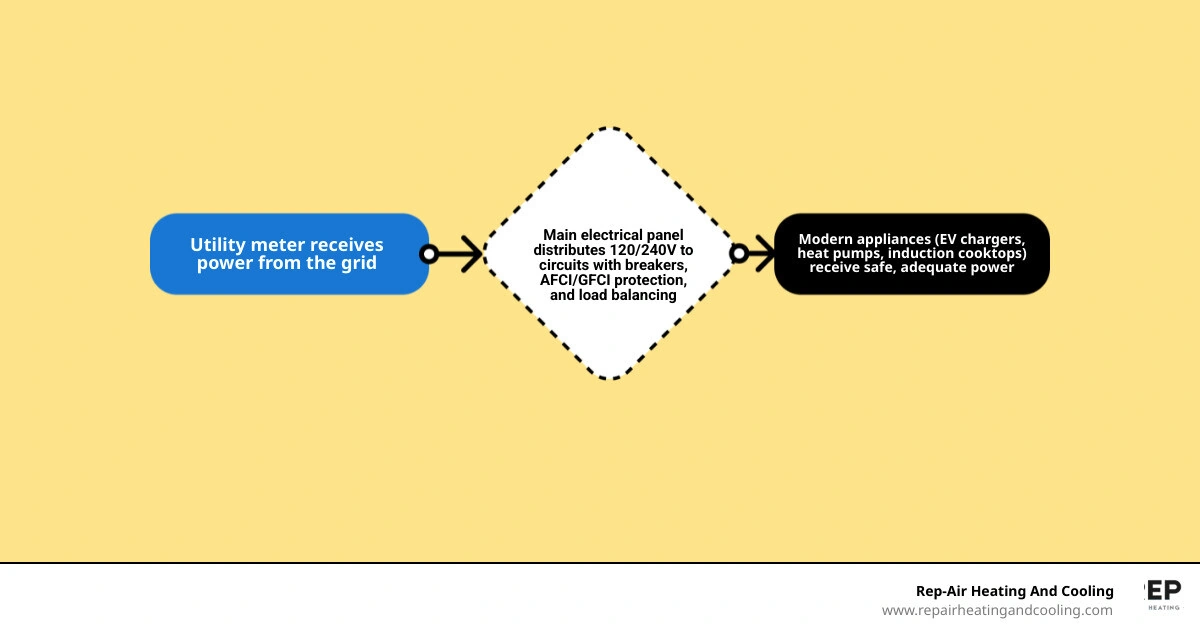
Is your electrical system safe for modern appliances? If your home was built more than 30 years ago, the honest answer is: probably not without some upgrades. Electrical systems designed in the 1970s, 80s, or even early 90s were never built to handle today's power demands — think EV chargers, induction cooktops, heat pumps, smart home devices, and high-efficiency HVAC systems all running at once.
Here is a quick way to assess where your home stands:
Quick Safety Check: Is Your Electrical System Ready for Modern Appliances?
• Panel rated at 60 or 100 amps — What It Means: Likely undersized for modern loads — Action Needed: Professional assessment
• Flickering lights or dimming when appliances start — What It Means: Voltage sag or overloaded circuits — Action Needed: Electrician inspection
• Warm outlets or burning smells — What It Means: Potential fire hazard — Action Needed: Stop using, call electrician now
• Knob-and-tube or aluminum wiring — What It Means: Higher fire risk with high-draw appliances — Action Needed: Professional remediation
• Breakers tripping regularly — What It Means: Circuit overload or faulty breaker — Action Needed: Load calculation needed
• Two-prong outlets throughout — What It Means: Ungrounded system — Action Needed: Upgrade required
• Federal Pacific, Zinsco, or Pushmatic panel — What It Means: Known safety defects — Action Needed: Replace immediately
More than 30 million homes in North America are at least 50 years old, and older homes carry a disproportionately high risk of electrical fires — especially when modern appliances push aging wiring beyond what it was ever designed to handle. Homes wired with aluminum, for example, are 55 times more likely to develop connections that reach fire hazard conditions than those with copper wiring.
The gap between what older electrical systems were built for and what we now plug into them every day is wider than most homeowners realize. A household in 2026 can easily draw two to three times the power of the same home in 1975 — and that mismatch is where the real danger lives.
This guide walks you through how to spot the warning signs, understand your panel's limits, and know when it is time to call a licensed electrician before a small problem becomes a serious one.
Explore more about is your electrical system safe for modern appliances:
• electrical panel upgrade and whole home protection
• how to know if your electrical panel needs replacing
Red Flags: Is Your Electrical System Safe for Modern Appliances?
When we plug modern, high-tech appliances into an outdated electrical system, the system rarely fails silently. It usually sends out clear, physical warning signs that it is struggling to keep up with the electrical load. Recognizing these red flags early can mean the difference between a simple circuit adjustment and a devastating household fire.
• Flickering or Dimming Lights: If your kitchen lights dim momentarily when your refrigerator kicks on, or if the living room lamps flicker when you run the vacuum, you are experiencing "voltage sag." This happens because the appliance is drawing a massive amount of startup current, leaving insufficient voltage for the rest of the devices on that circuit.
• Warm Outlets or Switch Plates: Outlets and switches should always remain at ambient room temperature. If an outlet feels warm to the touch, it indicates that heat is building up behind the wall. This is a pre-fire condition often caused by loose wiring connections or an overloaded circuit carrying more current than its physical gauge can handle.
• Burning Odors or Buzzing Sounds: A faint smell of burning plastic or fish near an outlet or your panel is a critical emergency. It means the insulation on your wiring is actively melting. Similarly, a buzzing or sizzling sound behind your walls indicates electrical arcing—where electricity is jumping across a gap in a damaged wire or loose terminal.
• Frequent Breaker Trips: Circuit breakers are designed to trip and cut off power when a circuit carries more amperage than it is safely rated to handle. If you find yourself frequently walking to the panel to reset a breaker, your system is telling you that you have exceeded its safe operating capacity. For homeowners in the Fraser Valley dealing with this issue, our Breaker Keeps Tripping Mission BC Guide offers practical troubleshooting steps.
Evaluating Your Electrical Panel Capacity and Wiring Hazards
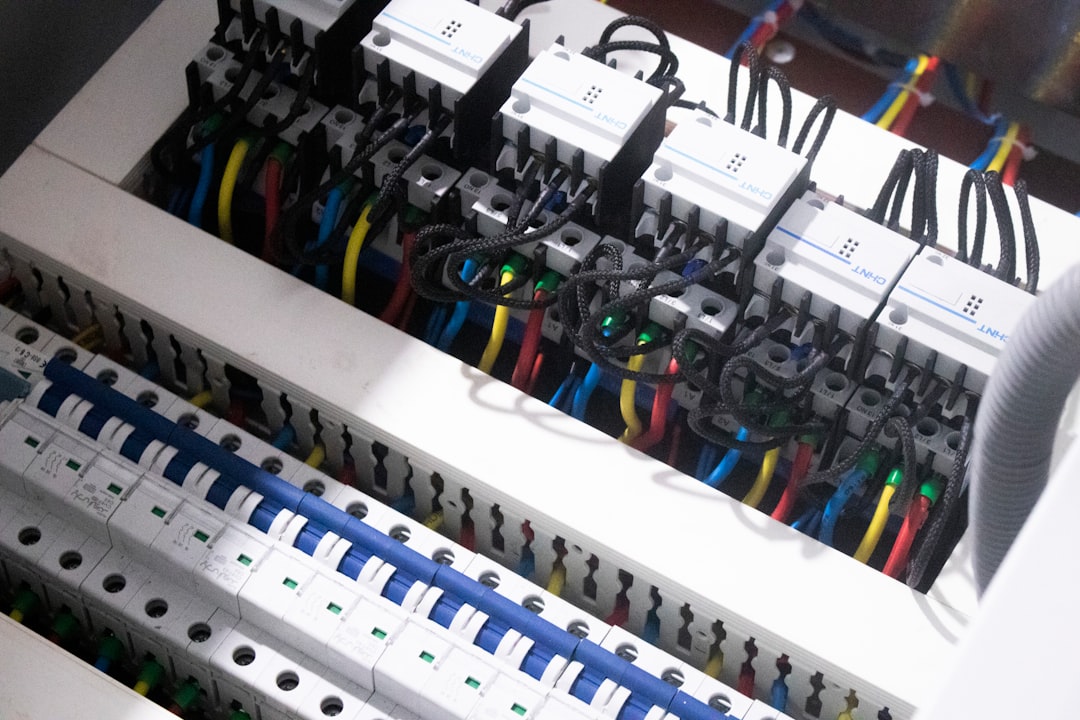
To determine whether your home can safely support modern technology, we have to look at the heart of your electrical system: the service panel and the physical wiring hidden behind your drywall.
Your electrical panel's capacity is measured in amperes (amps). Most homes built in the mid-20th century were equipped with 60-amp or 100-amp service. While a 60-amp panel was plenty when a home only ran a few lightbulbs and a radio, it is barely enough to power a modern kitchen today. In 2026, the standard for a typical single-family home is 200 amps, which provides the necessary headroom for high-draw devices.
Beyond capacity, the type of wiring in your walls plays a massive role in your home's safety margin.
• Knob-and-Tube — Era of Use: 1880s – 1930s — Key Safety Risks: No ground wire; fabric insulation degrades; cannot be safely covered by modern home insulation. — Modern Compatibility: Extremely dangerous; cannot support high-draw appliances.
• Aluminum Wiring — Era of Use: 1965 – 1973 — Key Safety Risks: Highly unstable connections; expands and contracts rapidly; 55 times more likely to reach fire-hazard conditions. — Modern Compatibility: High risk; requires specialized copper pigtailing remediation.
• Copper Wiring — Era of Use: 1970s – Present — Key Safety Risks: Minimal risk when properly sized and installed; excellent conductivity. — Modern Compatibility: Highly compatible; industry standard for modern power loads.
If your home contains knob-and-tube or single-strand aluminum branch wiring, plugging in a high-draw appliance like a portable air conditioner or a modern high-efficiency washing machine can cause the connections to overheat rapidly. If you are unsure what kind of panel or wiring you have, you can read our detailed breakdown on How to Know If Your Electrical Panel Needs Replacing to identify hazardous panel brands like Federal Pacific Stab-Lok or Zinsco.
Upgrading for High-Draw Technology: EV Chargers, Heat Pumps, and Hot Tubs
As we transition toward cleaner energy, homeowners in communities like Abbotsford, Langley, and Coquitlam are rapidly adopting electric vehicles, heat pumps, and luxury amenities like hot tubs. However, these modern upgrades place an unprecedented continuous load on your electrical panel.
Before adding any of these major loads to your system, it is vital to understand their specific electrical requirements. For example, installing a backyard spa requires dedicated, heavy-duty circuits with precise safety features. To learn more about these specific requirements, check out our guide on Hot Tub Electrical Requirements and Installation.
Is your electrical system safe for modern appliances like EV chargers?
A standard Level 1 EV charger plugs into a regular household outlet, but it charges incredibly slowly. To get a practical charge overnight, most homeowners install a Level 2 EV charger. A Level 2 charger requires a dedicated 240-volt circuit and draws between 30 to 50 amps of continuous power.
Because an EV charger runs continuously for several hours, it is classified as a "continuous load." Under the electrical code, continuous loads must not exceed 80% of the circuit's rated capacity. Adding a continuous 40-amp load to an older 100-amp panel that is already running your stove, dryer, and lights will almost certainly overload the system.
In some cases, you can avoid a costly utility service upgrade by utilizing smart load management solutions. These smart devices monitor your home's real-time power consumption and temporarily pause or dial down your EV charging rate when high-draw household appliances (like your oven) are running. However, if you want the freedom to run all your appliances simultaneously without restriction, upgrading to a 400 Amp Panel for Home provides the ultimate capacity and future-proofing.
Is your electrical system safe for modern appliances after a home renovation?
Kitchen remodels are one of the most common triggers for unexpected electrical issues. Modern professional-grade kitchen appliances demand dedicated power lines:
• Induction Cooktops: 40 to 50 amps (240V)
• Double Wall Ovens: 30 to 40 amps (240V)
• Built-in Microwaves and Dishwashers: Dedicated 15 to 20 amp circuits (120V)
During a renovation, focusing solely on cabinet aesthetics while ignoring what is behind the walls is a recipe for frequent breaker trips. Modern building codes require multiple dedicated small-appliance branch circuits in the kitchen to prevent overloading. Ensuring your panel is upgraded during the renovation process protects your investment and guarantees your high-end appliances receive the stable, clean voltage they require to function properly. For more details on how to coordinate these upgrades, read about our Electrical Panel Upgrade and Whole Home Protection services.
Modern Safety Devices: Panel Replacements, Service Upgrades, and Breaker Technology
When addressing an inadequate electrical system, homeowners often confuse a "panel replacement" with a "service upgrade."
• Panel Replacement: This involves swapping out your old, physical breaker box for a modern, safe panel of the same amperage. This is necessary if your existing panel is rusted, damaged, or is a recalled brand (like Federal Pacific or Zinsco) that poses an immediate fire hazard.
• Service Upgrade: This is a comprehensive project that increases the actual capacity of electricity entering your home from the utility grid (e.g., upgrading from 100-amp service to 200-amp service). This requires coordinating with BC Hydro, installing a new outdoor meter base, running heavier gauge service entrance cables, and replacing the indoor panel.
A modern service panel does not just provide more power; it also introduces advanced safety technologies that older systems lack, specifically AFCI and GFCI protection:
• Arc-Fault Circuit Interrupters (AFCIs): While standard breakers only trip during a massive overload or short circuit, AFCI breakers use advanced microprocessors to detect the specific electrical signature of sparking (arcing) behind your walls. This prevents fires before they can start.
• Ground-Fault Circuit Interrupters (GFCIs): Essential in wet areas like kitchens, bathrooms, and outdoors, GFCIs monitor the balance of current flowing through a circuit. If they detect even a tiny fraction of electricity leaking (such as through water or a human body), they shut off the power in milliseconds, virtually eliminating the risk of lethal electrocution.
How to Estimate Your Home's Electrical Load Before Buying New Appliances
Before you bring home a new high-draw appliance, you can perform a basic load calculation to see if your system has the available capacity.
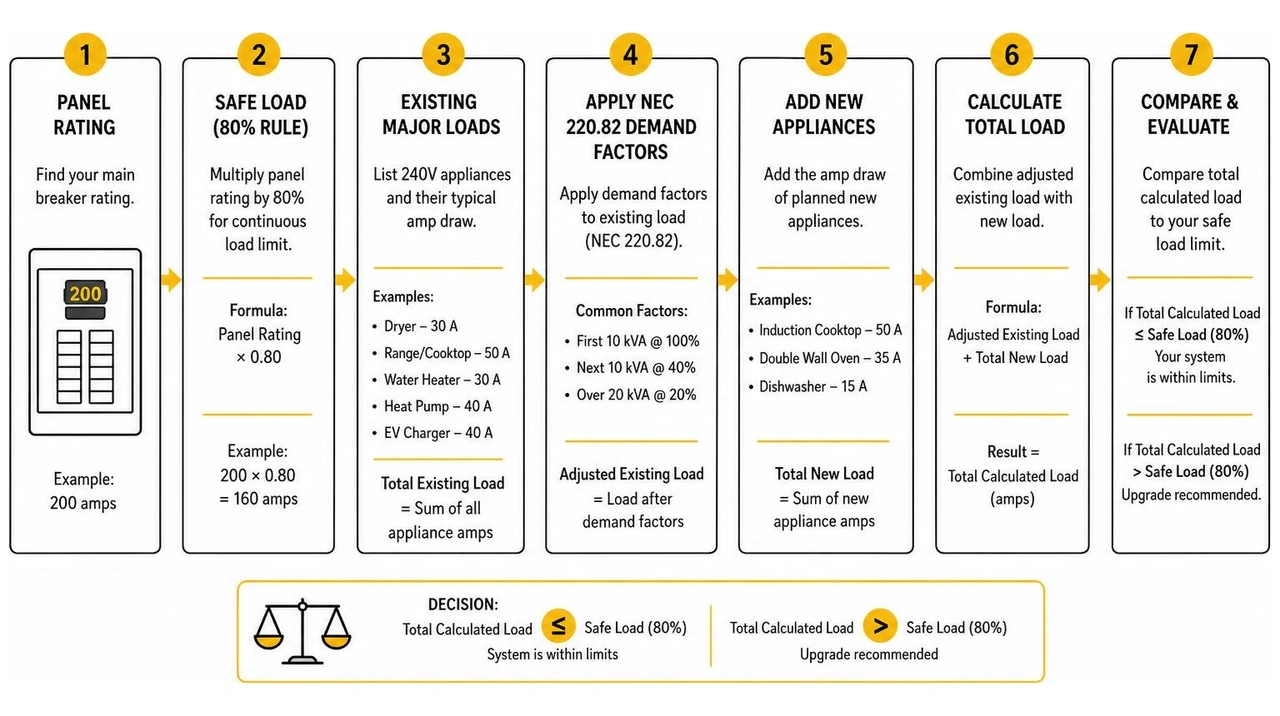
Here is how you can estimate your load at home:
1. Locate Your Panel's Amperage Rating: Open your panel door and look at the main breaker (usually located at the very top or bottom). The number stamped on the handle (e.g., 100, 125, 150, or 200) indicates your total household capacity in amps.
2. Determine Your Safe Load Limit (80% Rule): To prevent continuous overload, your home's sustained load should not exceed 80% of your panel's rating. For a 100-amp panel, your safe limit is 80 amps. For a 200-amp panel, it is 160 amps.
3. Inventory Your Existing Major Loads: Note down the major 240-volt appliances currently running in your home and their typical draw:
— Electric Clothes Dryer: ~30 amps
— Electric Range / Oven: ~40 amps
— Central Air Conditioner / Heat Pump: ~20 to 30 amps
— Electric Water Heater: ~20 to 25 amps
4. Convert Watts to Amps: If an appliance only lists its power draw in watts, use the formula: Amps = Watts / Volts. For example, a 1,500-watt space heater running on a standard 120-volt circuit draws 12.5 amps (1,500 / 120 = 12.5).
5. Apply Demand Factors (NEC 220.82): You do not simply add up every single breaker in your panel. In the real world, you do not run your dryer, oven, vacuum, and hair dryer all at the exact same millisecond. Professional load calculations use specific math rules (such as counting the first 10 kW of general loads at 100% and the remainder at 40%) to determine your true peak demand.
If your calculated load is close to or exceeds your safe limit, do not guess. Hire a licensed electrician to perform a professional load calculation before installing any new equipment.
Frequently Asked Questions about Electrical Safety
How many amps does a modern home actually need?
For most modern homes in the Lower Mainland, a 200-amp service is the recommended standard. If you have gas heating and gas cooking, a 100-amp panel can sometimes suffice. However, if you plan to transition to an all-electric home—incorporating a heat pump, an electric vehicle charger, an induction stove, and a hot tub—200 amps is the bare minimum required to future-proof your home.
Why do my lights dim when the vacuum turns on?
This is a classic sign of voltage sag. When a motorized appliance like a vacuum or a refrigerator compressor starts up, it requires a brief surge of high current (startup current) to get the motor spinning. If the circuit is already carrying other loads, or if the wiring leading back to your panel is undersized, this sudden draw causes the voltage on that line to drop momentarily, causing your lights to dim.
Is aluminum wiring always a fire hazard?
Single-strand aluminum wiring (commonly installed in homes built between 1965 and 1973) is inherently more unstable than copper. Aluminum expands and contracts dramatically when heated by electrical current, causing connections at outlets and switches to loosen over time. While the wire itself won't burn, these loose connections create high-resistance points that can easily spark and start a fire. It is considered a significant safety risk that requires professional remediation, such as copper pigtailing with specialized, code-approved connectors.
Conclusion
Ensuring your home's electrical system is safe for modern appliances is not just about avoiding annoying tripped breakers; it is about protecting your family, your home, and your expensive high-tech investments. Today's homes in the Lower Mainland demand clean, stable, and abundant power that older systems simply cannot deliver safely.
At Rep-Air Heating And Cooling, we pride ourselves on treating our customers like family. Whether you are in Abbotsford, Mission, Langley, or anywhere else in the Lower Mainland, our certified, expert electricians are ready to inspect your system, perform precise load calculations, and safely handle your panel upgrades.
Don't wait for a flicker to become a flame. Schedule Expert Electrical Service with us today to make sure your home is fully prepared for the demands of modern life.
hear what our satisfied clients have to say
Neighbourhoods in the Fraser Valley