A Comprehensive Guide to Electrical Panel Upgrade and Whole Home Protection
Why Every Lower Mainland Homeowner Should Know About Electrical Panel Upgrades and Whole Home Protection
Electrical panel upgrade and whole home protection go hand in hand when it comes to keeping your BC home safe, efficient, and ready for modern demands. Here is a quick overview of what you need to know:
• Electrical panel upgrade: Replacing or expanding your home's main breaker panel to handle more electrical load — often moving from 100A to 200A service
• Whole home surge protection: A device installed at your panel that shields every outlet and hardwired appliance from voltage spikes
• Why they matter together: A new panel without surge protection leaves your modern appliances exposed; surge protection on an overloaded panel can't fix the root problem
• Key signs you need attention: Flickering lights, tripping breakers, burning smells, or planning to add a heat pump or EV charger
• Who installs them: A licensed electrician handles both, often in a single visit
Think about the last time your breaker tripped — or your lights dimmed when the HVAC kicked on. These are not just minor annoyances. They are signals that your home's electrical system may be struggling to keep up. Older homes across the Lower Mainland, from Surrey, BC to Maple Ridge, BC, were built long before EV chargers, heat pumps, and smart home devices became everyday realities. Today's electrical loads are simply not what builders planned for decades ago.
At the same time, power surges — caused by everything from BC Hydro line switching to your own AC compressor cycling on — quietly wear down your appliances and electronics every single day. A whole-home surge protector installed at your panel addresses this around the clock, for every device in your home, including hardwired systems that a standard power strip can never reach.
This guide walks you through everything: how to spot a panel that needs upgrading, what the installation process looks like, how whole-home surge protection works, and how to make smart decisions for your home in British Columbia.
Understanding Electrical Panel Upgrades: Capacity vs. Safety
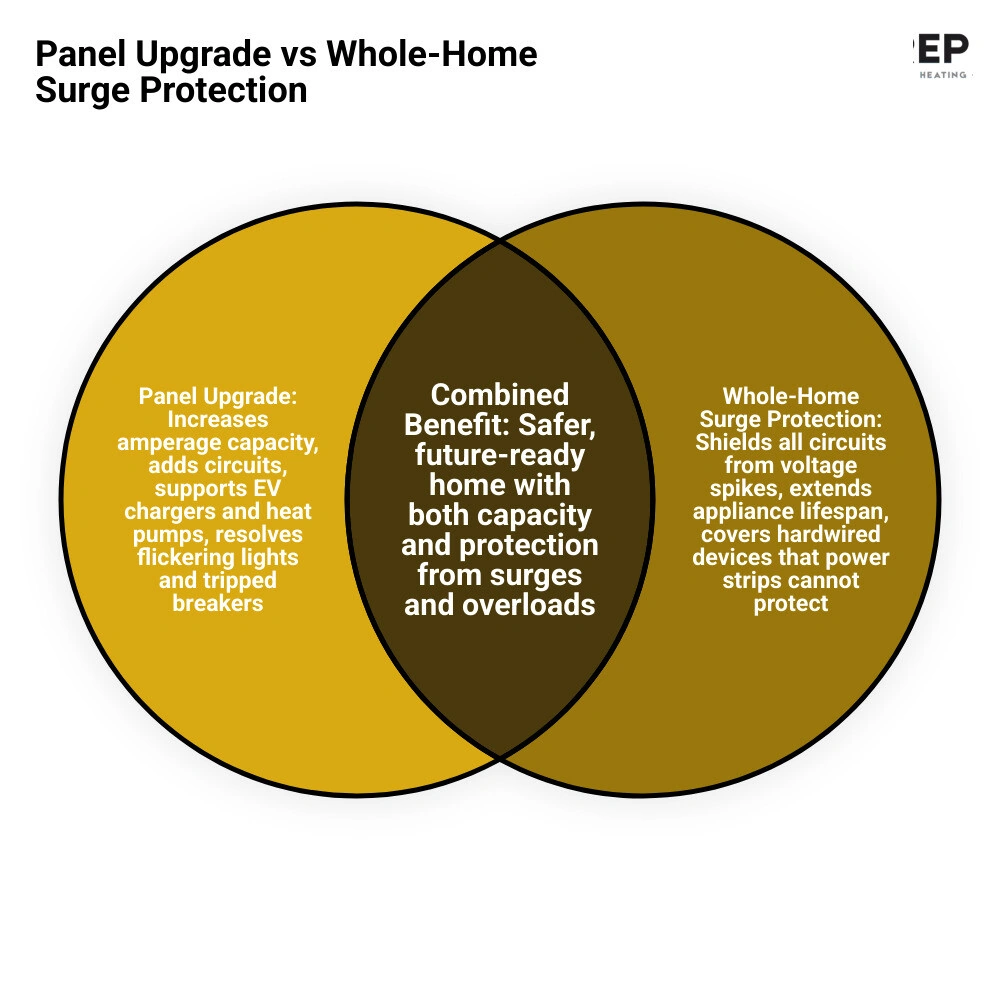
When we talk about your electrical panel, we are talking about the heart of your home's power distribution system. Every single watt of power pulled from the BC Hydro grid flows through this metal box. It has two main jobs: distributing that power to individual circuits throughout your house, and safety-tripping to cut off electricity if a circuit draws too much current.
An electrical panel upgrade is often necessary for two primary reasons: capacity and safety.
On the capacity side, older homes in our communities were frequently built with 60-amp or 100-amp service. Decades ago, this was plenty of power to run a few lights, a refrigerator, and a television. Today, we live in an era of rapid home electrification. If you are planning to add a high-efficiency heat pump, an electric vehicle (EV) Level 2 charger, or a hot tub, a 100-amp panel will likely struggle to support the load. Upgrading to a 200-amp panel provides the physical space and electrical capacity to run these modern systems simultaneously without overloading your home.
On the safety side, electrical panels do not last forever. Over time, internal connections can loosen, moisture can cause corrosion, and circuit breakers can wear out. When breakers fail to trip during an overload, the wires inside your walls can overheat, creating a severe fire hazard. Opting for professional Panel Upgrades in Maple Ridge, BC or scheduling an assessment for Panel Upgrades in Abbotsford, BC ensures that your home is equipped with a modern, reliable system that meets current Canadian Electrical Code (CEC) standards.
Signs of an Outdated or Overloaded Panel
How do you know if your panel is crying out for help? Your electrical system will usually give you several warning signs before a major failure occurs. Ignoring these signs can lead to damaged appliances or, worse, electrical fires.
• Flickering or Dimming Lights: If your lights flicker or momentarily dim when your refrigerator, vacuum, or air conditioner kicks on, it means your panel is struggling to handle the temporary voltage drop. This is a common issue we address for homeowners experiencing Flickering Lights in Pitt Meadows, BC.
• Frequently Tripping Breakers: If you find yourself constantly walking to the basement or garage to reset a breaker, your circuits are overloaded. For a deeper look at why this happens and how to resolve it safely, read our Breaker Keeps Tripping in Mission, BC Guide.
• Warm Outlets or Switches: Outlets, switches, or the panel itself should never feel warm to the touch. Heat is a direct symptom of electrical resistance, loose wiring, or overloaded circuits.
• Burning Smells or Buzzing Noises: A buzzing sound coming from your panel or a faint, plastic-like burning smell near outlets indicates active arcing or melting insulation. This is an electrical emergency that requires immediate professional attention.
• Outdated Brands (FPE and Zinsco): If your home still has a Federal Pacific (often branded as Federal Pioneer in Canada) Stab-Lok panel or a Zinsco panel, it should be replaced immediately. Independent testing has shown that these vintage breakers have exceptionally high failure rates, often failing to trip during an overload, which has directly caused thousands of house fires over the decades.
Panel Upgrade vs. Replacement vs. Service Upgrade
Many homeowners use these terms interchangeably, but they actually refer to different levels of electrical work. Understanding the differences will help you communicate clearly with your electrician.
• Panel Replacement (Same Amperage): This involves swapping out an old, damaged, or unsafe breaker box for a brand-new one of the exact same amperage (e.g., replacing an old 100A panel with a modern 100A panel). This is done purely for safety, code compliance, or to resolve physical damage like rust.
• Panel Upgrade: This involves replacing your existing panel with one that has more circuit spaces and a higher amperage capacity (typically upgrading from 100A to 200A). This gives you the room and capability to add heavy-draw appliances.
• Service Upgrade: This is the most comprehensive option. It includes upgrading your panel, replacing the service mast (the pipe on the side of your house), running new, thicker service entrance conductors, and coordinating with BC Hydro to upgrade the lines feeding your home from the street.
For exceptionally large homes with multiple EV chargers, workshops, and extensive electric heating, we sometimes design and install a 400 Amp Panel for Home to handle the massive load.
• Amperage Change — Panel Replacement: None (e.g., 100A to 100A) — Panel Upgrade: Increases (e.g., 100A to 200A) — Service Upgrade: Increases (e.g., 100A to 200A/400A)
• Utility Coordination — Panel Replacement: Rarely required — Panel Upgrade: Yes, for power disconnect — Service Upgrade: Yes, requires BC Hydro line upgrade
• New Meter Base — Panel Replacement: No — Panel Upgrade: Sometimes — Service Upgrade: Yes
• New Service Mast — Panel Replacement: No — Panel Upgrade: No — Service Upgrade: Yes
• Primary Benefit — Panel Replacement: Restores safety & reliability — Panel Upgrade: Adds circuit space & capacity — Service Upgrade: Maximizes capacity for full electrification
What to Expect During a Panel Upgrade Installation
A professional panel upgrade is a highly coordinated event. Because it involves live high-voltage electricity, it is not a DIY project. Here is what you can expect when our team performs an upgrade:
1. Permits and Planning: Before any physical work begins, we pull the necessary electrical permits with Technical Safety BC or your local municipality. We also coordinate with BC Hydro to schedule the power disconnect and reconnect times.
2. The Power Outage: On the day of the installation, BC Hydro will temporarily shut off power to your home. You should plan to be without electricity for 4 to 8 hours. We recommend keeping your refrigerator and freezer doors closed to preserve your food, or storing perishables in a cooler.
3. The Swap: Our licensed electricians will carefully remove your old panel, install the new UL-listed breaker box, run new grounding and bonding wires, and wire in modern Arc-Fault Circuit Interrupter (AFCI) and Ground-Fault Circuit Interrupter (GFCI) breakers where required by current codes.
4. Inspection and Reconnection: Once the physical installation is complete, a local safety inspector will review the work. After passing inspection, BC Hydro will safely reconnect the power, and we will thoroughly test every circuit in your home.
If you want a detailed breakdown of this process, check out our Panel Upgrade Guide in Mission, BC or explore our services for Panel Upgrades in Pitt Meadows, BC.
Why Your Lower Mainland House Needs an Electrical Panel Upgrade and Whole Home Protection
The Lower Mainland is experiencing a major shift in how we power our homes. As we work toward reducing our carbon footprint, many homeowners are transitioning away from natural gas and adopting clean, electric alternatives. However, this transition places a much heavier demand on your home's electrical infrastructure.
When you install a modern ductless heat pump, a fast EV charger, or an induction cooktop, your old electrical panel can quickly become a bottleneck. Upgrading your panel ensures you have the raw capacity to power these eco-friendly systems.
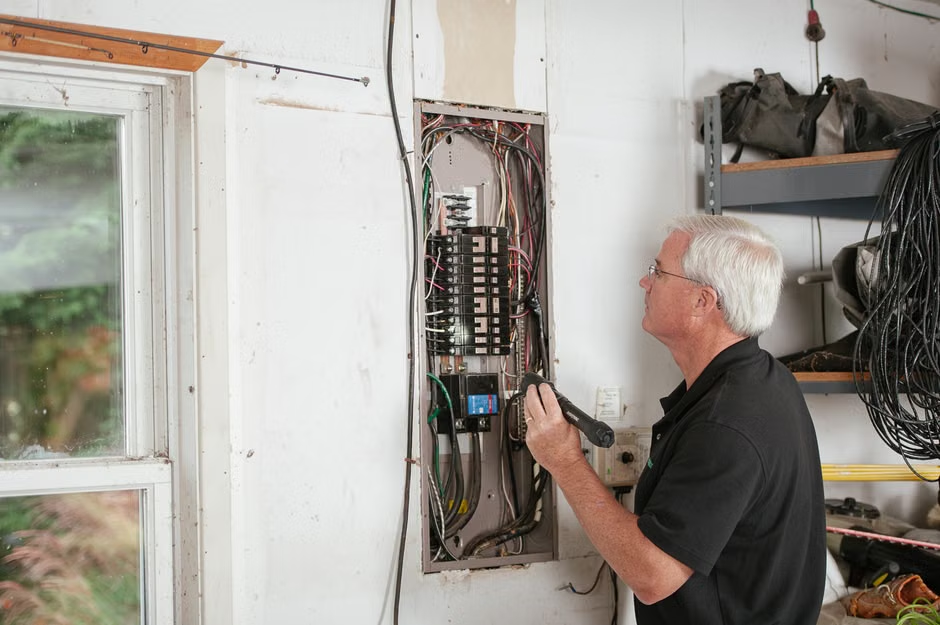
But capacity is only half the battle. Modern appliances are incredibly smart, meaning they are packed with sensitive microprocessors and electronic control boards. A high-efficiency furnace, a smart refrigerator, and a modern heat pump are essentially computers that happen to heat, cool, or preserve food. These microchips are highly vulnerable to voltage fluctuations. This is why pairing an electrical panel upgrade and whole home protection is the smartest way to safeguard your investments.
Whether you need Whole Home Protection in Langley, BC or Whole Home Protection in Abbotsford, BC, adding surge protection ensures your new, expensive equipment won't be ruined by a sudden power spike.
The Synergy Between an Electrical Panel Upgrade and Whole Home Protection
Why should you install whole-home surge protection at the exact same time as a panel upgrade? The answer comes down to safety, efficiency, and economics.
When we upgrade your electrical panel, we are already shutting down the power, removing the old breaker box, and rewiring your system. Your panel is completely open and accessible. Installing a whole-home surge protective device (SPD) during this process takes our electricians less than an hour. Combining these two projects saves you time, minimizes disruption to your daily routine, and eliminates the need to pay for a second service call down the road.
Furthermore, a new electrical panel creates the perfect integration point for an SPD. Modern panels have dedicated spaces designed specifically for clean, hardwired surge protectors. By installing them together, you create a robust, layered defense system. The new panel provides the stable capacity your home needs, while the surge protector guards the entry point of your electrical system, keeping voltage spikes from ever reaching your home's circuits.
We regularly help homeowners implement this dual-protection approach, providing peace of mind with Whole Home Protection in Pitt Meadows, BC and Whole Home Protection in Mission, BC.
Electrification: Upgrading vs. Existing Panel
Can you electrify your home without upgrading your panel? In some cases, yes. If your home already has a modern 100-amp or 150-amp panel, you might be able to add a heat pump or an EV charger without a full service upgrade.
To determine this, a licensed electrician must perform a professional load calculation according to Canadian Electrical Code standards. This calculation takes into account your home's square footage, your heating and cooling systems, and your existing major appliances.
If the load calculation shows you are close to your panel's limit, you have a choice to make:
• Electrifying on Your Existing Panel (Pros & Cons):
— Pros: Avoids the initial time and coordination of a panel upgrade.
— Cons: You may have to use smart load-sharing devices that prevent you from running your dryer and EV charger at the same time. It leaves zero room for future additions, and your panel will run closer to its maximum capacity, which can increase operating temperatures.
• Upgrading Your Panel (Pros & Cons):
— Pros: Provides complete freedom to use your appliances whenever you want. Future-proofs your home for solar panels, battery storage, or additional renovations. Increases your home's resale value and appeals to tech-savvy buyers.
— Cons: Requires a scheduled power outage during the installation.
If you are weighing these options, our teams specializing in Panel Upgrades in Langley, BC and Panel Upgrades in Town Centre, BC can perform a precise load calculation to help you make an informed decision.
Planning Your Electrical Panel Upgrade and Whole Home Protection in BC
Planning an electrical upgrade in the Lower Mainland requires navigating local guidelines and safety regulations. In British Columbia, all major electrical work must comply with the Canadian Electrical Code and is regulated by Technical Safety BC.
Additionally, because we coordinate directly with BC Hydro, we must follow their strict utility standards. This includes ensuring your outdoor meter base is at the correct height, your service mast has the proper structural support to handle heavy winter snow or wind, and your grounding system uses two copper-clad ground rods spaced at least three meters apart.
When you work with us, we handle every single step of this planning process — from pulling the permits to coordinating with BC Hydro and scheduling the final safety inspection. If you are located in the Tri-Cities area, you can learn more about how we manage these local requirements by visiting our pages on Whole Home Protection in Town Centre, BC and Electrical Services in Town Centre, BC.
The Mechanics of Whole-Home Surge Protection
To understand why whole-home surge protection is so vital, we first need to understand what a power surge actually is. A power surge is a temporary, intense spike in electrical voltage that travels through your home's wiring. While standard household electricity in Canada runs at a stable 120 volts, a surge can send thousands of volts through your system in a fraction of a millisecond.
Many people assume that surges are only caused by lightning strikes. While a direct lightning strike is indeed the most powerful type of surge, it is also the rarest. In the Lower Mainland, surges are far more commonly caused by:
• Utility Grid Switching: BC Hydro routing power around the grid or repairing downed lines after a windstorm.
• Downed Power Lines: Tree branches falling on lines during wet, windy coastal storms.
• Internal Appliance Cycling: Every time your air conditioner, heat pump, or vacuum cleaner shuts off, the sudden stop in electrical demand sends a minor voltage spike back into your home's circuits. These small, daily surges happen dozens of times a day, slowly degrading the delicate microchips in your electronics until they eventually fail.
If you want to protect your home from these invisible threats, our team can help you find the right solution through our Electrical Services in Langley, BC.
How Surge Protection Works
A whole-home surge protective device (SPD) acts like a pressure relief valve for your electrical system. It is hardwired directly to your main electrical panel, connected to both hot utility lines, the neutral line, and the ground.
When the voltage entering your home is normal, the SPD sits quietly, acting as an open switch. However, the instant the voltage exceeds a safe threshold (known as the clamping voltage), the internal components of the SPD (typically Metal Oxide Varistors, or MOVs) instantly react. The MOVs channel the excess surge current harmlessly away from your home's circuits and deep into the earth through your grounding system.
Under IEEE standards, residential surge protection is classified into different types:
• Type 1 SPD: Installed on the utility side of your main service disconnect. These are designed to handle massive external surges, like direct lightning strikes.
• Type 2 SPD: Installed on the load side of your main disconnect, typically inside or right next to your electrical panel. This is the standard and most effective choice for residential whole-home protection, as it guards against both external utility surges and internal appliance-generated surges.
Our licensed team can help you select and install the perfect Type 2 device through our Electrical Services in Maple Ridge, BC.
Point-of-Use Devices vs. Whole-Home Systems
Many homeowners believe they are fully protected because they have plugged their computer or TV into a standard power strip. While point-of-use power strips are a great secondary line of defense, they are completely inadequate as your primary protection.
First, standard power strips have very low joule ratings (typically between 200 and 2,000 joules). A whole-home SPD, by comparison, is rated to handle massive energy surges, often between 40,000 and 108,000 joules.
Second, a power strip can only protect devices that are physically plugged into it. It does nothing to protect your hardwired systems, which are often the most expensive appliances in your home.
Devices Protected by a Whole-Home Surge Protection System:
• Your central heating and cooling systems (heat pumps, furnaces, and AC units)
• Kitchen appliances (refrigerator, stove, oven, dishwasher, and microwave)
• Laundry appliances (washer and dryer)
• EV charging stations
• Smart home hubs, security cameras, and built-in lighting controls
• Tankless water heaters
• Home office equipment and entertainment systems
For true safety, we recommend a layered protection strategy: a Type 2 whole-home surge protector installed at your panel to clamp major surges, combined with Type 3 power strips at your sensitive electronics to absorb any tiny remaining voltage remnants.
Rebates and Incentives in 2026
If you are planning to upgrade your electrical panel to prepare for clean energy improvements, you may be eligible for financial incentives in 2026.
South of the border, programs like the Energy Efficient Home Improvement Tax Credit offer homeowners up to a 30% credit (up to $600) for panel upgrades when completed in conjunction with heat pump installations. Here in British Columbia, clean energy initiatives and provincial programs like CleanBC regularly offer rebates for panel upgrades when you transition from fossil fuel heating to an efficient heat pump system.
Because these programs are updated frequently, our team stays on top of the latest local incentives to help you maximize your savings. For advice on planning your project and navigating current rebates, you can consult our guide on Electrical Services in Maple Ridge, BC.
Frequently Asked Questions About Electrical Upgrades
We understand that electrical upgrades can feel overwhelming. Here are answers to some of the most common questions we hear from homeowners across the Lower Mainland.
Why does my AC circuit breaker keep tripping?
An air conditioner or heat pump circuit breaker that keeps tripping is a sign that something is wrong. Breakers trip to prevent electrical fires, so you should never ignore this issue or repeatedly force the breaker to reset. The most common causes include:
• A Dirty Air Filter: A clogged filter restricts airflow, forcing your AC blower motor to work much harder and draw more electrical current than the breaker is rated for.
• A Failing Compressor: As your AC compressor ages, its internal motor windings can degrade, causing it to draw excessive current upon startup.
• An Electrical Short: A loose wire or damaged insulation inside the AC unit can cause a short circuit, triggering an instant safety trip.
• A Weak Breaker: Over time, circuit breakers can wear out and trip at lower currents than they are designed to handle.
If you are dealing with this frustrating issue, read our articles on why an AC Circuit Breaker Keeps Tripping and explore our helpful guide on Troubleshooting AC Circuit Breaker Issues.
How long does a whole-home surge protector last?
A quality whole-home surge protector typically lasts between 5 and 10 years. However, their lifespan is measured in "surge absorption" rather than just time.
Every time a surge protector diverts excess voltage to the ground, its internal components degrade slightly. A single massive surge (like a nearby transformer failure) can use up the device's protective capacity instantly. Fortunately, modern whole-home SPDs come equipped with LED indicator lights. As long as the green light is glowing, you know your home is protected. If the light turns red or goes out entirely, it means the device has successfully absorbed a major surge and needs to be replaced.
Do I need a permit for a panel upgrade in BC?
Yes, absolutely. In British Columbia, replacing or upgrading an electrical panel is considered regulated work under the Safety Standards Act. It requires an electrical permit pulled by a licensed electrical contractor through Technical Safety BC (or the appropriate municipal authority if you live in a self-governing jurisdiction like Burnaby, BC or Vancouver, BC).
Once the work is complete, it must be inspected by a certified safety officer to ensure it complies with the Canadian Electrical Code. Attempting to complete a panel upgrade without a permit is not only dangerous and illegal, but it can also void your homeowner's insurance policy in the event of a future fire.
Conclusion
Your home's electrical panel is the foundation of your entire household's comfort, convenience, and safety. If you are living in an older home, planning to adopt modern electric appliances, or simply want to protect your valuable electronics from unexpected power surges, investing in an electrical panel upgrade and whole home protection is one of the smartest decisions you can make.
At Rep-Air Heating And Cooling, we are proud to serve our neighbors across the Lower Mainland with top-tier HVAC, plumbing, and electrical services. We treat every customer like family, providing unmatched customer service, transparent communication, and comprehensive maintenance plans to keep your home running smoothly year-round.
Don't wait for a flickering light or a tripped breaker to turn into an electrical emergency. Schedule electrical services with Rep-Air Heating And Cooling today to have our licensed professionals inspect your system and help you build a safer, more efficient home for the future.
hear what our satisfied clients have to say
Neighbourhoods in the Fraser Valley