Most Common AC Repairs and Their Hidden Causes

What Are the Most Common AC Repairs and What Causes Them?
Understanding the most common AC repairs and what causes them can save you from a sweltering home in the middle of a Lower Mainland summer. Whether your system is blowing warm air, making strange noises, or shutting off unexpectedly, most breakdowns trace back to a handful of well-known failure points.
Here is a quick overview of the most common AC repairs homeowners face:
• Capacitor failure — Most Common Cause: Normal wear; accounts for 21.5% of all service calls
• Dirty air filter — Most Common Cause: Neglected filter changes; linked to 90% of cooling issues
• Frozen evaporator coil — Most Common Cause: Restricted airflow or low refrigerant
• Refrigerant leak — Most Common Cause: Corrosion, improper installation, or aging components
• Clogged condensate drain — Most Common Cause: Algae, mold, and debris buildup in drain lines
• Electrical/breaker issues — Most Common Cause: Short cycling, corrosion, or overloaded circuits
• Thermostat malfunction — Most Common Cause: Dead batteries, misconfiguration, or faulty sensors
Most AC problems do not appear out of nowhere. They build quietly over weeks or months: a filter that goes unchanged, a drain line that slowly clogs, a capacitor that is gradually losing its ability to hold a charge. By the time the system stops working, the underlying cause has usually been developing for a while.
The good news is that the majority of these failures are preventable with routine maintenance and early attention to warning signs. In the sections below, we break down each of the most common repairs in detail so you know exactly what to watch for and when to call a professional.
The Most Common AC Repairs and What Causes Them
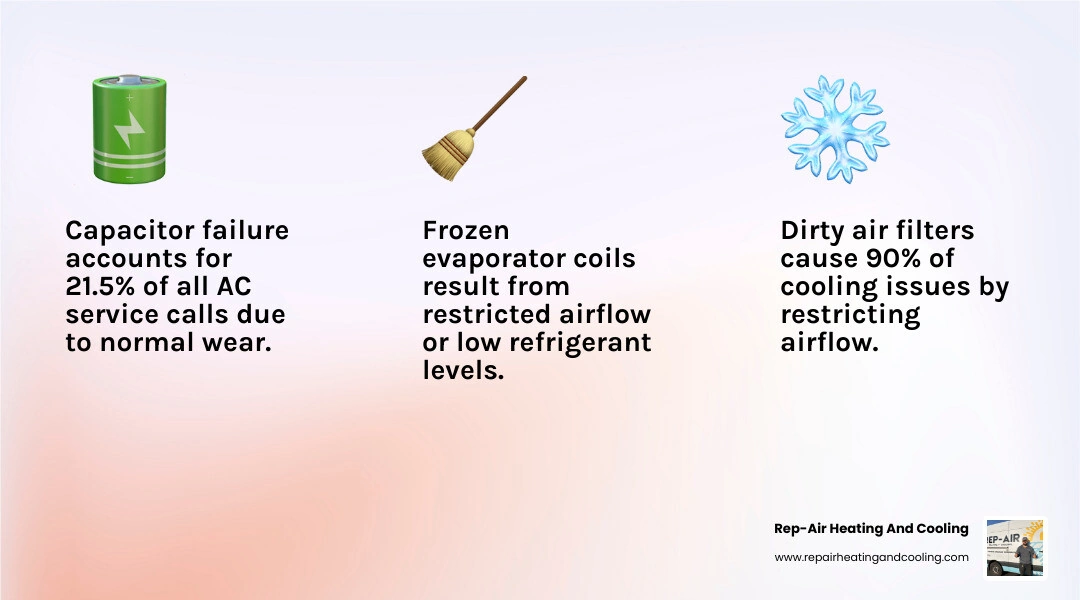
When we look at the data from thousands of service calls across the Lower Mainland, a clear pattern emerges. In a recent analysis of 242 real-world repair visits, one component stood out as the "MVP" of failures: the capacitor. Bad capacitors account for 52 out of 242 calls, or roughly 21.5% of all AC repairs.
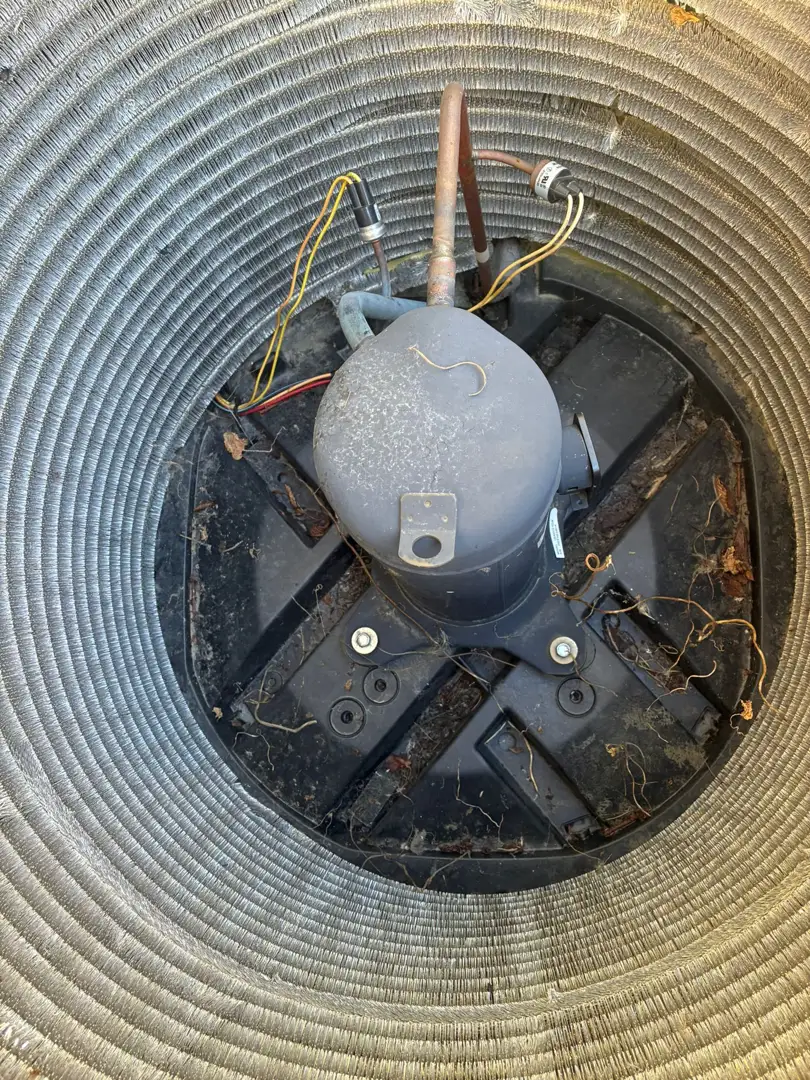
But why do these parts fail? In places like Abbotsford or Langley, our systems work hard during the humid summer months. Mechanical wear and tear is the primary driver, but environmental factors like dust and fluctuating electrical currents also play a role. If you notice your outdoor unit humming but the fan isn't spinning, or if the system struggles to start, you're likely looking at a capacitor issue.
Recognizing the Signs Your AC Needs Repair early can prevent a small electrical failure from cascading into a much more expensive AC Indoor Unit Repair. When a capacitor fails, it puts immense strain on the compressor and fan motors, which can lead to total system burnout if ignored.
How dirty air filters trigger the most common ac repairs and what causes them
It might seem hard to believe that a simple piece of pleated fabric or fiberglass could be the root of 90% of all central air malfunctions, but the data doesn't lie. Airflow is the lifeblood of your HVAC system. When a filter becomes clogged with dust, pet hair, and debris, it acts like a wall, forcing your blower motor to work twice as hard to pull air through the system.
This restriction doesn't just make your home less comfortable; it's a primary trigger for the most common ac repairs and what causes them. A struggling blower motor consumes more electricity: often increasing energy costs by up to 15%, and generates excess heat that can melt wire insulation or trip circuit breakers. We frequently see What Happens When You Don't Take Care of Your HVAC in homes where filters haven't been touched in six months. The result is usually a "suffocated" system that eventually shuts down to protect itself from permanent damage.
Identifying electrical issues as the most common ac repairs and what causes them
Electrical failures are often the most frustrating for homeowners because they can be invisible. Beyond the high-frequency capacitor failures, we often encounter "pitted" or "arced" contactors. The contactor is a small switch that tells your compressor and outdoor fan to turn on. Over time, the electrical arc created every time the system starts can burn the metal surfaces, eventually preventing the electrical current from reaching the motors.
Symptoms of electrical distress include:
• Clicking sounds: The system is trying to start, but the contactor or capacitor isn't engaging.
• Humming noises: A motor is receiving power but cannot start due to a failed capacitor.
• Tripped breakers: If your AC is Troubleshooting AC Circuit Breaker Issues, it's often because a component is drawing too much "startup" current, signaling an internal short or a motor that is beginning to seize.
Why Airflow Issues Lead to Frozen Evaporator Coils
It's one of the great ironies of HVAC: your air conditioner can actually turn into a block of ice in the middle of a 30°C July afternoon. When homeowners see ice forming on the copper refrigerant lines or the indoor unit, they often think the system is "cooling extra hard." In reality, it's a sign of a major failure.
Frozen evaporator coils happen when the heat exchange process is disrupted. Your AC works by blowing warm indoor air over a very cold coil. The refrigerant inside the coil absorbs the heat. If airflow is restricted, perhaps due to a dirty filter or Solving Poor Airflow from AC Vents in Mission Homes; there isn't enough heat for the refrigerant to absorb. The temperature of the coil drops below freezing, and the moisture in the air turns to ice.
One common mistake we see in the Lower Mainland is the use of high-efficiency MERV 13 filters in systems not designed for them. While great for air quality, the mesh is so fine it can act as a solid barrier, causing the system to freeze. If you find ice, the first step is to turn the AC off and set the fan to "on." This "fan only" method allows the ice to melt safely before a technician can identify the underlying airflow or refrigerant pressure issue.
Refrigerant Leaks and Condensate Drainage Problems
Your AC system is designed to be a "closed loop, " meaning the refrigerant should never "run out." If your levels are low, you have a leak. These leaks often stem from formicary corrosion: tiny, microscopic holes in the copper coils caused by a chemical reaction between the copper and pollutants in the air.
As of May 2026, the industry has moved entirely away from older refrigerants like R-22. If your older system has a leak, it can be a significant decision point, as these older chemicals are increasingly scarce. Common signs of a leak include a "sweet" chemical smell, bubbling or hissing sounds near the unit, and the frustrating scenario of your AC Blowing Warm Air 5 Essential Fixes.
Then there is the issue of water. Your AC removes gallons of moisture from the air every day. This water is supposed to exit through a condensate drain line. However, in the humid climate of places like Pitt Meadows and Mission, algae and mold love to grow in these warm, damp pipes. When the line clogs, the water backs up. This is Why Your Mission AC Unit is Leaking Indoors. Without a functioning float switch to shut the system down, this can lead to water damage in your ceilings or floors.
Deciding Between Repair and Replacement in the Lower Mainland
When faced with a major repair, many homeowners in Coquitlam or Maple Ridge wonder if it's time to pull the plug and invest in a new system. To make this easier, we often recommend the "$5, 000 Rule."
The $5, 000 Rule: Multiply the age of your AC unit by the estimated cost of the repair. If the total exceeds $5, 000, a replacement is usually the smarter financial move.
• System Age — Repair: Under 10-12 years — Replace: Over 15 years
• Efficiency — Repair: Standard SEER — Replace: Modern SEER2 (Up to 30% more efficient)
• Refrigerant — Repair: Uses R-410A — Replace: Uses obsolete R-22
• Reliability — Repair: First major issue — Replace: Frequent "short cycling" and breakdowns
If your system is showing AC Repair Red Flags That Mean You Need a New System, such as a failed compressor or a severely corroded coil, the long-term energy savings of a new SEER2-rated unit often outweigh the cost of keeping an old "energy hog" on life support. We often find that The Worst Ways to Use an Air Conditioner, like cranking the thermostat to 16°C, only accelerate the demise of these older units.
Frequently Asked Questions about Common AC Repairs
Why is my AC blowing warm air in Mission, BC?
In Mission, the most common reason for warm air is either a tripped outdoor breaker, a failed capacitor, or a refrigerant leak. First, check your thermostat to ensure it hasn't been bumped to "Heat" or "Fan Only" mode. If the settings are correct but the air is still lukewarm, the compressor likely isn't engaging. Check our guide on AC Blowing Warm Air 5 Essential Fixes for more DIY steps.
What causes my AC to make a loud banging noise?
Banging or clanging usually indicates a mechanical obstruction or a loose part. It could be a fan blade that has become unbalanced or a motor mount that has failed, allowing the motor to vibrate against the housing. If you hear this, shut the system off immediately. Running a banging AC can turn a simple part replacement into a total system replacement in seconds.
How often should I change my filters to avoid repairs?
For most homes in the Lower Mainland, a standard 1-inch pleated filter should be changed every 90 days. However, if you have pets (the "fur factor"), smokers in the home, or live near a construction site in a growing area like Willoughby or Langley, you should check it every 30 days. Preventative AC Service is Essential to keep your airflow unrestricted and your blower motor healthy.
Conclusion
At Rep-Air Heating And Cooling, we've spent years helping families across the Lower Mainland, from the quiet streets of Babich to the bustling neighborhoods of Port Coquitlam, stay comfortable all year round. We believe in a "family-first" approach, which means we'd rather help you prevent a breakdown through a comprehensive maintenance plan than see you suffer through a heatwave without cooling.
The most common AC repairs and what causes them are often predictable and, more importantly, avoidable. Whether you need a quick capacitor swap or a full system evaluation, our team is dedicated to providing customer service and technical expertise. We consider every AC Service Mission Complete 1st Rate Comfort only when your home is perfectly cooled and your system is running at peak efficiency.
Don't wait for the next record-breaking heatwave to find out if your AC is up to the task. Request professional air conditioning services today and let us keep your home the sanctuary it should be.
hear what our satisfied clients have to say
Neighbourhoods in the Fraser Valley