How to Fix Ice on AC in 5 Easy Steps
Why Ice Forming on Your AC Unit Is a Warning Sign You Can't Ignore
If you've noticed ice forming on your AC unit, here's what you need to know right away:
Quick Answer: Common Causes and What to Do
1. Dirty or clogged air filter: Replace it immediately (most common cause, ~50% of cases)
2. Low refrigerant from a leak: Turn off the system and call a professional
3. Blocked supply or return vents: Open and clear all vents in your home
4. Dirty evaporator coil: Schedule a professional coil cleaning
5. Failing blower motor or fan: Have a technician inspect and replace it
What to do right now:
• Turn your AC off at the thermostat
• Set the fan to On (not Auto) to thaw the coil
• Check and replace your air filter
• Wait 1–4 hours before restarting
• Call a professional if ice returns
It's a hot summer day in the Lower Mainland, and your home just won't cool down. You head outside or check your indoor air handler, and find a thick layer of ice coating your AC unit. It feels completely backwards. How can a cooling system freeze up in the middle of a heatwave?
Here's the reality: ice on your air conditioner is never a sign it's working extra hard. It's always a signal that something is wrong, either airflow is being restricted, or refrigerant levels have dropped due to a leak. Left unchecked, a frozen AC can quickly escalate from a minor fix into a damaged compressor and a much bigger repair bill.
At Rep-Air Heating And Cooling, we see this problem regularly across Coquitlam, BC, Maple Ridge, BC, and communities throughout British Columbia's Lower Mainland. This guide will walk you through exactly why it happens and how to fix it safely.
Ice forming on your ac unit causes and what to do vocab explained:
• ac circuit breaker keeps tripping what it means
• ac troubleshooting tips before calling a pro
• why is my ac blowing warm air troubleshooting steps
Ice Forming on Your AC Unit Causes and What to Do: The Core Triggers
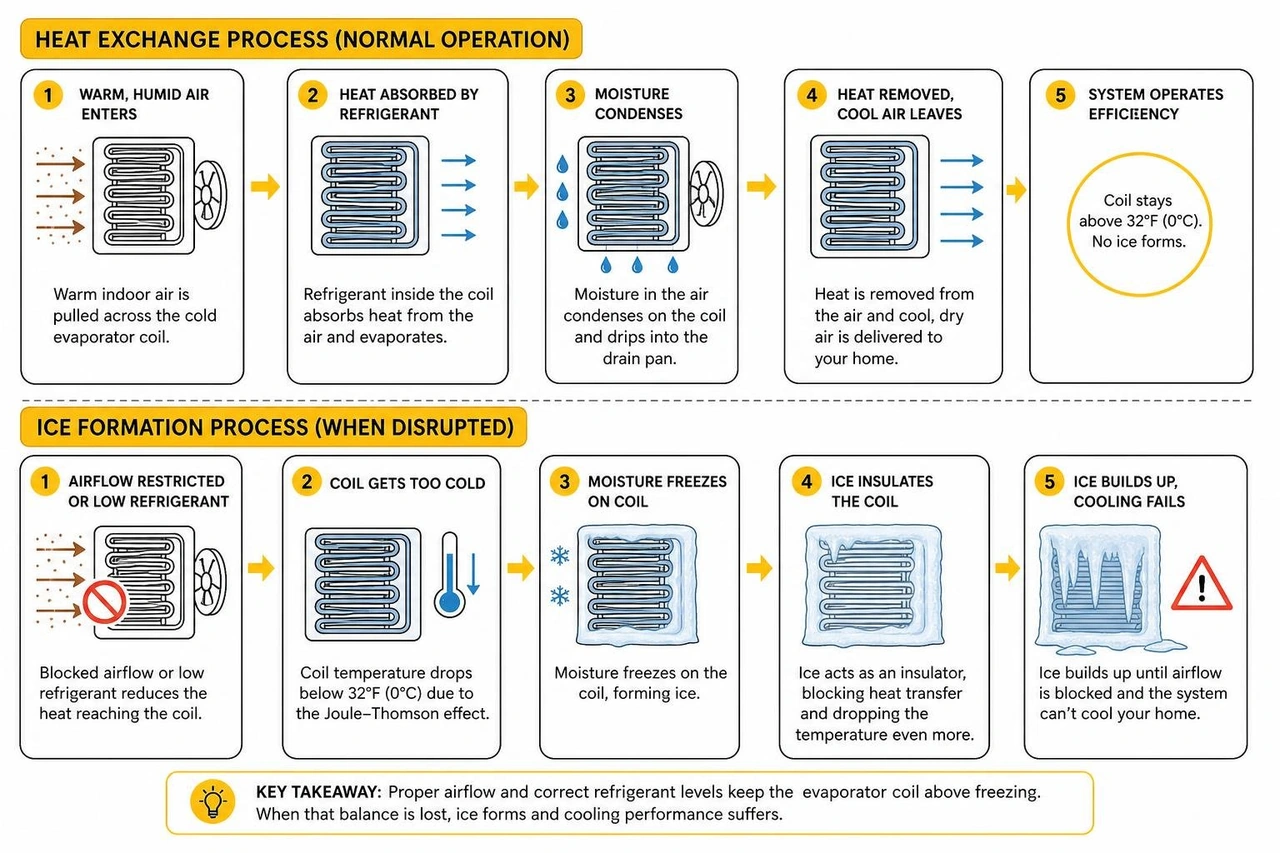
To understand why ice forms on your air conditioner, we have to look at the basic physics of how your system cools your home. Your air conditioner doesn't actually "create" cold air; instead, it removes heat from your indoor spaces.
Inside your home, the indoor unit houses the evaporator coil. Cold, liquid refrigerant flows through this coil. As warm, humid indoor air is blown across the cold coil by your blower fan, the refrigerant inside absorbs the heat from the air. This process also causes moisture in the air to condense on the outside of the coil, much like water droplets forming on a cold glass of iced tea on a hot day.
Normally, this condensation drips safely into a drain pan and flows away. However, if the system's balance is disrupted, the temperature of the evaporator coil can drop below freezing (32°F or 0°C). When this happens, the moisture condensing on the coil instantly freezes, starting a runaway effect. The ice acts as an insulating barrier, preventing the coil from absorbing heat, which causes the temperature to drop even further, building up thicker and thicker layers of ice.
This temperature drop is governed by the Joule-Thomson effect, which explains how expanding gases cool down. If the pressure inside the evaporator coil drops too low, the refrigerant becomes exceptionally cold, freezing any moisture on contact. When this occurs, you might notice your system running constantly but failing to lower the temperature in your home. If you are experiencing this, you should read about Why is My AC Blowing Warm Air? Troubleshooting Steps to understand how these issues are closely linked.
Airflow Issues: Ice Forming on Your AC Unit Causes and What to Do
Restricted airflow is the single most common reason why evaporator coils freeze, accounting for roughly half of all service calls for frozen air conditioners. For your air conditioner to function properly, a steady stream of warm indoor air must pass over the evaporator coil. This warm air supplies the heat that keeps the refrigerant at a safe, stable operating temperature. If that airflow is restricted, the refrigerant inside the coil gets too cold, causing the condensation on the outside to freeze.
Several factors can severely restrict airflow through your system:
• A Clogged or Dirty Air Filter: This is the primary culprit in about 50% of all frozen AC cases. When an air filter becomes caked with dust, pet dander, and debris, it acts like a wall, preventing the blower fan from pulling enough air through the return vents.
• Blocked Return or Supply Vents: Closing vents in unused rooms or blocking them with furniture, heavy drapes, or rugs disrupts the system's static pressure. We recommend keeping at least 80% of your supply registers and all of your return grilles fully open to maintain proper airflow.
• A Dirty Evaporator Coil: Over time, fine dust particles that bypass your air filter can settle on the wet surface of the evaporator coil. This layer of dirt acts as an insulator, preventing the warm air from contacting the cold copper lines directly and reducing heat transfer.
• Failing Blower Motor or Fan: If the blower motor is wearing out, spinning too slowly, or has a broken fan belt, it won't move enough air across the coil. A failing blower motor accounts for about 5% of freezing issues.
• Improper MERV Ratings: Using a filter with a MERV rating that is too high for your specific residential system can restrict airflow just as much as a dirty filter.
Refrigerant Leaks: Ice Forming on Your AC Unit Causes and What to Do
The second major cause of a frozen air conditioner is low refrigerant, which is responsible for approximately 25% of all freezing incidents. It is a common misconception that air conditioners "consume" refrigerant over time. In reality, your AC is a sealed system. If the refrigerant level is low, it is always because there is a physical leak somewhere in the copper lines or coils.
When refrigerant leaks out, the overall pressure inside the system drops. According to the laws of thermodynamics, a drop in pressure leads to a corresponding drop in temperature. As the pressure collapses, the remaining refrigerant expands more than it should, causing its temperature to plummet well below freezing.
As this super-chilled refrigerant flows through the evaporator coil, it rapidly freezes the moisture in the air. This ice often starts near the beginning of the coil where the refrigerant enters, but it can quickly spread to cover the entire indoor coil, travel down the copper lines, and even encase the outdoor condenser unit in a block of ice.
Running your system with low refrigerant and frozen coils is incredibly dangerous for your compressor. The compressor is designed to pump gaseous refrigerant. However, when the evaporator coil is frozen solid, the heat exchange process stops completely. This means the liquid refrigerant cannot evaporate into a gas.
This liquid refrigerant can travel back down the suction line and enter the compressor, a destructive phenomenon known as "liquid slugging." Because liquids cannot be compressed, liquid slugging can destroy the compressor's internal valves and bearings within hours, turning a straightforward leak repair into an expensive component replacement. For detailed insights on handling this issue, see our guide on Solving AC Refrigerant Leaks.
How to Safely Thaw a Frozen Air Conditioner in 5 Steps
If you discover ice on your indoor or outdoor AC components, you must act quickly to prevent damage to your compressor. Do not simply turn down the thermostat hoping it will push through the ice. Follow these five safe steps to thaw your system completely:
1. Turn the System OFF at the Thermostat: Switch your thermostat setting from "Cool" to "Off" immediately. This stops the compressor from running and halts the active cooling cycle, preventing further ice accumulation and protecting the compressor from liquid slugging.
2. Switch the Blower Fan to "ON": Change your fan setting from "Auto" to "On." This keeps your indoor blower fan running continuously, pulling warm household air across the frozen evaporator coil to melt the ice naturally and safely.
3. Check the Condensate Drain Line: As the ice melts, it will shed a significant volume of water, often between 500 and 800 milliliters in just half an hour. Keep a close eye on your drain pan and condensate line to ensure they aren't clogged. A blocked drain line can quickly lead to water overflowing and damaging your drywall or flooring. If you notice water pooling where it shouldn't, read about what to do when your AC Unit is Leaking Indoors.
4. Inspect and Replace Your Air Filter: While the system is thawing, slide out your air filter. Hold it up to a light source. If you cannot see light passing through the filter, it is severely clogged and must be replaced before you attempt to restart the system.
5. Wait Patiently for a Complete Thaw: Depending on the thickness of the ice, thawing can take anywhere from 1 to 4 hours. In severe cases where the outdoor unit is heavily encased, it may take up to 24 hours. Do not attempt to speed up the process using improper methods.
• Running the indoor blower fan on the On setting — Unsafe Thawing Methods: Using a hair dryer on high heat (can cause thermal shock and crack coils)
• Allowing the ice to melt naturally with warm indoor air — Unsafe Thawing Methods: Chipping or scraping ice with screwdrivers, knives, or sharp tools
• Clearing the condensate drain line to handle water runoff — Unsafe Thawing Methods: Pouring boiling or hot water directly onto freezing cold copper lines
• Replacing a clogged air filter during the defrost period — Unsafe Thawing Methods: Running the AC in "Cool" mode while ice is still present on the coils
Recognizing the Signs and Knowing When to Call a Professional
It is crucial to catch a freezing air conditioner early, before a thick block of ice completely encases your system. By paying attention to how your system performs, you can spot the warning signs of a frozen unit before they lead to a complete breakdown.
Common signs and symptoms of a frozen air conditioner include:
• Weak or Warm Airflow: If you feel very little air coming out of your supply registers, or if the air blowing into your rooms feels warm, ice may be blocking the air pathways through your evaporator coil.
• Constant Running or Short-Cycling: Because the ice prevents the system from cooling your home effectively, your AC may run continuously without ever reaching your thermostat's setpoint, or it may cycle on and off rapidly.
• Hissing or Bubbling Noises: If you hear hissing or bubbling sounds coming from your indoor air handler or along the copper refrigerant lines, this is a strong indicator of a refrigerant leak.
• Water Pooling Near the Unit: If you see water pooling around the base of your indoor furnace or air handler, or if you spot water dripping from your ceiling, the ice on your coil is likely melting faster than your drain line can handle.
• Visible Frost: You may see frost forming on the copper refrigerant lines leading to your outdoor condenser unit, or visible ice behind the access panel of your indoor unit.
While you can easily replace a dirty air filter or clear furniture away from blocked return vents yourself, many causes of a frozen AC require professional tools and training. You should call a certified technician immediately if:
1. The Ice Returns Within 24 Hours: If you have thawed your system, replaced the air filter, opened all vents, and the coils freeze up again shortly after restarting, the root cause is likely a refrigerant leak or a mechanical failure.
2. You Suspect a Refrigerant Leak: Handling refrigerant requires specialized equipment and EPA certification. A professional technician must locate the leak, repair the copper tubing, flush the system, and recharge it with the precise amount of refrigerant.
3. The Blower Fan Isn't Spinning: If your thermostat is set to "Fan On" but you hear no sound and feel no air moving from your vents, your blower motor may have failed, or there may be a faulty relay in your control board.
4. The Circuit Breaker Trips: If your AC repeatedly trips your electrical panel's circuit breaker when it tries to start, the compressor or blower motor may be drawing dangerous levels of electrical current due to the strain of running while frozen.
For more information on identifying these critical issues, you can read our guide on Signs Your AC Needs Professional Repair Services or learn more about When to Call a Professional for AC Problems.
Frequently Asked Questions About Frozen AC Units
Can I run my AC with ice on the coils?
No, you should never run your air conditioner if there is ice on the coils. Operating a frozen AC is one of the fastest ways to destroy your compressor, which is the most expensive component in your system.
When the coils are frozen, the ice acts as a thick layer of insulation, meaning your system cannot absorb heat from your home. Your AC will consume massive amounts of electricity while providing virtually no actual cooling. More importantly, running the system under these conditions can cause liquid refrigerant to flood back into the compressor, leading to catastrophic mechanical failure.
How long does it take for a frozen AC to thaw completely?
For most residential systems with light-to-moderate frost, it takes between 1 and 4 hours to thaw completely if you turn the cooling off and run the indoor blower fan on the "On" setting.
If the ice buildup is exceptionally thick or if the outdoor condenser unit is completely encased in a block of ice, the thawing process can take up to 24 hours. It is vital to let the ice melt naturally; never use sharp objects to chip away at the ice, as you can easily puncture the delicate aluminum fins or copper refrigerant lines.
Will a frozen air conditioner fix itself?
No, a frozen air conditioner will not fix itself. While the ice will eventually melt if you turn the system off or if the outdoor temperatures warm up, the underlying issue that caused the freeze in the first place will still remain.
As soon as you turn the cooling mode back on, the coils will begin to freeze again. To resolve the issue permanently, you must address the root cause: whether that means replacing a clogged air filter, clearing blocked vents, cleaning a dirty coil, or calling a professional technician to repair a refrigerant leak.
Conclusion
A frozen air conditioner is a clear warning sign that your system is struggling with restricted airflow or a refrigerant leak. Ignoring the ice and continuing to run your AC can quickly turn a simple maintenance task, like replacing a dirty filter, into a major compressor replacement.
By taking immediate action to shut down the system, setting the fan to thaw the ice safely, and checking your filters and vents, you can protect your equipment from severe damage.
For homeowners in Abbotsford, BC, Chilliwack, BC, Coquitlam, BC, Mission, BC, and across the Lower Mainland, keeping your cooling system in top shape is essential for staying comfortable throughout the warm summer months. Regular preventative maintenance is the best way to prevent ice from forming on your system in the first place.
If you have thawed your system and replaced your filter, but the ice continues to return, don't wait for a costly breakdown. Schedule Professional Air Conditioning Services with our experienced team at Rep-Air Heating And Cooling today, and we'll ensure your home stays cool, safe, and comfortable all summer long.
hear what our satisfied clients have to say
Neighbourhoods in the Fraser Valley