What to Ask Before You Say Yes to a New AC Unit
What Should I Ask Before Replacing My AC in Langley, BC?
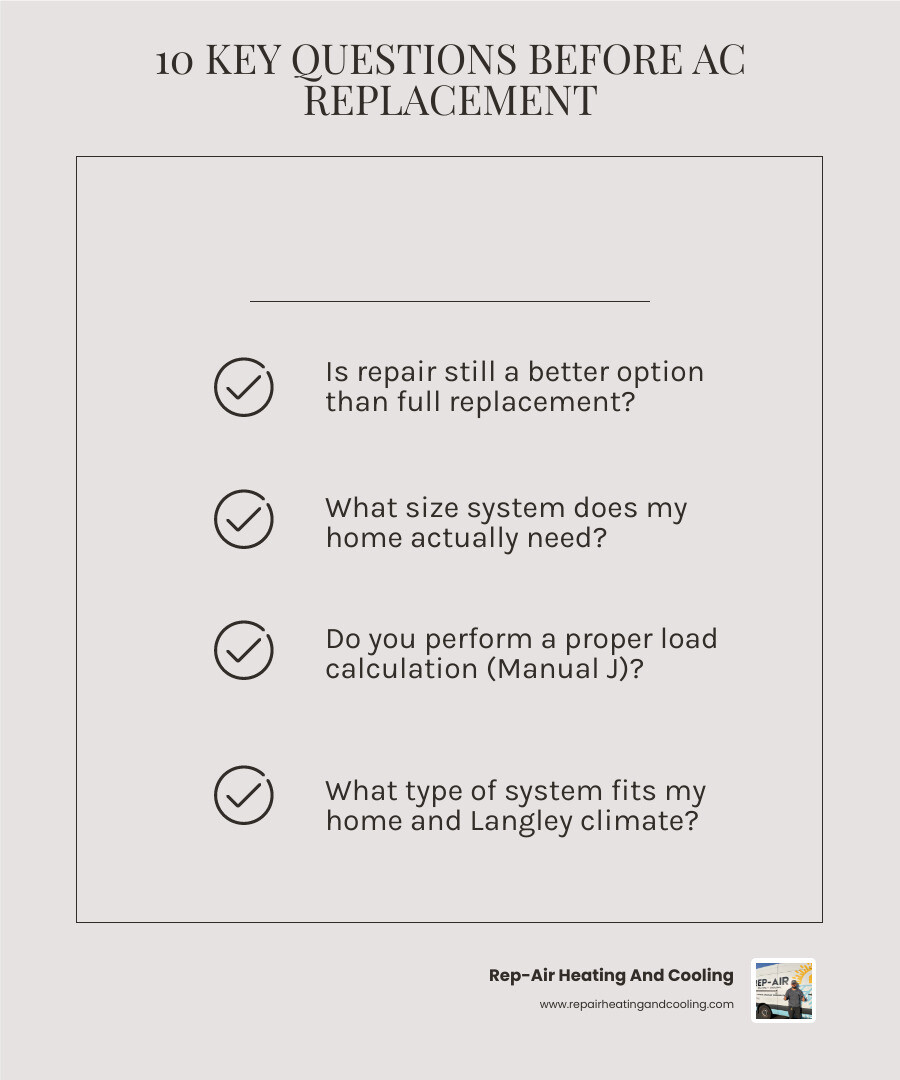
Before you sign anything, here are the most important questions to ask before committing to AC replacement:
1. Is repair still a better option than full replacement?
2. What size system does my home actually need?
3. Do you perform a proper load calculation (Manual J)?
4. What type of system fits my home and the Lower Mainland climate?
5. What brands and models do you recommend, and why?
6. What is the SEER2 rating, and are there rebates or tax credits available?
7. Are you licensed and insured in BC?
8. What warranties cover both equipment and installation?
9. What does the written scope actually include?
10. What support do you offer after the install is done?
Replacing your air conditioner is one of the bigger home decisions you will make. With heating and cooling accounting for nearly half of a home's total energy use, getting this choice right matters a lot not just for comfort, but for your long-term efficiency and peace of mind. Yet many homeowners in Langley, BC feel rushed into a decision, especially when a system fails in the middle of a hot Lower Mainland summer.
The good news is that asking the right questions up front puts you firmly in the driver's seat. Whether your current system is approaching the end of its 15 to 20-year lifespan or it has simply become unreliable, knowing what to ask your HVAC provider helps you avoid oversized units, hidden surprises, and regret down the road.
This guide walks you through every key question from sizing and efficiency to warranties and what happens after installation day.
Questions to Ask Before Committing to AC Replacement in Langley, BC
If you are searching for questions to ask before committing to ac replacement, you are already doing the smart thing. A new cooling system should fit your home, your comfort needs, and the way Langley weather actually behaves. We do not get the same climate as desert cities, so the best choice here depends on more than just square footage and a guess.
A good replacement conversation should cover:
• Whether replacement is actually necessary
• Proper sizing based on a real load calculation
• The best system type for your home
• Efficiency and rebate eligibility
• Written scope, warranties, and timeline
• What support you get after installation
Is replacement really the right move, or would a repair still make sense?
This is the first question to ask, because sometimes replacement is the right answer, and sometimes it is not.
In general, air conditioners tend to last about 10 to 15 years on average, with some reaching 15 to 20 years when they have been maintained very well. If your system is newer and the issue is isolated, a repair may still be the better move. But if your AC is older, breaking down often, struggling to cool evenly, or becoming less efficient, replacement starts to make more sense.
It is especially worth asking for a replacement recommendation if:
• The system is near or past the typical lifespan
• Repairs are becoming frequent
• Cooling performance is poor
• Humidity control is getting worse
• The system still uses older, harder-to-service components
• Your home has hot and cold spots that never seem to improve
Older systems can be dramatically less efficient than newer ones. A 15-year-old central air conditioner may only be rated around 8 to 10 SEER, while newer equipment sold in 2026 must meet modern SEER2 efficiency standards. That gap can have a real effect on comfort and energy use.
If you are still unsure whether your unit is truly at the end of the road, these reads can help:Signs it may be time for a new AC unit and how to know when it is time for AC installation.
What are the most important questions to ask before committing to ac replacement?
If you want the short checklist, make sure you ask these before saying yes:
• What size AC unit does my home need?
• Do you perform a proper load calculation?
• What type of AC system is best for my home and climate?
• Will my ductwork and thermostat work with the new unit?
• What brands and models do you recommend, and why?
• How efficient is the unit?
• Are there rebates, incentives, or financing options?
• Are you licensed and insured?
• Can you show local reviews or references?
• What warranties cover the equipment and installation?
• What does the written scope include?
• How long will installation take?
• What happens if there is a problem after installation?
• Do you offer maintenance after the job is complete?
That may sound like a lot, but this is one of those times when asking extra questions is a feature, not a bug.
Ask About Sizing, Home Fit, and the Best System Type
What size AC unit does my home need?
The right size is not based on your neighbor's house, your old equipment label, or a quick glance from the driveway.
Correct sizing depends on factors like:
• Total square footage
• Ceiling height
• Insulation levels
• Window size and orientation
• Sun exposure
• Air leakage
• Number of occupants
• Duct performance
• Indoor humidity goals
If the system is too small, it may run constantly and still leave parts of the house warm. If it is too large, it may cool too fast, short cycle, and fail to remove enough humidity. That can leave the house feeling cool but clammy, which is basically the HVAC version of wearing socks in a puddle.
Do you perform a proper load calculation for sizing?
This is one of the most important questions in the entire process.
A proper load calculation, often called a Manual J, is the industry standard for sizing residential cooling equipment. It looks at how your home gains and loses heat. That is much more accurate than replacing your current unit with the same size just because "that is what was there before."
That matters because homes change over time. Maybe you replaced windows, added insulation, finished a basement area, or changed the layout. All of those can affect the cooling load.
A proper calculation helps avoid:
• Oversized systems that short cycle
• Undersized systems that never quite catch up
• Uneven temperatures
• Higher energy use
• Faster wear and tear
If a contractor is not discussing load calculations, that is a sign to slow down and ask more questions.
What type of AC system is best for my home and climate?
In Langley, BC and across the Lower Mainland, the best answer depends on your home layout, existing equipment, and comfort priorities.
Common options include:
• Central air conditioning for homes with existing ductwork
• Ductless mini-split systems for additions, suites, or homes without ducts
• Heat pumps for homeowners who want efficient cooling and heating from one system
For some homes, central AC is the cleanest fit. For others, ductless may be better if ductwork is limited or certain rooms never stay comfortable. Heat pumps are also worth discussing in our climate because they can handle both cooling and a good portion of seasonal heating needs.
Ask how the recommendation fits:
• Your existing ducts
• Your current indoor equipment
• Areas with uneven temperatures
• Future renovation plans
• Zoning needs
• Energy goals
Will my current ductwork, thermostat, or indoor equipment work with the new system?
A new outdoor unit is only one piece of the puzzle. The rest of the system matters too.
Ask whether the contractor will inspect:
• Ductwork for leaks or poor airflow
• Static pressure
• The indoor coil or air handler
• Furnace compatibility
• Thermostat compatibility
• Filter setup and indoor air quality options
Even a high-efficiency system will not perform as expected if the ductwork leaks or airflow is poor. In some homes, a thermostat upgrade or duct improvements may be needed to get the results you expect from the replacement.
For more on what installation planning can involve, see this AC installation guide for Aldergrove, BC.
Compare Efficiency, Models, and Long-Term Value
What brands and models do you recommend, and why?
This question helps you understand whether the recommendation is actually tailored to your home.
A useful answer should explain:
• Why a certain model fits your home size and layout
• Whether it is single-stage, two-stage, or variable-speed
• How noisy or quiet it is
• How it handles humidity
• What warranty support comes with it
• Whether it works well with your indoor equipment and thermostat
The best model is not always the fanciest one. Sometimes a mid-range system is the best fit. Sometimes better humidity control or quieter operation is worth prioritizing. The key is that the recommendation should be explained clearly, in plain language.
How efficient is the unit, and are there rebates or tax incentives available?
Efficiency is usually measured with SEER2 for cooling systems. In 2026, new AC units sold must meet updated regional SEER2 minimums, generally in the 13.4 to 15.2 range depending on region and equipment category.
Higher-efficiency equipment can reduce electricity use, which matters because heating and cooling make up about 48% of a home's overall energy expenditure. If you are replacing an older system, the difference can be substantial.
Ask:
• What is the SEER2 rating?
• Is it ENERGY STAR certified?
• Does it qualify for any current rebates or incentives?
• Are there maintenance requirements to keep eligibility or warranty coverage?
For homeowners reading U.S.-based advice online, note that some articles mention federal tax credits under the Inflation Reduction Act. Those programs are location-specific and may not apply in BC, so always ask what incentives are actually relevant in Langley and the Lower Mainland.
Will a higher-efficiency system actually lower my cooling costs?
Usually yes, but the amount depends on what you are replacing and how your home performs overall.
For example, research shows upgrading from a 10 SEER system to a 20 SEER system can reduce cooling costs by roughly 50% under the right conditions. That does not mean every home sees the same savings, but it shows how much old equipment can lag behind modern options.
Here is the bigger point: if your current unit is older, inefficient, and paired with poor airflow, a well-matched high-efficiency replacement can improve both comfort and energy use.
• Efficiency level — Older AC: Often much lower — Newer High-Efficiency AC: Meets modern SEER2 standards
• Cooling cycles — Older AC: May run longer or short cycle — Newer High-Efficiency AC: Better matched when sized properly
• Humidity control — Older AC: Often weaker — Newer High-Efficiency AC: Usually improved, especially with better staging
• Energy use — Older AC: Higher — Newer High-Efficiency AC: Lower in many homes
• Comfort consistency — Older AC: Less even — Newer High-Efficiency AC: More balanced when installed correctly
Can this upgrade improve humidity control and indoor air quality too?
Yes, and this is a great question because many homeowners focus only on temperature.
A new system may also help with:
• Better humidity removal
• Improved filtration
• Cleaner airflow
• Reduced dust circulation
• Better comfort for allergy-sensitive households
Ask whether your replacement can be paired with:
• Higher-quality filter cabinets
• Better MERV filtration
• Humidity control options
• Air purification add-ons
• Smart thermostat controls
If your current setup leaves rooms muggy or stale, this is the perfect time to improve more than just cooling capacity. You can learn more about what ongoing professional service can include here: What professional AC service includes.
Check Credentials, Reviews, Warranties, and What Happens After Installation
Are you licensed, insured, and certified?
This should be a simple question, and you should get a clear answer.
You want to know the company is properly licensed and insured to work in BC and ready to handle permits or code-related requirements where needed. Insurance matters because it helps protect the homeowner if something unexpected happens during the job.
You can also ask about manufacturer training and product familiarity. What matters most to homeowners is that the installation is done correctly, safely, and to required standards.
Can you provide references or reviews from past customers?
A reliable company should be able to point you to recent local feedback.
Look for signs like:
• Consistent reviews over time
• Comments about professionalism and communication
• Mentions of tidy installation and follow-up
• Feedback from homeowners in Langley or nearby Lower Mainland communities
This does not have to be complicated. You are simply looking for evidence that other homeowners had a good experience from consultation through installation and aftercare.
What warranties do you offer on equipment and installation?
Always ask about both sides of warranty coverage:
• Manufacturer warranty on parts or equipment
• Labor or workmanship warranty on the installation itself
Then ask the follow-up questions homeowners often forget:
• How long does each warranty last?
• Does the equipment need to be registered?
• Is annual maintenance required to keep coverage valid?
• What is excluded?
• Is the warranty transferable if you sell the home?
Many warranties have conditions, so it is better to understand them before installation day instead of discovering them later when your paperwork is buried in a drawer next to mystery takeout menus.
What happens if problems arise after installation?
This tells you a lot about post-install support.
Ask:
• Who do I call if something seems off?
• How are callback issues handled?
• Is there a follow-up check after installation?
• What if airflow, thermostat settings, or comfort are not right?
• Will I receive documentation for the equipment and warranty?
A good installation process should not end the moment the truck pulls away. There should be a clear plan for troubleshooting and follow-up if needed.
What services do you offer beyond installation, like maintenance?
This is important because most HVAC systems last longer and perform better with regular service. Research consistently shows systems typically last 10 to 20 years depending on maintenance and usage.
Ask whether the company offers:
• Seasonal tune-ups
• Filter inspections
• Coil cleaning
• Performance checks
• Maintenance plans
• Reminder scheduling
• Priority service options
Routine care also helps support warranty compliance in many cases. If you want to see why long-term service matters, read AC maintenance tips for Langley homeowners and how maintenance history can affect your AC replacement timeline.
Understand the Installation Process Before You Sign
Will the company provide a free, detailed quote in writing?
Before you commit, ask for the proposal in writing.
A written quote should clearly explain:
• Equipment model details
• Scope of work
• Included accessories
• Installation tasks
• Permit notes if applicable
• Any assumptions or exclusions
• Warranty summary
This helps prevent crossed wires later. And with HVAC, crossed wires are something we prefer to keep inside the system.
How long will the installation take, and what is the timeline?
Most standard AC replacements can often be completed in a day, but not every job is standard.
The timeline can depend on:
• Equipment availability
• Permit coordination
• Duct or thermostat updates
• Indoor coil or furnace compatibility changes
• Weather conditions
• Access to the home and work areas
Ask for a realistic timeline from approval to installation day, not just how long the crew will be at the house.
Does the written scope include removal of the old unit, permits, and cleanup?
Do not assume these details are automatically included. Ask directly.
The written scope should clarify whether it includes:
• Removal of old equipment
• Refrigerant handling and disposal
• Haul-away
• Permit coordination if needed
• Protection of floors and work areas
• Final cleanup
• Startup and testing
This is one of the easiest ways to avoid surprises after the job starts.
Are financing options available if I want more flexibility?
Many homeowners ask this, and they should. Replacement is a major home expense, so flexibility matters.
If financing is available, ask:
• What types of plans exist?
• Are there promotional terms?
• What is the application process?
• Are there timing requirements tied to current offers?
You do not need to decide on the spot, but it is good to know your options before you move forward.
Frequently Asked Questions About Questions to Ask Before Committing to AC Replacement
Is it okay to replace my AC with the same size as my old one?
Not automatically. Your old unit may have been incorrectly sized from the start, or your home may have changed since it was installed. Insulation upgrades, new windows, renovations, and even changes in occupancy can all affect the load. A fresh calculation is the safer route.
What SEER2 rating should I look for in 2026?
At minimum, the system should meet 2026 efficiency requirements for its category and region. Beyond that, the best SEER2 rating depends on your home, usage patterns, and overall goals. Higher is not always better if the rest of the system is not matched properly, but efficiency should absolutely be part of the discussion.
Should I ask about maintenance before the new system is installed?
Yes. Maintenance affects efficiency, lifespan, and often warranty compliance. It is much easier to understand the service plan before installation than to figure it out later. It also helps you protect your investment from day one.
Conclusion
If you are planning an AC upgrade in Langley, BC, asking the right questions can make the difference between a smooth, confident decision and one you second-guess later. The best replacement is not just a new box outside the house. It is a properly sized, well-matched system backed by clear communication, solid warranties, and long-term support.
At Rep-Air Heating And Cooling, we believe homeowners deserve straight answers and careful guidance before making a major comfort decision. If you want to protect your new system for the long run, learn more about our maintenance plan.
hear what our satisfied clients have to say
Neighbourhoods in the Fraser Valley