How Improperly Sized Systems Shorten Equipment Life
The Hidden Reason Your HVAC System May Fail Years Too Soon
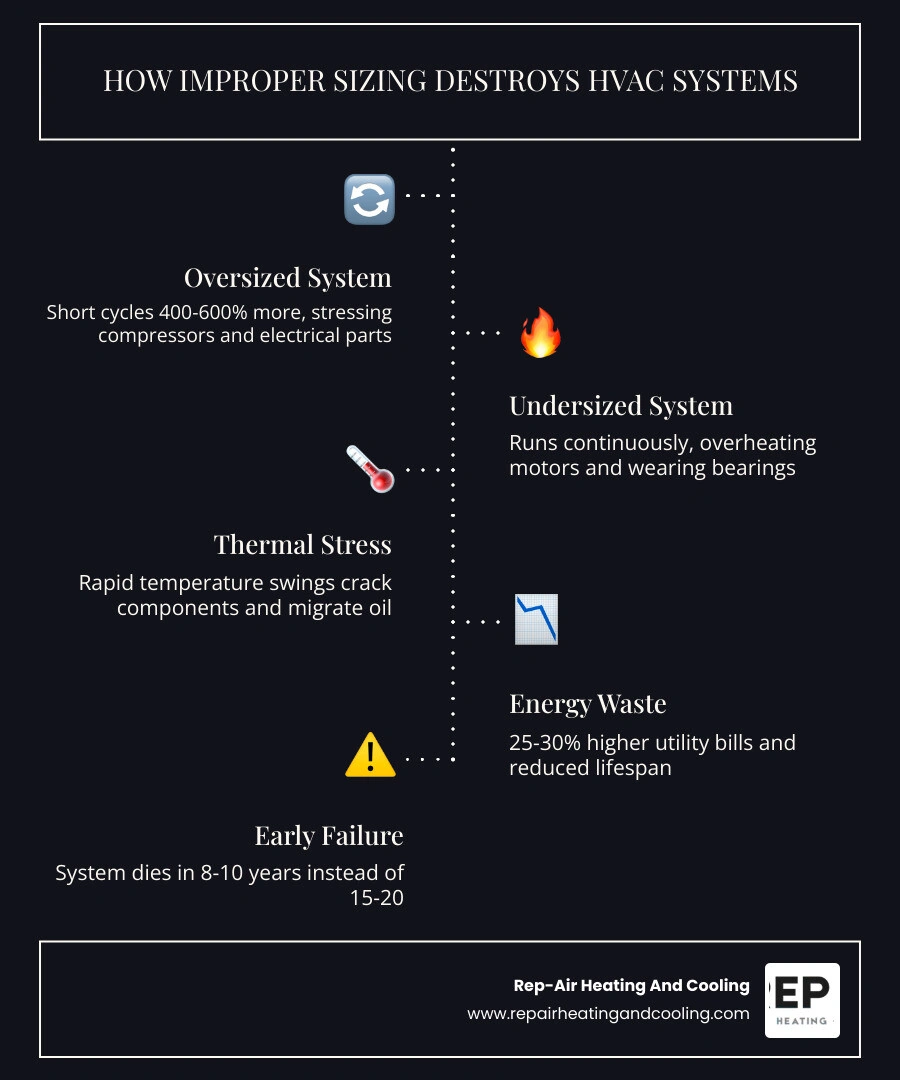
How improperly sized systems shorten equipment life is one of the most common — and most overlooked — causes of early HVAC failure in homes across the Lower Mainland, BC. Most homeowners expect their heating and cooling system to last 15 to 20 years. But when the equipment is the wrong size for the home, that lifespan can be cut nearly in half — often failing somewhere between years 8 and 10.
Here is a quick summary of how sizing errors damage your system:
• Oversized systems short-cycle — turning on and off too frequently — which causes 400 to 600% more wear events on compressors and electrical components
• Undersized systems run almost continuously, overheating motors, wearing out bearings, and burning through components from sheer exhaustion
• Both scenarios increase energy bills by 25 to 30% and can void manufacturer warranties if no proper load calculation was performed
• Over 60% of residential HVAC systems in North America are incorrectly sized, according to Department of Energy data
• The average residential system is installed up to three times larger than the home actually needs
This is not just a comfort problem. It is a mechanical and financial one — and it starts the moment the wrong-sized unit is installed.
In the Lower Mainland, where homes range from compact Burnaby, BC condos to sprawling Abbotsford, BC acreages, and where mild but damp winters demand precise humidity control, getting the size right matters even more than in drier climates. A system that is even slightly off can struggle year-round, quietly burning through its lifespan while you pay more on every utility bill.
How improperly sized systems shorten equipment life terms to know:
• getting the right size hvac for the fraser valley homes
• how hvac load calculations work
What Does "Improperly Sized" HVAC Mean?
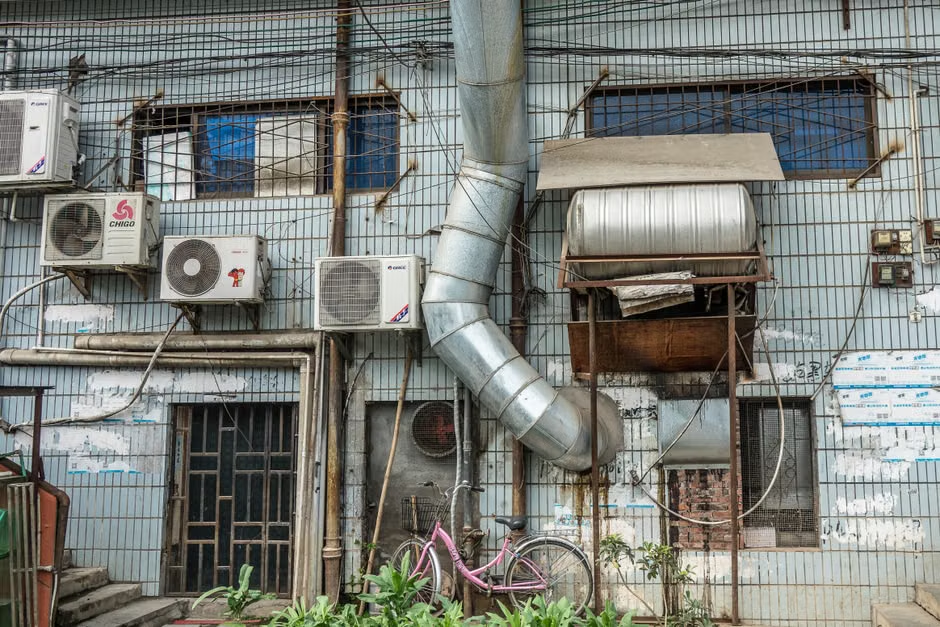
When we talk about an "improperly sized" HVAC system, we are not referring to the physical dimensions of the outdoor metal cabinet or the indoor furnace. Instead, we are talking about capacity — the system's ability to add or remove heat from your home, measured in British Thermal Units (BTUs) or "tons."
To understand this, let's break down the core terminology:
• BTU (British Thermal Unit): This is the basic unit of heat energy. One BTU is the amount of heat required to raise the temperature of one pound of water by one degree Fahrenheit. In heating mode, a furnace's capacity tells us how many BTUs of heat it can deliver per hour.
• Tonnage: Used primarily for air conditioners and heat pumps, "tons" do not refer to the weight of the equipment. Historically, one ton of cooling was defined as the amount of heat required to melt one ton (2,000 pounds) of ice over a 24-hour period. In modern HVAC terms, one ton of cooling equals 12,000 BTUs per hour. Therefore, a 3-ton air conditioner can remove 36,000 BTUs of heat from your home every hour.
An improperly sized system is either oversized (possessing too much heating or cooling capacity for the home's physical footprint and thermal dynamics) or undersized (lacking the capacity to meet the thermal demands of the space).
To size a system correctly, an experienced technician must calculate two distinct types of heat loads:
1. Sensible Load: The dry heat that you can measure with a standard thermometer. This is the energy required to physically lower or raise the air temperature in your living space.
2. Latent Load: The moisture or humidity in the air. In places like Richmond, BC, or Delta, BC, managing the latent load is critical. Your air conditioner must run long enough to condense moisture out of the air, lowering the relative humidity so you feel comfortable.
If a contractor guesses your home's needs based purely on square footage, they will almost always get these loads wrong. For a deeper look at why matching these loads perfectly is so critical, check out our guide on The Importance of Properly Sized HVAC Mission BC.
How Improperly Sized Systems Shorten Equipment Life
To understand exactly how improperly sized systems shorten equipment life, we must look at the different mechanical and electrical stresses placed on oversized versus undersized units. They are two different paths to the exact same destination: premature system failure.
• Oversized Unit — Primary Operational Symptom: Short cycling (cycles < 10 mins, 30–50 starts/day) — Affected Components: Compressors, contactors, capacitors, heat exchangers — Main Failure Mechanism: Electrical inrush current heat, lack of oil migration, thermal shock — Lifespan Reduction: 40% to 50% (fails in 8–10 years)
• Undersized Unit — Primary Operational Symptom: Continuous operation (runs 18–24 hours/day) — Affected Components: Blower motors, compressor windings, bearings — Main Failure Mechanism: Heat buildup, motor insulation breakdown, liquid slugging — Lifespan Reduction: 30% to 40% (fails in 10–12 years)
The Destructive Cycle of Oversized HVAC Units (Short Cycling)
An oversized system is like a high-performance sports car trapped in bumper-to-bumper traffic in downtown Vancouver, BC. It starts up, blasts a massive amount of hot or cold air into the home, satisfies the thermostat in 5 to 7 minutes, and shuts off. Ten minutes later, the temperature drifts, and it starts all over again.
This behavior is called short cycling, and it destroys equipment through several distinct physical mechanisms:
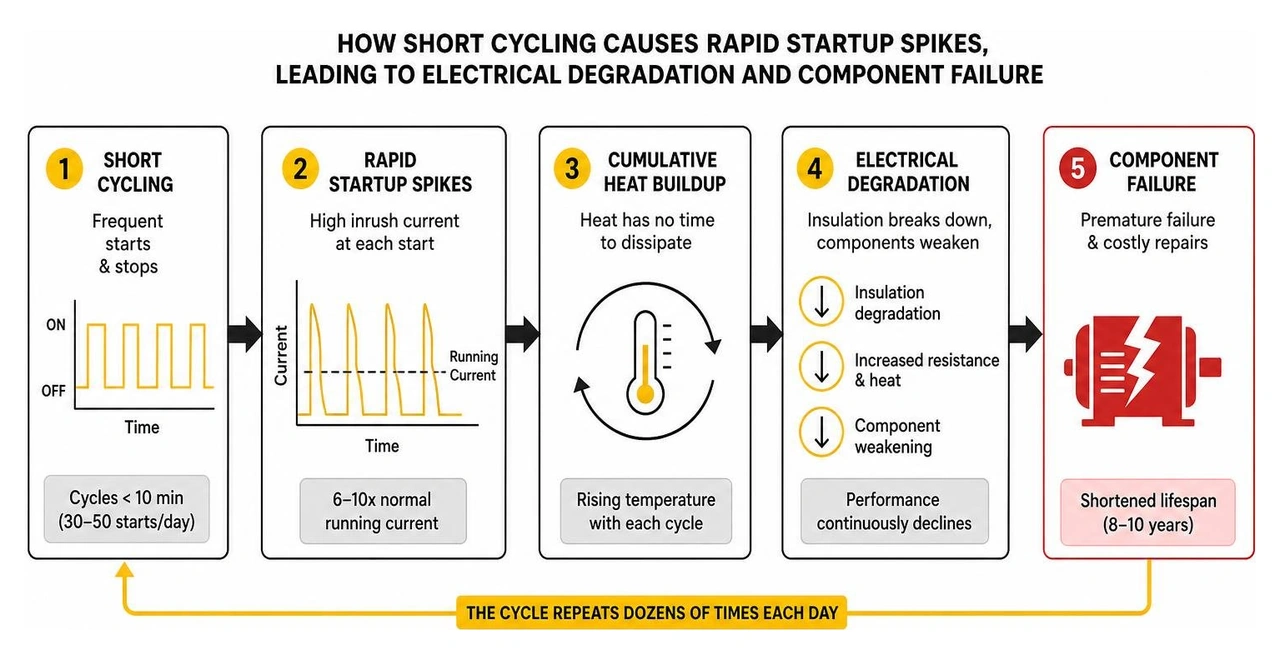
1. Inrush Current Stress
Every time an electric motor starts up, it experiences a massive spike in electrical current known as "inrush current" or "locked rotor amps" (LRA). This startup current is typically 6 to 10 times higher than the normal running current.
This sudden surge creates intense heat within the motor windings. When a properly sized system starts up 6 to 8 times a day, the heat has time to dissipate. When an oversized system short-cycles 30 to 50 times a day, the motor windings never cool down. This cumulative thermal stress rapidly degrades the electrical insulation, leading to direct short circuits and motor burnout.
2. Oil Migration Failure
The compressor in your outdoor unit relies on specialized oil to lubricate its rapidly moving internal parts. This oil is designed to mix with the refrigerant and travel through the system.
However, it takes about 10 to 15 minutes of continuous operation for the refrigerant to reach the velocity and temperature needed to carry that oil back to the compressor. In a short-cycling system that only runs for 5 minutes at a time, the oil gets trapped in the indoor evaporator coils. Starved of lubrication, the compressor runs "dry," causing internal metal-on-metal friction, mechanical wear, and eventual seizure.
3. Thermal Shock
In heating systems, particularly gas furnaces, short cycling causes the steel heat exchanger to rapidly heat up and cool down. This constant expansion and contraction creates extreme physical stress on the metal welds, eventually leading to cracks.
To learn more about the severe consequences of neglecting these operational stresses, read our detailed article on What Happens When You Don't Take Care of Your HVAC.
The Undersized Struggle (Continuous Operation)
An undersized system faces the opposite problem. During a summer heatwave in Chilliwack, BC, or a freezing winter night in Mission, BC, an undersized unit simply does not have the capacity to satisfy the thermostat. It runs continuously for hours on end.
This constant runtime leads to:
• Motor Overheating: Blower motors and compressor motors are designed for intermittent duty cycles. Running continuously for 18 to 24 hours causes heat to build up faster than the system can reject it, baking the internal lubricants and degrading the wire insulation.
• Frozen Evaporator Coils: Because an undersized air conditioner cannot keep up, the pressure in the evaporator coil can drop below freezing. Condensation on the coil quickly turns to ice, completely blocking airflow.
• Liquid Slugging: When the evaporator coil freezes, the liquid refrigerant cannot absorb enough heat to boil off into a vapor. This unevaporated liquid refrigerant flows back down the line directly into the compressor. Because liquids are incompressible, this "liquid slugging" instantly shatters the compressor's internal valves and pistons.
The Mechanical Toll: Vulnerable Components and Lifespan Reductions
When a system is improperly sized, specific components bear the brunt of the physical damage. Let's look at the most vulnerable parts of your HVAC system and how their lifespans are affected:
1. The Compressor
The compressor is the "heart" of your air conditioner or heat pump. It is also the most expensive single component to replace.
• With Proper Sizing: A compressor should easily last 12 to 15 years.
• With Improper Sizing: Short cycling (oversized) or liquid slugging (undersized) often causes the compressor to burn out or seize in just 5 to 8 years.
Because replacing a compressor is highly labor-intensive and requires recovering refrigerant, it is often a major financial decision. Discover why in our guide How Compressor Replacement Often Means Full System Replacement.
2. Contactors and Capacitors
These electrical components act as the gatekeepers for your system's power.
• Contactors use physical silver-plated contacts to close the circuit and start the compressor. The electrical arcing that occurs during each startup eventually pits and burns these contacts. Short cycling speeds up this pitting by 400 to 600%, causing the contacts to weld shut (running the system non-stop) or fail to close entirely.
• Capacitors store electrical energy to help start and run the motors. The intense heat generated by frequent startups degrades the chemical electrolyte inside the capacitor, causing it to lose capacitance and bulge or burst. A capacitor that should last 10 years can easily fail in 2 to 4 years under short-cycling conditions.
3. Blower Motors
Your indoor blower motor distributes air throughout your ductwork. In an undersized system running constantly, the bearings in this motor dry out and fail, leading to loud squealing noises and motor burnout. In an oversized system, the motor is often forced to push more air than your ductwork can handle, leading to high static pressure that overheats the motor windings.
4. Heat Exchangers (Furnaces)
In a gas furnace, the heat exchanger keeps toxic combustion gases separate from the clean breathing air circulating through your home.
• With Proper Sizing: A heat exchanger should last 20 to 25 years.
• With Oversizing: The rapid heating and cooling from short cycling causes the metal to fatigue and crack in as little as 8 to 10 years. A cracked heat exchanger is a severe safety hazard, as it can leak carbon monoxide directly into your home's air supply.
Beyond the Equipment: Humidity, Air Quality, and Comfort Issues
While the mechanical damage is severe, the immediate impact of an improperly sized system is felt in your daily living conditions. Your home comfort and indoor air quality (IAQ) suffer dramatically.
High Humidity and the "Cool and Clammy" Effect
In the Lower Mainland, summer temperatures are often accompanied by high relative humidity. To remove moisture from the air, your air conditioner's evaporator coil must get cold, and air must pass over it repeatedly.
It takes approximately 10 to 15 minutes of continuous runtime for the evaporator coil to reach its optimal operating temperature and start condensing water out of the air.
• An oversized system cools the air temperature down so fast that it shuts off after only 5 to 7 minutes.
• While the air feels cold, the moisture is never removed.
• This leaves your home feeling "cool and clammy," creating the perfect breeding ground for mold growth, dust mites, and musty odors.
High Static Pressure and Ductwork Restrictions
Many homeowners do not realize that their ductwork has a physical limit on how much air it can carry. If a contractor installs a 4-ton system in a home with ductwork designed for a 2.5-ton system, the result is incredibly high static pressure.
This is the equivalent of trying to breathe through a tiny straw while running a marathon. The air vents will become incredibly noisy, the system will struggle to distribute air evenly, and the blower motor will burn out prematurely due to the extreme resistance.
The Solution: Accurate Load Calculations Over Rules of Thumb
How do you avoid the destructive cycle of an improperly sized system? The answer lies in scientific calculations rather than lazy guesswork.
For decades, many contractors relied on outdated "rules of thumb," such as allocating "one ton of cooling per 500 square feet." In 2026, these rules are completely obsolete. Modern homes are built with advanced insulation, high-performance double or triple-pane windows, varying ceiling heights, and unique architectural layouts that drastically alter their thermal behavior.
To get the sizing right, a professional HVAC technician must perform a series of calculations established by the Air Conditioning Contractors of America (ACCA):
1. Manual J: Load Calculation
This is the mathematical foundation of proper sizing. A Manual J calculation analyzes:
• The exact square footage and volume of every room
• The orientation of the home (which direction the windows face)
• The R-value of the wall, floor, and ceiling insulation
• The type and age of the windows and doors
• Local climate data for your specific Lower Mainland community (e.g., Abbotsford's warmer summers vs. North Vancouver's cooler, wetter microclimate)
• The heat generated by appliances, lighting, and the number of occupants
To learn more about this detailed calculation process, read our guide on How HVAC Load Calculations Work.
2. Manual S: Equipment Selection
Once the exact heating and cooling loads are known, Manual S is used to select the specific equipment that matches those loads. This step ensures that the furnace, heat pump, or air conditioner performs optimally under local weather conditions.
3. Manual D: Duct Design
Finally, Manual D ensures that the ductwork is physically sized and routed to handle the exact airflow requirements of the selected equipment. This prevents high static pressure and ensures quiet, even air distribution.
For a localized perspective on how these calculations protect homes in our unique regional climate, see our article on Getting the Right Size HVAC for the Fraser Valley Homes.
Frequently Asked Questions about HVAC Sizing
Navigating HVAC sizing can be confusing. Here are answers to some of the most common questions we hear from homeowners across the Lower Mainland. If you suspect your current system is already failing due to sizing issues, you can learn more about your options in our article When Your Technician Recommends Replacement Over Repair.
How long should a properly sized HVAC system last in 2026?
With professional installation, precise sizing, and consistent semi-annual maintenance, a standard central air conditioner or heat pump should last 15 to 20 years. A high-quality gas furnace can often reach 20 to 25 years.
However, if the system is improperly sized, this lifespan is routinely cut down to just 8 to 10 years. To understand how your maintenance habits interact with your system's overall lifespan, read How Your AC Replacement Timeline Depends on Maintenance History.
What are the signs of an oversized air conditioner?
The most common red flags of an oversized system include:
• Short Run Times: The system turns on, runs for less than 10 minutes, and shuts off.
• High Humidity: The indoor air feels cold but sticky or clammy.
• Uneven Temperatures: Some rooms are freezing cold while others remain warm.
• Noisy Airflow: You hear a loud rushing or whistling sound from your vents whenever the system turns on.
• Frequent Electrical Failures: You are constantly replacing blown capacitors, burnt contactors, or tripped fuses.
Can regular maintenance fix how improperly sized systems shorten equipment life?
No. While professional maintenance is essential, it cannot change the physical capacity of your equipment.
Think of it like putting premium fuel into a car with a broken transmission; it might keep the engine cleaner, but it won't fix the underlying mechanical issue. Maintenance can temporarily mitigate some symptoms — such as adjusting blower fan speeds or keeping coils perfectly clean to prevent freezing — but replacement with a correctly sized system is the only permanent solution. To understand what a standard tune-up can and cannot achieve, check out How a Tune-Up Improves Efficiency and Lowers Bills.
Conclusion
At Rep-Air Heating And Cooling, we believe that your home comfort should never be left to guesswork. An improperly sized HVAC system is a ticking financial time bomb, quietly destroying its own expensive internal components while driving up your monthly utility bills.
Whether you are building a new home or replacing an aging system, demanding an accurate, professional load calculation is the single best way to protect your investment, maintain your manufacturer's warranty, and enjoy quiet, efficient comfort for decades to come.
Protecting Your Lower Mainland Home from how improperly sized systems shorten equipment life
If you are ready to stop patching up symptoms and want to ensure your home's heating and cooling system is the perfect fit, we are here to help. Our expert technicians serve communities across the Lower Mainland, providing:
• Precision Abbotsford HVAC services tailored to the Fraser Valley's unique climate
• Reliable Surrey heating and cooling installations backed by detailed Manual J calculations
• Expert Coquitlam home comfort evaluations to resolve uneven temperatures and humidity issues
• Comprehensive system commissioning to verify airflow, static pressure, and refrigerant charges
Explore our professional HVAC services today or contact us to schedule a comprehensive sizing assessment for your home!
hear what our satisfied clients have to say
Neighbourhoods in the Fraser Valley