How to Troubleshoot AC Blowing Warm Air in 7 Simple Steps
Why Is My AC Blowing Warm Air? Here's What's Going On
If you're wondering why is my AC blowing warm air, you're not alone — it's one of the most common HVAC complaints homeowners in the Lower Mainland face during BC's warm summer months. Before diving into the full troubleshooting guide, here's a quick answer:
Common reasons your AC is blowing warm air:
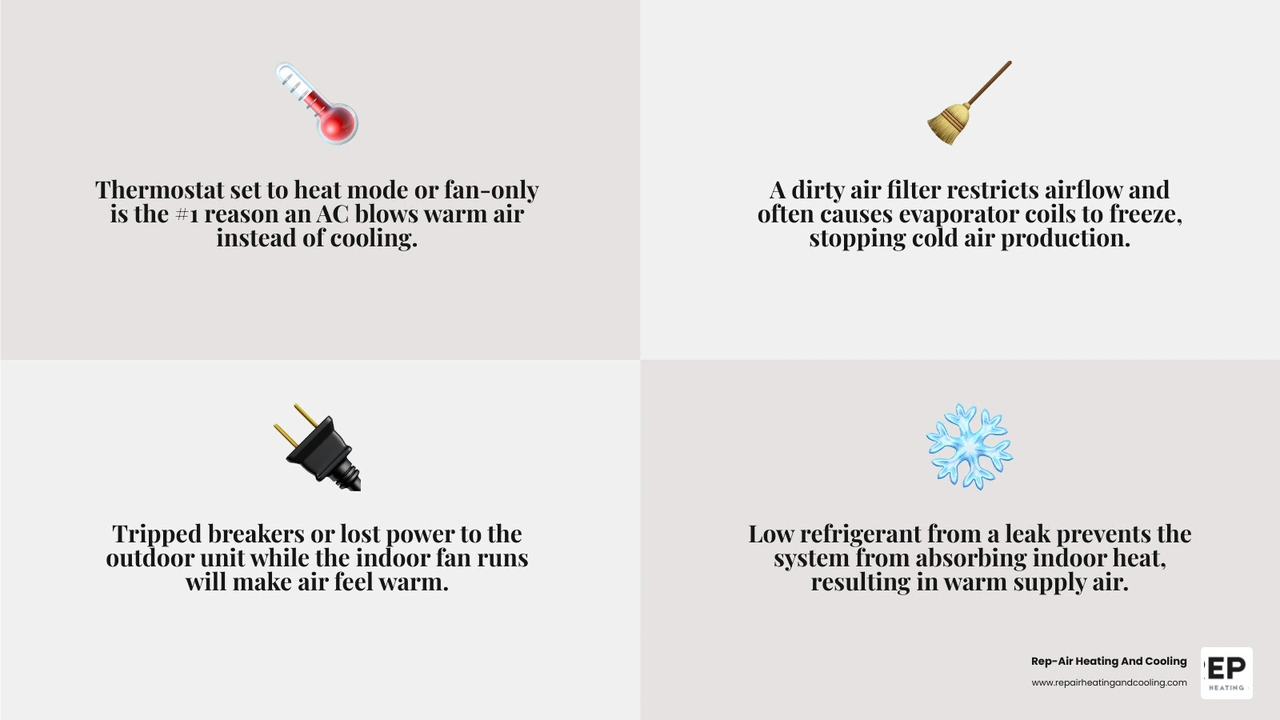
1. Thermostat set incorrectly — switched to heat mode or fan-only instead of cool
2. Dirty or clogged air filter — restricts airflow, can freeze evaporator coils
3. Low refrigerant from a leak — prevents the system from absorbing heat
4. Tripped circuit breaker — outdoor unit loses power while indoor fan keeps running
5. Frozen evaporator coils — ice buildup blocks proper heat exchange
6. Dirty or blocked outdoor condenser unit — can't release heat effectively
7. Failing compressor or electrical components — shuts down the refrigeration cycle
Most of these issues start at the outdoor condenser unit — in fact, roughly 90% of warm air problems trace back to that part of the system. The good news is that several of these causes are things you can check yourself before calling a technician.
Rep-Air Heating And Cooling serves homeowners across the Lower Mainland — including Abbotsford, BC, Mission, BC, Chilliwack, BC, Surrey, BC, and beyond — and our team sees these exact issues every summer. Whether it's a quick filter swap or a refrigerant leak that needs professional attention, this guide walks you through exactly what to check and when to call for help.
Explore our AC repair and service options or book a service call if your system needs hands-on attention.
Why is my ac blowing warm air terms simplified:
• ac making strange noises what they mean
• when to call a professional for ac problems
Understanding Why Is My AC Blowing Warm Air
To understand why is my ac blowing warm air, it helps to look at how your cooling system functions. Many homeowners believe that an air conditioner creates cold air out of nothing, much like an ice machine. In reality, your air conditioner is a heat mover. Its primary job is to extract heat and humidity from inside your living spaces and dump it outside.
If any part of this delicate heat-transfer cycle is disrupted, the indoor blower fan will continue to spin, but it will only circulate unconditioned, room-temperature, or even warm air. Recognizing the early Signs Your AC Needs Repair can save you from total system failure on a sweltering summer afternoon in British Columbia.
How the Refrigeration Cycle Works
The refrigeration cycle relies on a continuous loop of a chemical compound called refrigerant. This substance changes states from a low-pressure gas to a high-pressure liquid to absorb and release heat.
Here is how the four primary components work together:
1. The Evaporator Coils: Located inside your indoor air handler, these cold copper coils contain low-pressure refrigerant. As warm indoor air is blown across them, the refrigerant absorbs the heat, leaving the air beautifully chilled before it goes into your ductwork.
2. The Compressor: Often called the heart of the system, this outdoor pump compresses the heat-laden gaseous refrigerant into a hot, high-pressure state, readying it to release its stored energy.
3. The Condenser Coils: Located in your outdoor unit, these coils allow the hot refrigerant to release its heat into the outside air with the help of a heavy-duty exhaust fan.
4. The Expansion Valve: This component decompresses the refrigerant, cooling it down significantly before it loops back to the indoor evaporator coils to repeat the cycle.
When the refrigerant cycle is interrupted—whether due to a blockage, electrical failure, or physical damage—the entire cooling process stops. For a deep dive into how these components fail, read our guide on AC Refrigerant Issues in Homes.
Home AC vs. Car AC Systems
While both residential and automotive air conditioners rely on the same thermodynamic principles, their physical designs and common failure points differ.
• The Cabin Filter vs. Home Air Filter: A car's cabin filter is compact and designed to block road dust and pollen, whereas a home's furnace or air handler filter manages a much larger volume of air and household dander.
• Refrigerant Types: Most modern car AC systems run on R134a or newer eco-friendly automotive refrigerants, while home systems utilize R410A or newer residential blends.
• Sealed Systems and Leaks: Both are factory-sealed systems that should never require a "top-up" under normal operating conditions. If either system is low on refrigerant, there is a physical leak.
• The Compressor Clutch: A car's compressor is driven mechanically by the engine's serpentine belt via an electromagnetic clutch. When a car AC blows warm air, it is often due to a failing clutch or belt. Home compressors run purely on high-voltage electrical power, meaning home failures are typically related to electrical capacitors, contactors, or direct motor failures.
7 Simple Steps to Troubleshoot Your Air Conditioner
Before you schedule an emergency service call, there are several safe, simple steps you can take to diagnose the problem. Following this structured checklist can save you time and help you determine if the issue is a simple oversight or a mechanical problem that requires professional tools.

If you want a quick reference to keep on hand, you can bookmark our AC Blowing Warm Air Troubleshooting Guide or review the Why Is My AC Blowing Warm Air Troubleshooting Steps for a quick breakdown. We also recommend checking out our general AC Troubleshooting Tips Before Calling a Pro to rule out minor issues.
Step 1: Verify Thermostat Settings
It sounds incredibly simple, but incorrect thermostat settings are one of the most common reasons an air conditioner blows warm air.
• Check the Mode: Ensure the thermostat is set to COOL and not HEAT. It is surprisingly easy for a guest, child, or house cleaner to accidentally nudge the switch.
• Check the Fan Setting: Ensure the fan is set to AUTO rather than ON. When set to "ON," the indoor blower fan runs continuously, even when the outdoor unit isn't actively cooling. This means that between cooling cycles, the system will blow unconditioned, warm room-temperature air through your vents.
• Inspect the Batteries: If your thermostat has a blank or fading display, replace the batteries immediately. A low battery can prevent the thermostat from sending the signal to turn on the outdoor condenser.
• Consider an Upgrade: If your manual thermostat is old or unresponsive, upgrading to a smart thermostat can prevent communication errors and offer more precise temperature scheduling.
Step 2: Inspect and Replace the Air Filter
A dirty, clogged air filter is a major threat to your HVAC system. When dust, pet hair, and debris blanket the filter, it restricts airflow through the system.
Without sufficient warm air passing over the indoor evaporator coils, the refrigerant inside them gets too cold. This causes any ambient moisture on the coils to freeze solid, turning your evaporator coil into a block of ice. Once the coil is frozen, it acts as a physical barrier, blocking any air from being cooled and causing the system to blow warm air.
We recommend checking your air filter every 30 days during peak summer use in places like Abbotsford, BC and Mission, BC, and replacing it at least every 1 to 3 months. Keeping a clean filter reduces system strain, lowers your energy bills, and prevents frozen coils.
Step 3: Check the Outdoor Condenser Unit
Remember: roughly 90% of the time, the root cause of an AC blowing warm air traces back to the outdoor condenser unit.
Walk outside to where your condenser unit sits. It needs plenty of breathing room to release the heat it absorbed from inside your home.
• Clear Vegetation: Ensure there is at least two feet of clear space around the entire unit. Cut back overgrown grass, weeds, shrubs, or tree branches.
• Remove Debris: Clear away grass clippings, leaves, or cottonwood seeds that have accumulated on the metal fins.
• Gently Clean the Coils: If the condenser coils are caked in dirt, turn off the power to the unit and use a gentle garden hose (never a pressure washer, which can bend the delicate aluminum fins) to rinse the coils clean.
Step 4: Look for Frozen Evaporator Coils
If your indoor system is running but blowing warm air, you may have frozen evaporator coils.
• Check for Ice: Look at the brass or copper refrigerant lines entering your indoor air handler. Do you see frost or ice buildup?
• Listen for Water: Do you hear a dripping sound, or see water pooling around the bottom of your indoor furnace or air handler?
• Thaw the System: If you suspect ice, turn the system completely off at the thermostat. Switch the fan setting to ON to help blow room-temperature air over the coils and speed up the thawing process. Do not turn the cooling back on until the ice has completely melted, which can take several hours.
Step 5: Assess the Circuit Breakers
Your air conditioning system actually runs on two separate electrical circuits: one for the indoor blower fan and thermostat, and one for the outdoor condenser unit.
If a power surge occurs, the breaker for the outdoor unit may trip while the indoor unit continues to run. This results in your indoor fan blowing uncooled, warm air throughout your house because the outdoor compressor cannot turn on.
Go to your home's electrical panel. Look for a tripped breaker labeled "AC" or "Air Conditioner." If it is tripped, flip it completely to the "OFF" position and then back to "ON." If the breaker trips again immediately, do not reset it a second time. This indicates a serious electrical fault or a failing compressor, and continuing to reset it can cause permanent damage or electrical fires.
Step 6: Inspect Supply Vents and Return Grilles
For your air conditioner to maintain proper pressure balance, air must flow freely throughout your entire home.
• Open All Vents: Ensure that your supply vents are completely open and unobstructed by furniture, rugs, or drapes. Closing vents in unused rooms does not save energy; instead, it disrupts the system's pressure balance and can cause the evaporator coil to freeze.
• Clear Return Grilles: Ensure your large return air grilles are clean and unblocked. If your system cannot pull air in, it cannot blow cool air out.
Step 7: Check for Ductwork Leaks
If you have tried all of the steps above and some vents are blowing cooler air than others, you might have a physical leak in your ductwork.
Ducts running through unconditioned spaces—like attics, crawl spaces, or unfinished basements—can slip apart or develop tears. When this happens, hot, dusty air from these unconditioned spaces is sucked directly into your home's air supply, mixing with the cool air and causing warm air to blow from your vents. A professional duct inspection can quickly locate and seal these hidden leaks.
When to Call a Professional for AC Repair
While basic troubleshooting steps like swapping a dirty filter or resetting a breaker are safe for homeowners to perform, major mechanical and chemical issues require professional expertise. Working with high-voltage electricity and pressurized chemical refrigerants is dangerous and requires specialized licensing.
When basic troubleshooting fails to restore cool air to your home, our experienced technicians at Rep-Air Heating And Cooling are here to help. If you live in the Lower Mainland, you can read our localized guides on AC Not Blowing Cold Air Mission, BC HVAC Troubleshooting and Identifying and Solving AC Leaks in Abbotsford, BC Homes to learn more about how we diagnose these issues in your specific area. You can also read about Common AC Repair Issues and Their Solutions to understand what to expect during a service visit.
Why is my ac blowing warm air due to refrigerant leaks?
If you are wondering why is my ac blowing warm air, a refrigerant leak is one of the most common professional-grade issues. Refrigerant does not get "used up" like fuel in a car; it circulates in a closed loop indefinitely. If your system is low on refrigerant, you have a leak.
Signs of a refrigerant leak include:
• A hissing or bubbling sound coming from the indoor or outdoor unit
• Ice building up along the copper refrigerant lines
• The AC running constantly without lowering the indoor temperature
• A sweetish, chemical odor near your indoor air handler
Refrigerant handling is strictly regulated. A certified HVAC technician must use specialized electronic leak detectors to find the leak, repair the physical hole in the copper tubing, evacuate the system, and perform a precise recharge according to manufacturer specifications.
Why is my ac blowing warm air because of compressor failure?
The compressor is the heart of your cooling system. If it fails, the refrigerant cannot circulate, and the cooling cycle stops entirely.
Compressor issues are often preceded by electrical component failures, such as a bad capacitor or a pitted contactor. The capacitor acts like a large battery that provides the initial electrical jolt to start the compressor. If the capacitor fails, you may hear a humming noise from your outdoor unit, but the compressor itself will not run, resulting in warm air blowing inside. Replacing a capacitor is a quick and straightforward repair for a professional.
However, if the compressor itself has suffered a mechanical failure or an internal electrical short, it may need to be replaced. To help you make an informed decision, read our guides on AC Replacement Red Flags That Mean You Need a New System and When the Cost of AC Repair Exceeds the Value of Your System.
Frequently Asked Questions About AC Performance
Should I turn off my AC if it is blowing warm air?
Yes, you should turn off your air conditioner immediately if it is blowing warm air. Continuing to run a malfunctioning system can cause severe, irreversible damage to the compressor.
If the warm air is caused by a refrigerant leak, running the system can cause the compressor to overheat and burn out. If the issue is a frozen evaporator coil, continuing to run the system will only build more ice, potentially leading to water damage in your home when the ice eventually melts. Turn the system off at the thermostat and set the fan to "AUTO" or "OFF" until the issue is diagnosed.
Can a dirty air filter cause my AC to blow warm air?
Absolutely. A heavily clogged air filter restricts the volume of air flowing across your indoor evaporator coils. Without enough warm air to absorb, the refrigerant temperature drops rapidly, causing the moisture on the coils to freeze. This ice block prevents any further heat transfer, choking the system and causing it to blow warm or room-temperature air. Changing your filter every 1 to 3 months is the best way to prevent this issue.
Why does my AC blow warm air only during the hottest part of the day?
If your system cools fine in the morning and evening but struggles during the hottest afternoon hours, it usually points to one of three issues:
1. A Dirty Condenser Coil: The outdoor unit is already struggling to release heat. When the outdoor temperature rises, the unit overheats and shuts down on a thermal overload safety limit.
2. Low Refrigerant: Your system has enough refrigerant to handle light cooling loads, but loses its cooling capacity under extreme heat.
3. An Aging or Undersized System: The system simply cannot keep up with the heat gain of your home during peak hours.
Conclusion
Discovering that your air conditioner is blowing warm air can be incredibly frustrating, especially during the peak of summer in the Lower Mainland. Fortunately, by following our 7 simple troubleshooting steps—checking your thermostat, replacing your air filter, clearing your outdoor unit, and inspecting your breakers—you can resolve many common issues yourself.
However, if your system requires a professional touch to handle refrigerant leaks, electrical failures, or a struggling compressor, the team at Rep-Air Heating And Cooling is here to help. We proudly serve homeowners across Abbotsford, BC, Mission, BC, Chilliwack, BC, Surrey, BC, and the surrounding communities, treating every customer like family and delivering unmatched service.
Don't spend another day sweating in a warm home. Explore our air conditioning services or contact us today to schedule a professional maintenance visit or repair!
hear what our satisfied clients have to say
Neighbourhoods in the Fraser Valley